Optical Quartz Glass: A Complete Guide to Fused Silica Optics, Grades & Specifications
When an optic has to work in the deep ultraviolet, survive a high-power laser, or hold its shape under thermal load, designers reach for one material: fused silica. This guide explains why fused silica is the workhorse of precision optics, how windows, lenses and prisms are graded and polished, and which specifications actually decide whether an optic performs.
Most optical glasses do a fine job in the visible spectrum at room temperature. Push them into the ultraviolet, hit them with a focused laser, or cycle them through a wide temperature range, and they fall short — they absorb, they expand, they damage. Fused silica is the material engineers turn to precisely when ordinary optical glass runs out of room.
Optical quartz glass — fused silica windows and optical flats, lenses, prisms, viewports and cuvettes — combines an exceptionally wide transmission range, very low thermal expansion, a high laser-damage threshold and the homogeneity needed for demanding wavefront control. That combination is why it sits at the heart of lithography, laser systems, UV processing and analytical instruments.
This guide covers the whole picture: why fused silica behaves the way it does optically, the full family of optical components made from it, how a blank becomes a finished precision optic, the specifications that define quality, and how to choose the right grade for the job.
This guide covers transmissive fused silica optics — windows, lenses, prisms, flats, viewports and cuvettes — and how they are graded, fabricated and specified. It does not cover thin-film optical coatings (applied by coating houses) or non-silica optical materials such as calcium fluoride and sapphire, which are touched on only for comparison.
01 — Why Fused Silica Is the Premier Optical Material
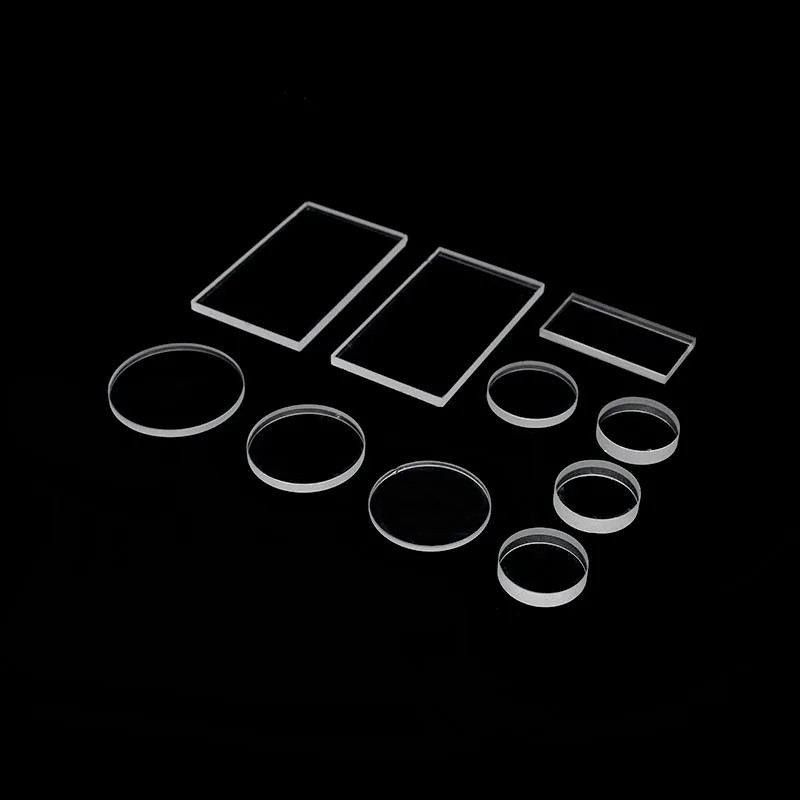
Fused silica earns its place in optics through a rare combination of properties that no single competing material matches across the whole UV-to-near-infrared range:
- Exceptionally wide transmission. High-quality synthetic fused silica transmits from the deep ultraviolet, through the entire visible band, into the near-infrared — a span few optical materials cover in one piece.
- Very low thermal expansion. The optic holds its figure under thermal load, which is decisive for high-power laser optics and for instruments that must stay aligned across temperature swings.
- High laser-damage threshold. Clean, inclusion-free synthetic fused silica withstands high optical flux, making it the default substrate for UV and high-power laser systems.
- High homogeneity and low birefringence. Achievable index uniformity and low stress birefringence allow the tight wavefront control that precision imaging and metrology demand.
- Chemical durability and hardness. It resists most chemicals and takes a hard, durable polish, so optics keep their surface quality in service.
The OH trade-off: there is no single “best” fused silica
The most important thing to understand about optical fused silica is that the grade must be matched to the wavelength. The hydroxyl (OH) content of the glass sets where it transmits best. High-OH synthetic material gives the best deep-ultraviolet transmission but introduces absorption bands in the infrared; low-OH material transmits further into the infrared but is less suited to deep-UV work. There is no universally “best” fused silica — only the right grade for the job, which is why specifying the application up front matters more than chasing a single headline number.
How it compares to other optical materials
Standard optical glasses are cheaper and excellent in the visible, but their ultraviolet transmission is limited and their thermal expansion is far higher — so they struggle in UV, laser and thermally demanding roles. Calcium fluoride reaches deeper into the UV and IR but is soft, sensitive to thermal shock and costly; sapphire is extremely hard and durable but is birefringent and harder to fabricate to optical figure. Fused silica sits in the sweet spot for the broad UV-to-near-IR precision work that makes up the bulk of demanding optics — which is exactly why it is the workhorse material.
Choose fused silica when you need UV transmission, thermal stability, high laser-damage resistance or broadband performance in one material. Tell your supplier the operating wavelength, optical power and environment first — the correct grade and specification follow from those, not the other way around.
02 — The Family of Fused Silica Optical Components
Fused silica is fabricated into a wide range of optical components. They differ in geometry and function, but all draw on the same material advantages — and all rise or fall on surface quality and the right grade choice.
| Component | Function | Where it is used |
|---|---|---|
| Optical windows | Flat, parallel-faced plates that pass light while sealing or protecting a system | Laser systems, sensors, instrument ports |
| Lenses | Curved elements that focus or collimate, especially in the UV and at high power | UV lithography, laser focusing, imaging |
| Prisms | Redirect, disperse or rotate beams via precise angled faces | Spectrometers, beam steering, interferometers |
| Optical flats & mirror substrates | Ultra-flat references and stable bases for reflective coatings | Metrology, laser cavities, high-power mirrors |
| Viewports | Windows mounted in flanges for vacuum or controlled-atmosphere chambers | Vacuum systems, deposition tools, research chambers |
| Cuvettes & sample cells | UV-transparent vessels for measuring liquids and gases | Spectroscopy and analytical chemistry |
| Lamp envelopes | UV-transmitting enclosures for high-output and germicidal lamps | UV curing, sterilisation, photolithography sources |
| Photomask / substrate blanks | Ultra-homogeneous flats that carry the lithography pattern or sensor | Semiconductor lithography, advanced sensors |
Photomask blanks and deep-UV projection optics sit at the intersection of optics and chip making — the most homogeneity- and durability-critical optics in the world. If your interest is the fab side, see the semiconductor quartz glass resources. For made-to-print optics, FGQuartz offers custom quartz glass fabrication.
03 — From Blank to Finished Precision Optic
Step 1 · Grade selection — the decision that comes first
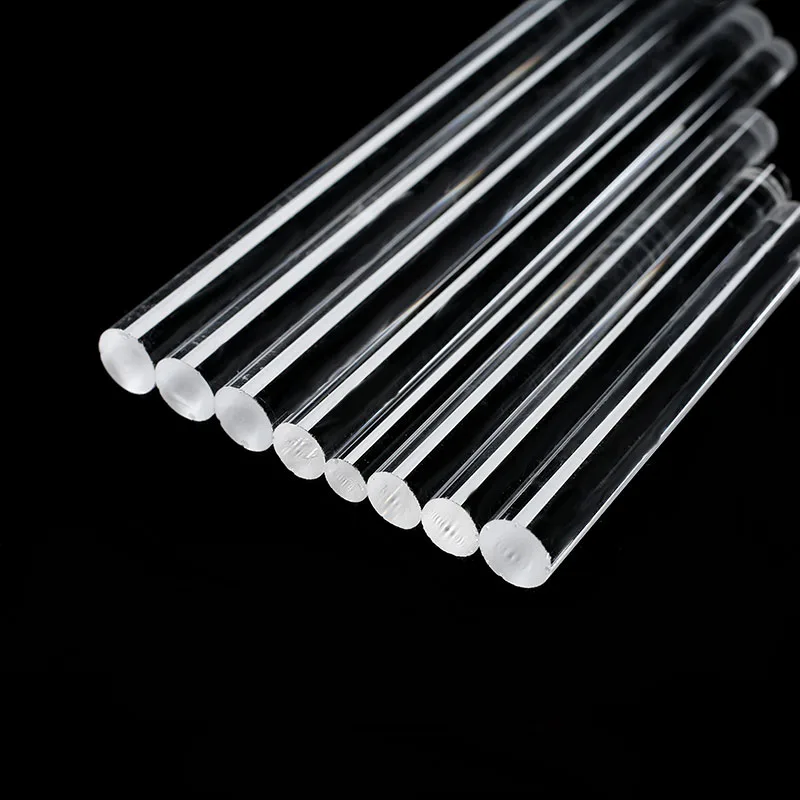
Before any glass is cut, the grade is chosen to match the application: UV grade (high-OH synthetic) for deep-UV transmission, IR grade (low-OH) for infrared work, excimer grade for the purity and laser durability that 248 nm and 193 nm laser optics demand, and natural fused quartz for less demanding visible-range optics and lamp envelopes where cost matters more than deep-UV performance. Homogeneity class, striae grade and bubble/inclusion limits are specified here too, because they cannot be improved by polishing later. Blank stock is drawn from plate for windows and flats, or from rod for lenses and prisms.
Step 2 · Shaping — cutting, grinding and generating
The blank is cut to size and the basic geometry is generated by grinding — flats for windows, curves for lenses, angled faces for prisms — using diamond tooling and CNC machining. This stage establishes the dimensions, the rough form and the edges, leaving a controlled amount of material for the polishing stage to remove. Good shaping minimises subsurface damage, because cracks left below the surface here will limit both the final polish and the laser-damage threshold.
Step 3 · Precision polishing — where the optic is made or lost
Polishing brings the surface to its final figure, smoothness and parallelism. This is the step that defines an optic: surface figure (how closely the surface matches the intended flat or curve), surface roughness (down to the angstrom scale for laser optics), parallelism or wedge between faces, and surface quality (the scratch-and-dig count). Each is driven to the spec the application needs — a beam-steering window for a high-power laser is held far tighter than a protective viewport. Achieving a tight figure over a large aperture without leaving subsurface damage is the core craft of optical fabrication.
Step 4 · Inspection and finishing
Finished optics are verified against drawing: interferometry measures surface figure and transmitted wavefront, a spectrophotometer confirms transmission across the working band, and homogeneity and stress birefringence are checked where the application is sensitive to them. Edges may be bevelled and faces cleaned to the required surface-quality grade. Anti-reflection and other thin-film coatings — usually applied by specialist coating houses — are added last, after the substrate itself meets every spec.
04 — The Specifications That Define an Optical Part
An optical drawing is a list of tolerances, and each line on it maps to a real performance outcome. These are the specifications that decide whether a fused silica optic does its job — and the ones worth understanding before you request a quote.
| Specification | What it controls | Why it matters |
|---|---|---|
| Surface figure (flatness / power & irregularity) | How closely the polished surface matches the intended flat or curve | Directly sets transmitted wavefront quality and how well a beam stays collimated or focused |
| Surface quality (scratch–dig) | The count and size of surface scratches and digs | Defects scatter light and seed laser damage; critical at high power and short wavelength |
| Surface roughness | Micro-scale smoothness of the polished face | Lower roughness reduces scatter loss and raises the laser-damage threshold |
| Parallelism / wedge | Angle between the two faces of a window or flat | Excess wedge deviates the beam and causes pointing error and ghosting |
| Transmitted wavefront error | Total distortion the optic adds to a beam passing through it | The bottom-line metric for imaging and beam-quality-sensitive systems |
| Homogeneity, striae & birefringence | Index uniformity, internal streaks and residual stress in the bulk material | Bulk material flaws cannot be polished out; they limit wavefront and polarisation performance |
| Laser-damage threshold | The optical flux the optic survives without damage | Sets the safe operating power for any laser optic; driven by purity and surface quality |
Cost rises steeply as surface figure, scratch–dig and homogeneity tighten. A protective viewport does not need laser-grade figure, and a high-power UV optic must not be under-specified. The economical path is to specify each tolerance to what the application actually requires — no looser, no tighter — which is why a good supplier asks about the use case before quoting.
05 — Choosing the Right Grade, and the Market Landscape
Grade selection is the highest-leverage decision in an optical order, and it comes down to matching material to wavelength, power and budget rather than to any single rating:
- UV grade (high-OH synthetic) — best deep-ultraviolet transmission; the default for UV optics and germicidal applications, accepting infrared absorption bands as the trade-off.
- IR grade (low-OH) — extended near-infrared transmission with the OH water bands suppressed; chosen for near-IR laser and sensing optics.
- Excimer grade — high purity and high resistance to laser-induced absorption and compaction; specified for 248 nm and 193 nm excimer-laser and lithography optics.
- Natural fused quartz — economical and well suited to visible-range optics and lamp envelopes where deep-UV performance and the lowest impurity levels are not required.
Market structure. A small group of global synthetic fused silica makers supply the highest homogeneity and excimer grades for lithography and high-end laser optics. A broad mid-tier of optical fabricators turns standard and UV-grade material into windows, lenses and prisms for laser, UV and instrument markets. A wide base of suppliers serves visible-range and lamp-envelope optics in natural quartz. The differentiator up-market is the combination of premium material plus the polishing capability to hold tight figure over large apertures.
06 — Handling, Cleaning and Service Life
Unlike a consumable crucible, an optical component is built to last — but its performance lives entirely on its surfaces, so handling discipline is what protects the investment.
Cleaning. Optical surfaces are cleaned with the gentlest effective method and approved solvents; abrasive wiping or the wrong solvent leaves scratches and haze that scatter light and lower the damage threshold. UV and laser optics are especially intolerant of fingerprints and residues, which can carbonise and initiate damage under high flux.
Laser-induced damage. The most common service-limiting mechanism for laser optics is gradual surface degradation under repeated high-flux exposure, accelerated by contamination. Optics in laser systems are inspected periodically and replaced before damage spreads into the beam path.
Recoating and refurbishment. A substrate whose coating has degraded can often be stripped, re-polished if needed, and recoated — extending its life well beyond the first coating, provided the bulk material and figure are still good.
Handling and storage. Optics are handled by their edges with clean gloves and stored in protective, low-particulate packaging. Most “defective” optics returned from the field are simply contaminated or mishandled, not genuinely out of spec.
07 — Optical Quartz in the Supply Chain
Optical fused silica splits into a material side and a fabrication side, and the value concentrates differently in each. Premium bulk material — the highest homogeneity and excimer grades — comes from a handful of synthetic fused silica producers, because the precursor chemistry and melting process that deliver that uniformity are hard to master. Fabrication — the precision polishing that turns a blank into a figured optic — is a separate, broadly distributed capability where craft, metrology and yield decide who can hold the tightest specs.
For buyers, the practical implication is that an optic’s quality depends on two independent links: the grade and homogeneity of the starting material, and the polishing capability of the fabricator. A premium blank polished poorly, or a modest blank polished superbly, both fall short for demanding work — the strongest suppliers control, or tightly coordinate, both links. As always in quartz, the value is in conversion know-how rather than in owning silica.
08 — Where Optical Quartz Glass Is Going
1 · Deep-UV lithography keeps raising the bar. Advanced chip lithography at 248 nm and 193 nm demands material that resists laser-induced absorption and density change over billions of pulses, plus homogeneity at the very edge of what is measurable. These are the most demanding optics made, and they pull the whole industry’s capability upward.
2 · UV-C disinfection has gone mainstream. Demand for germicidal UV — water, air and surface disinfection — has lifted the need for UV-transmitting windows, lamp envelopes and optics, broadening the market well beyond traditional industrial users.
3 · Higher-power lasers. As industrial, scientific and defence lasers climb in power, laser-damage threshold and thermal stability become the limiting specs, favouring the cleanest material, the best surface quality and the lowest-absorption finishing.
4 · Larger optics and tighter figure. Bigger apertures with tighter surface-figure tolerances — for large laser systems, astronomy and metrology — push fabricators toward more capable polishing and full-aperture interferometric verification.
09 — Frequently Asked Questions
What makes fused silica a good optical material?
Fused silica combines an exceptionally wide transmission range from the deep ultraviolet through the near-infrared, very low thermal expansion that keeps optics stable under heat, a high laser-damage threshold, and high homogeneity with low birefringence for precise wavefront control — plus chemical durability and a hard, durable polish. No single competing material matches that combination across the whole UV-to-near-IR range, which is why fused silica is the workhorse of demanding precision optics.
What is the difference between UV-grade and IR-grade fused silica?
The difference comes down to hydroxyl (OH) content. UV-grade synthetic fused silica has high OH, which gives the best deep-ultraviolet transmission but introduces absorption bands in the infrared. IR-grade fused silica has low OH, which suppresses those infrared water bands and extends transmission further into the near-infrared, at the cost of deep-UV performance. There is no universally best grade — you match the grade to the wavelength your optic has to work at.
When should I choose fused silica over standard optical glass?
Choose fused silica when the application needs ultraviolet transmission, thermal stability, a high laser-damage threshold, or broadband performance in a single material — situations where standard optical glasses fall short because of limited UV transmission and much higher thermal expansion. Standard optical glass remains a good, lower-cost choice for visible-only optics at moderate power and temperature. The deciding factors are wavelength, optical power and thermal environment.
Which surface specifications matter most for a window or lens?
The key surface specifications are surface figure (how closely the surface matches the intended flat or curve, which sets transmitted wavefront quality), surface quality or scratch–dig (the count and size of surface defects, which scatter light and seed laser damage), surface roughness (lower roughness means less scatter and a higher damage threshold), and parallelism or wedge between faces (excess wedge deviates the beam). Which ones dominate depends on the use: imaging and laser optics are figure- and wavefront-driven, while protective windows are far more forgiving.
What is laser-damage threshold and why does it matter?
Laser-damage threshold is the optical flux an optic can withstand before its surface or bulk is permanently damaged. It sets the safe operating power for any laser optic, so under-specifying it leads to optics that degrade or fail in service. The threshold is driven mainly by material purity (inclusion- and absorption-free glass), surface quality (scratches and digs initiate damage) and cleanliness (contamination carbonises under high flux). For high-power and UV laser systems it is often the single most important specification.
What optical components can be made from fused silica?
Fused silica is fabricated into optical windows, lenses, prisms, optical flats and mirror substrates, vacuum and chamber viewports, spectroscopy cuvettes and sample cells, UV lamp envelopes, and ultra-homogeneous photomask and substrate blanks for lithography. The same material advantages underlie all of them; what changes is the geometry and the tightness of the surface and material specifications, which are set by the application.
Need Fused Silica Optics Made to Your Drawing?
FGQuartz fabricates fused silica windows, flats, lenses, prisms and custom optics from our works in Lianyungang, China, shipped worldwide. For the commercial range and request-a-quote details, see our optical quartz glass application page, browse quartz plate & windows and quartz rod, see related fiber optic quartz, or view our full product range and application library.