Laboratory Quartz: A Complete Guide to Crucibles, Cuvettes, Tubes & ICP Torches
Walk into a serious analytical lab and you will find fused silica everywhere — in the ashing crucible coming out of the muffle furnace, in the cuvette running through the UV-Vis spectrometer, in the torch glowing inside the ICP, and in the tubes carrying samples through a furnace research rig. This guide explains what each piece of laboratory quartz does, when it matters, and how to specify it well.
The reason analytical labs reach for quartz is brutally practical. Borosilicate glassware does most everyday work fine — until you need to push past about 500 °C, until thermal shock starts cracking your beakers, until ultraviolet absorption ruins your spectrum, or until traces of metal leaching from the glass distort the result you are trying to measure. At that point, the right answer is fused silica.
Laboratory quartz products — crucibles, cuvettes, combustion and reactor tubes, ICP plasma torches, dishes, boats and bespoke research apparatus — extend what an analytical method can actually measure. They give labs higher operating temperature, deep-UV transparency, very low extractable contamination and the thermal-shock tolerance that aggressive sample preparation routinely demands.
This guide walks through the whole picture: when quartz is the right call versus borosilicate, the full family of analytical and research quartzware, which quality dimension matters for which method, and how to handle quartz to get a long working life out of it.
This guide covers fused silica labware used in analytical chemistry, spectroscopy, elemental analysis and materials research — crucibles, cuvettes, tubes, ICP torches, dishes and bespoke apparatus. It does not cover the volumetric and routine borosilicate glassware used for everyday wet chemistry, which is rarely a job for quartz.
01 — Why Labs Reach for Quartz Instead of Borosilicate
Borosilicate glassware runs most labs perfectly well. Quartz earns its place only when an experiment crosses one of four lines that borosilicate cannot:
- Temperature. Fused silica works continuously far above borosilicate’s practical ceiling, so ashing, calcination, fusion and high-temperature furnace work all move to quartz.
- Thermal shock. Quartz’s extremely low thermal expansion lets it survive rapid heating and quenching — pulling a crucible straight from a furnace, for instance — that would shatter ordinary glass.
- Ultraviolet transparency. Quartz transmits deep into the UV, where borosilicate absorbs, which is why spectroscopy cuvettes and optical cells are made of fused silica.
- Low extractable contamination. High-purity quartz leaches far less into the sample, which matters enormously for trace-element analysis where the container itself can otherwise corrupt the result.
The honest limits of quartz
Quartz is not universal, and a good lab knows where it stops. Hydrofluoric acid and strong fluoride solutions attack fused silica — these must be handled in fluoropolymer (PTFE/PFA) ware, never quartz. Hot concentrated alkalis also corrode it. And although quartz tolerates very high temperatures, prolonged exposure near its upper limit causes gradual surface devitrification, so the continuous-use temperature must be respected rather than treated as a hard ceiling. Match the material to the chemistry and the temperature, and quartz rewards you; ignore these limits and it fails predictably.
Reach for quartz when you need high temperature, thermal-shock survival, UV transparency or trace-level cleanliness. Stay with borosilicate for routine room-temperature wet chemistry, and switch to fluoropolymer whenever hydrofluoric acid or strong fluorides are involved.
02 — The Family of Laboratory Quartz Products
Analytical and research labs use fused silica in a surprisingly wide range of forms. Here is the core family and what each piece is for.
| Product | What it does | Typical use |
|---|---|---|
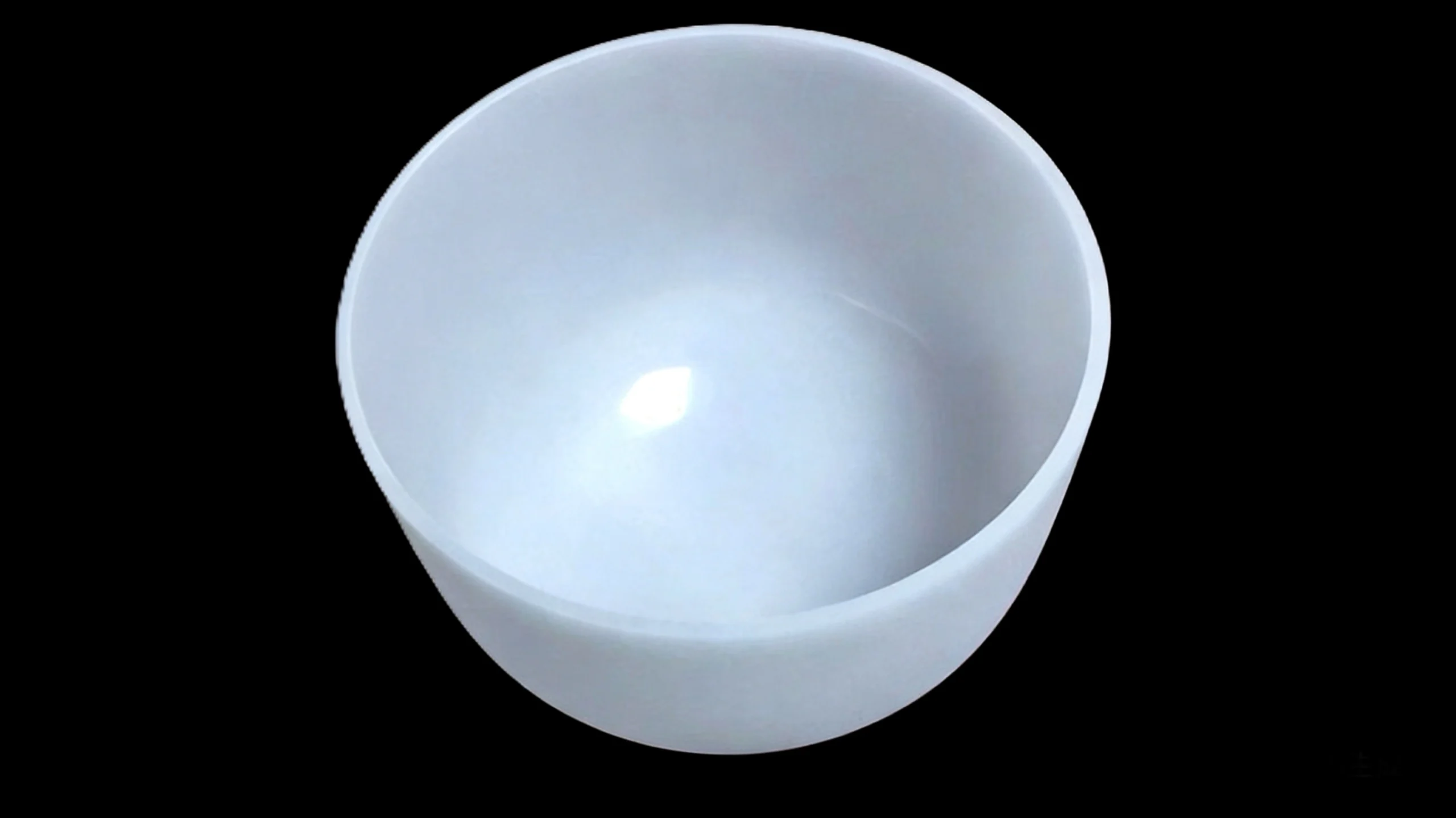
| Crucibles & dishes | Hold samples through high-temperature ashing, calcination and fusion | Gravimetric analysis, sample preparation, thermal analysis |
| Cuvettes & optical cells | UV-transparent vessels with precise path length and parallel faces | UV-Vis-NIR spectroscopy, fluorescence, photometry |
| ICP plasma torches | Concentric quartz assembly that sustains the argon plasma | ICP-OES and ICP-MS elemental analysis |
| Combustion tubes | Withstand oxidising conditions while a sample is burned for measurement | Elemental (CHN/S) and trace combustion analysis |
| Reactor & furnace work tubes | Contain a controlled atmosphere and sample inside a tube furnace | Catalysis studies, materials synthesis, heat treatment |
| Sample boats & setters | Carry powders or specimens into a hot zone | TGA, furnace processing, controlled-atmosphere runs |
| Stirring rods & small parts | Inert manipulation in hot or aggressive media | High-temperature melts, corrosive solutions |
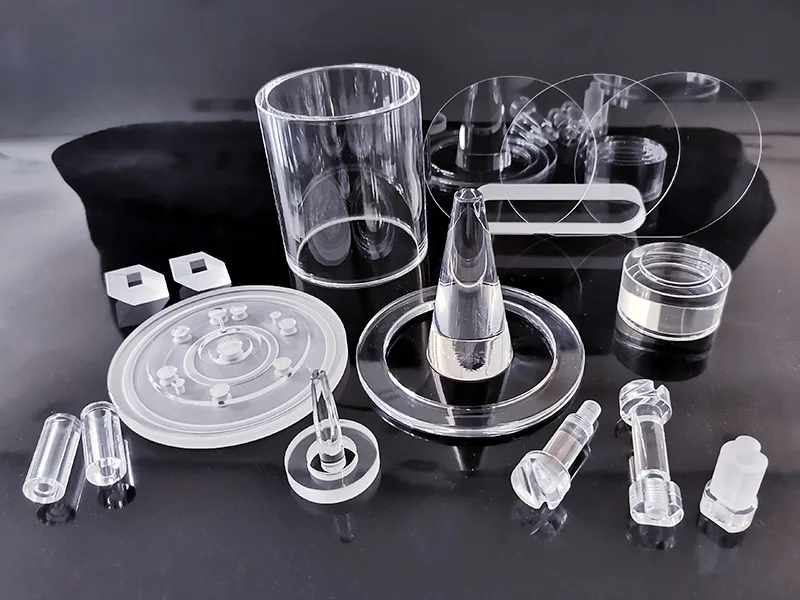
| Bespoke apparatus | One-off assemblies designed around a specific experiment | Custom instruments and research rigs |
Unlike a fab that buys one boat design by the thousand, a research lab often needs a handful of pieces in many shapes. FGQuartz supports research orders without a minimum quantity, including fully custom quartz apparatus built to a sketch or drawing — see also our stock crucibles, tubes and rods.
03 — Which Quartz Each Analytical Method Pulls In
Thermal analysis & gravimetry
When a method involves weighing a sample before and after heating — gravimetric analysis, loss-on-ignition, ashing — the sample sits in a fused silica crucible or dish. Quartz is chosen because it can be heated to high temperature without contributing weight of its own, survives the rapid transfer between furnace and desiccator without cracking, and does not react with most residues. The same logic puts quartz boats and sample holders inside thermogravimetric and furnace runs.
Spectroscopy
In UV-Vis and fluorescence spectroscopy the sample is held in a quartz cuvette, because the measurement reaches into the ultraviolet where ordinary glass absorbs. Here the demands shift from thermal to optical: the cuvette needs a precise internal path length, parallel and well-polished optical faces, and freedom from the surface defects and contamination that would distort the baseline. For the optical-fabrication side of this — windows, flats and cells — see our optical quartz glass resources.
Elemental analysis
Two heavyweight elemental methods lean hard on quartz. In combustion analysis, the sample is burned inside a quartz combustion tube that must endure repeated oxidising high-temperature cycles. In ICP-OES and ICP-MS, the heart of the instrument is a quartz plasma torch — a concentric assembly of quartz tubes that confines and shapes an argon plasma running at extreme temperature. Torch geometry and purity are critical, and for trace-metal work the quartz must contribute no detectable contamination of its own.
Catalysis & materials research
Materials and catalysis labs run reactions inside quartz reactor tubes and tube-furnace work tubes — a controlled atmosphere flowing over a sample held at high temperature. Quartz is ideal because it is transparent (you can sometimes watch the reaction), inert to most gases, and stable across the temperature range these studies need. For the heavy industrial end of furnace tubes and high-temperature hardware, see high-temperature quartz.
04 — Why “Lab Grade” Means Different Things for Different Parts
There is no single “laboratory grade” of quartz. The quality dimension that matters depends entirely on what the part has to do — and specifying the wrong one wastes money or ruins the result.
| Part | Quality dimension that dominates | What it controls |
|---|---|---|
| Cuvette / optical cell | Optical quality — path length, face flatness, UV transmission | Baseline stability and accuracy of the spectroscopic reading |
| Crucible for trace analysis / ICP torch | Purity — low extractable metallic content | Whether the container corrupts a trace-level measurement |
| Furnace / reactor work tube | Thermal robustness — temperature rating, wall uniformity, sag resistance | Service life and dimensional stability under repeated heating |
| Combustion tube | Oxidation & cycle endurance | How many analysis cycles before devitrification ends its life |
| General labware | Thermal-shock tolerance & inertness | Day-to-day durability across heating, quenching and cleaning |
Telling a supplier “lab grade” is not enough. State whether the part is for trace-metal analysis (purity-critical), spectroscopy (optics-critical) or high-temperature furnace work (thermal-critical), and the right material and finish follow. The wrong emphasis means either a needlessly expensive part or one that quietly biases your data.
05 — Quartz or Borosilicate? A Practical Decision
The most common procurement question in a lab is whether a given job actually needs quartz. A simple decision path: if the work stays below borosilicate’s temperature limit, involves no UV measurement, no severe thermal shock and no trace-level cleanliness requirement, borosilicate is the economical right answer. As soon as any one of those conditions flips — higher temperature, UV transparency, rapid thermal cycling, or trace analysis — quartz becomes worth its higher cost because borosilicate will either fail or bias the result.
One more practical point sets the lab market apart from industrial buyers: order flexibility. Research rarely needs a thousand identical pieces; it needs a few, often of an unusual shape, sometimes just once. FGQuartz supports research-scale orders without a minimum quantity, so a single bespoke crucible or a one-off reactor tube is as welcome as a production run.
06 — Cleaning, Devitrification and Service Life
Cleaning. Most lab quartz is cleaned with dilute acid soaks (never hydrofluoric) followed by thorough deionised-water rinsing and drying. For trace analysis, the cleaning regime itself must not introduce contamination. Cuvettes are a special case: their optical faces are cleaned gently and never abraded, since a scratched face permanently degrades the measurement.
Devitrification is the main ageing mechanism. Held at high temperature for long periods — especially if contaminated with sodium from fingerprints or dust — the quartz surface slowly crystallises into cristobalite, turning milky and brittle and eventually cracking on cooling. This is why high-temperature quartz should be handled with clean gloves and why combustion tubes and ICP torches are treated as consumables with a finite cycle life.
When to replace. Retire a piece when its surface turns cloudy or white (devitrification), when a cuvette’s faces are scratched or etched, when a torch’s geometry has distorted or its tubes have cracked, or when a furnace tube has sagged out of tolerance. Replacing on these signs — rather than waiting for a failure mid-run — protects both the apparatus and the data.
07 — Custom Apparatus: the Heart of Lab Quartz
Standard catalogue items cover a lot of lab work, but the most valuable laboratory quartz is often the piece that does not exist yet — a reactor with a particular port arrangement, a sample holder shaped to an instrument, a cell with a non-standard path length. This is where fused silica fabrication skill matters most: flame-working, fusing, shaping and finishing a one-off assembly to a researcher’s sketch.
For a custom piece to work, the conversation has to start with the experiment, not the part. The temperature, the chemistry, the optical requirement and the instrument it must fit all determine the grade, geometry and finish. A supplier who asks those questions first delivers apparatus that works the first time; one who simply quotes a shape often does not. FGQuartz builds custom quartz to drawing or sketch, with no minimum order — the same capability that serves our full range of applications.
08 — Where Laboratory Quartz Is Going
1 · Trace-metal analysis keeps getting more sensitive. As ICP-MS and related methods push detection limits ever lower — in semiconductor, pharmaceutical and environmental labs — the cleanliness demanded of crucibles, torches and sample vessels rises with them, because the container’s own contribution becomes the limiting factor.
2 · More custom, instrument-specific apparatus. As analytical instruments diversify, so does the quartz that feeds them. Demand is shifting from catalogue items toward bespoke cells, holders and reactors designed around a specific tool or experiment.
3 · Higher-temperature materials research. Battery materials, catalysts and advanced ceramics research drives more high-temperature tube-furnace work, and with it demand for reactor and work tubes that hold up to aggressive atmospheres and repeated cycling.
4 · Emerging fabrication methods. New ways of shaping fused silica, including additive approaches, are beginning to appear at the research scale and promise more intricate one-off geometries than conventional flame-working allows — a development worth watching for custom lab apparatus.
09 — Frequently Asked Questions
What is laboratory quartz used for?
Laboratory quartz — fused silica labware — is used wherever borosilicate glass falls short: high-temperature ashing and calcination in crucibles, UV-Vis spectroscopy in cuvettes, elemental analysis in combustion tubes and ICP plasma torches, and controlled-atmosphere reactions in tube-furnace reactor tubes. It is chosen for its high operating temperature, thermal-shock resistance, deep-UV transparency and very low extractable contamination, which together let analytical methods reach conditions and sensitivities that ordinary glass cannot support.
When do I need quartz instead of borosilicate glass?
Switch to quartz when the work crosses any one of four lines: it exceeds borosilicate’s practical temperature limit; it involves rapid heating or quenching that would thermally shock ordinary glass; it requires ultraviolet transparency, as in UV spectroscopy; or it demands trace-level cleanliness where leaching from the container would bias the result. If none of those apply, borosilicate is the more economical choice. Whenever hydrofluoric acid or strong fluorides are involved, use neither — switch to fluoropolymer ware.
What is the temperature limit of quartz labware?
Fused silica softens well above the working range of most lab furnaces, but the practical limit is set by devitrification, not softening. Held for long periods near its upper continuous-use temperature — and especially if contaminated — the surface gradually crystallises and weakens. So quartz labware has a continuous-use temperature that should be respected as a working ceiling rather than pushed toward the softening point. For genuinely higher continuous temperatures, ceramics such as alumina are the alternative, at the cost of transparency and thermal-shock resistance.
Can quartz labware be used with hydrofluoric acid?
No. Hydrofluoric acid and strong fluoride solutions attack fused silica, etching and eventually destroying the part — and contaminating the sample in the process. Quartz is otherwise highly resistant to acids, but HF is the clear exception. Work involving hydrofluoric acid must be done in fluoropolymer (PTFE or PFA) labware. Hot concentrated alkalis also corrode quartz and should be avoided in quartz vessels.
How should quartz labware be cleaned and handled?
Clean with dilute acid soaks (never hydrofluoric) followed by thorough deionised-water rinsing and drying; for trace analysis, ensure the cleaning regime itself adds no contamination. Handle high-temperature quartz with clean gloves, because sodium from fingerprints catalyses devitrification at temperature. Cuvette optical faces are cleaned gently and never abraded, since scratches permanently degrade the spectroscopic reading. Store pieces protected from dust and mechanical contact.
Why does an ICP torch wear out, and when should it be replaced?
An ICP plasma torch runs continuously at extreme temperature, so its quartz gradually devitrifies and can distort or crack over many hours of operation — it is a consumable, not a permanent fixture. Replace a torch when its surface turns cloudy or white, when the concentric tubes have shifted or deformed, when cracks appear, or when analytical performance drifts in a way traced to the torch. Clean handling and correct gas flows extend torch life, but every torch has a finite service life.
Need Quartz Labware or a Custom Research Piece?
FGQuartz makes fused silica crucibles, cuvettes, tubes, ICP torch parts and fully custom apparatus — with no minimum order for research — from our works in Lianyungang, China, shipped worldwide. For the commercial range and request-a-quote details, see our laboratory quartz application page, browse quartz crucibles and quartz tubes, request custom quartz apparatus, or view our full product range.