Quartz Glass Tubes
Quartz glass tubes — also sold as fused quartz tubes, fused silica tubes, fused silica glass tubes, or quartz glass tubing — are high-purity amorphous SiO₂ cylinders used as furnace tubes, process chambers, CVD liners, reaction tubes, UV lamp sleeves, and high-temperature conduits where borosilicate glass cannot take the heat and metal would contaminate the process.
FGQuartz is a manufacturer and supplier of custom quartz glass tubes: OD 5–1000 mm, wall 0.5–20 mm+, length up to 3000 mm (longer by welded sections), SiO₂ ≥ 99.99%. Our clear (transparent) quartz tubes are made from JGS2 fused quartz, and opaque quartz tubes are also available. Tubes are supplied plain-cut or fully fabricated — flanged, threaded, ported, bent, or welded — to your drawing, from a single prototype with no minimum order quantity. We export to the USA, Europe, and worldwide.
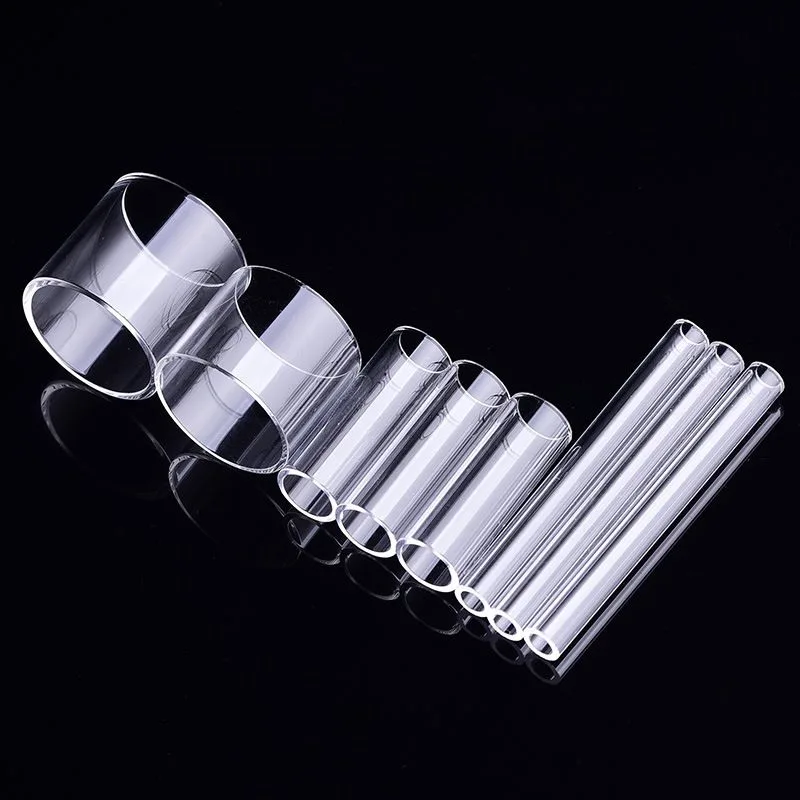
Tube types include regular (non-custom) quartz tubes, thin-wall and heavy-wall tubes, small-diameter and large-diameter tubes, capillary tubes on request, and custom-fabricated tubes with flanges, threads, holes, slots, side arms, bends, closed ends, expanded or reduced ends, multi-port manifolds, and welded assemblies.
Quick answer
What temperature can a quartz glass tube withstand? High-purity fused silica tubes run continuously to about 1200°C and briefly to about 1300°C. The material has no sharp melting point; it softens gradually near 1680°C. Thermal expansion is only about 5.5 × 10⁻⁷ /°C, so properly designed tubes survive rapid heating and cooling.
Key takeaways
- Tubes are made to your drawing, so there is no fixed SKU chart; send the OD, wall thickness, and length to check a size.
- Drawn tube, CNC machining, flame forming, welding, fire polishing, and annealing are done in one plant under one ISO 9001 system.
- Quartz resists HCl, HNO₃, H₂SO₄, aqua regia, and organic solvents, but is attacked by HF, hot concentrated phosphoric acid, and hot strong alkalis.
- Clear tubes are made from JGS2 fused quartz, a UV–visible optical grade; opaque quartz tubes are also available.
Written by the FGQuartz Engineering Team · Updated October 2026
On this page: Specifications · Material · Sizes · How to choose · Customization · Project examples · Applications · FAQ and quote
Lead time depends on size, grade, and drawing complexity; the quote confirms the schedule.
Features of high-purity, high-temperature quartz glass tubes
Product features
Quartz glass tube specifications
Technical specifications
Values below are FGQuartz published ranges for high-purity fused silica tubes. Critical dimensions and tolerances are set from the drawing and confirmed in design-for-manufacture (DFM) review.
| Parameter | Specification |
|---|---|
| Material | Clear (transparent) JGS2 fused quartz (SiO₂ ≥ 99.99%); opaque quartz tubes also available. See JGS1 vs JGS2 vs JGS3 for how the optical grades differ. |
| Outer diameter (OD) | 5 mm – 1000 mm, including large-diameter process tubes. |
| Inner diameter (ID) | Specified with OD and wall thickness, or taken from the drawing. ID is not published as a separate catalog range. |
| Wall thickness | 0.5 mm – 20 mm+. Heavy-wall options for vacuum service. |
| Length | Up to 3000 mm as a standard run. Longer tubes by welded sections when required. |
| Dimensional tolerance | Critical dimensions and tolerances are set from the drawing and confirmed in DFM review. Concentricity / bow can be held to a tight class (e.g. < 0.1 mm/m) where specified. |
| Purity | SiO₂ ≥ 99.99%. Typical process-grade baseline: Al < 10 ppm, Fe < 5 ppm, Na+K < 5 ppm, total metals < 20 ppm. Trace metals and OH vary by grade. |
| Surface finish | As-drawn, fire-polished, or centerless-ground to the sealing / mating requirement on the drawing. |
| Shape | Straight drawn tubes; bent (U / L / coil / custom radius); flanged; threaded; expanded, reduced, and necked ends; side-arm, ported, and manifold tubes; tubes with holes and slots; closed-end tubes; multi-part welded assemblies. |
| End type | Plain cut, chamfered, fire-polished, flanged (fused or CNC-machined, including O-ring faces), threaded (external / internal), or sealed (domed or flat). |
| Processing | Diamond cutting, core drilling, CNC milling and slotting, centerless grinding, oxy-hydrogen flame forming and welding, fire polishing, annealing. |
| Customization | Build-to-print from DXF, STEP, IGES, or PDF, or from a sample or dimensioned sketch. Single prototypes through production. No MOQ. |
Pressure and vacuum service. Quartz glass is much stronger in compression than in tension, so a high-pressure or vacuum quartz tube is sized from the drawing: internal-pressure service depends on wall thickness, OD, length, and surface condition. Pressure rating is calculated per drawing — it is not a catalog number. Tell us the working pressure, temperature, and cycle with your enquiry.
Full thermal, mechanical, optical, and chemical tables: Technical Specifications.
Quartz glass, fused quartz, and fused silica
Material
In industrial purchasing, quartz glass, fused quartz, and fused silica all refer to amorphous high-purity SiO₂ (typically ≥ 99.99%). They are not three different products on a packing list — they are names for the same family of material. For a fuller explanation, see What is quartz glass?
The distinction that matters is feedstock. Fused quartz is melted from natural quartz crystal. Fused silica is synthetic, usually made from SiCl₄. Synthetic material is purer and more optically homogeneous; natural fused quartz is the usual workhorse for process tubes, boats, and crucibles.
Optical grades JGS1 (deep UV), JGS2 (UV–visible), and JGS3 (infrared) are selected by working wavelength. Our clear quartz glass tubes are made from JGS2, a UV–visible grade used in furnace, process, laboratory, and lamp applications. If your tube is part of an optical path, send the working wavelength so we can confirm JGS2 is suitable. Opaque quartz tubes are available when the tube is a thermal liner rather than an optical path.
Comparing quartz with ordinary laboratory glass? Read quartz glass vs borosilicate glass.
Typical properties of fused silica
Typical values for high-purity fused silica. Optical transmission and OH content vary by grade.
| Continuous service | 1200°C |
| Short-term maximum | 1300°C |
| Softening point | ≈ 1680°C |
| Annealing point | ≈ 1215°C |
| Strain point | ≈ 1120°C |
| Thermal expansion (20–300°C) | 5.5 × 10⁻⁷ /°C |
| Thermal conductivity (20°C) | ≈ 1.4 W/(m·K) |
| Density | ≈ 2.2 g/cm³ |
Melting point: amorphous fused silica has no sharp melting point; it softens gradually near 1680°C.
Quartz tube sizes: made to drawing, not to a SKU chart
Available sizes
FGQuartz does not publish a standard OD × ID × wall stock list for quartz tubes. Custom sizes are manufactured according to customer drawings and application requirements, within the ranges in the specification table above.
Regular (non-custom) sizes are usually available quickly and restocked often; because stock moves fast, we confirm availability against the size you send. Thin-wall tubes (from 0.5 mm) suit fast heating and cooling; heavy-wall tubes (to 20 mm+) suit vacuum and pressure service.
Send OD and wall thickness (or OD and ID), length, and end details. If you are matching an existing tube, a sample or a dimensioned sketch is enough to start.
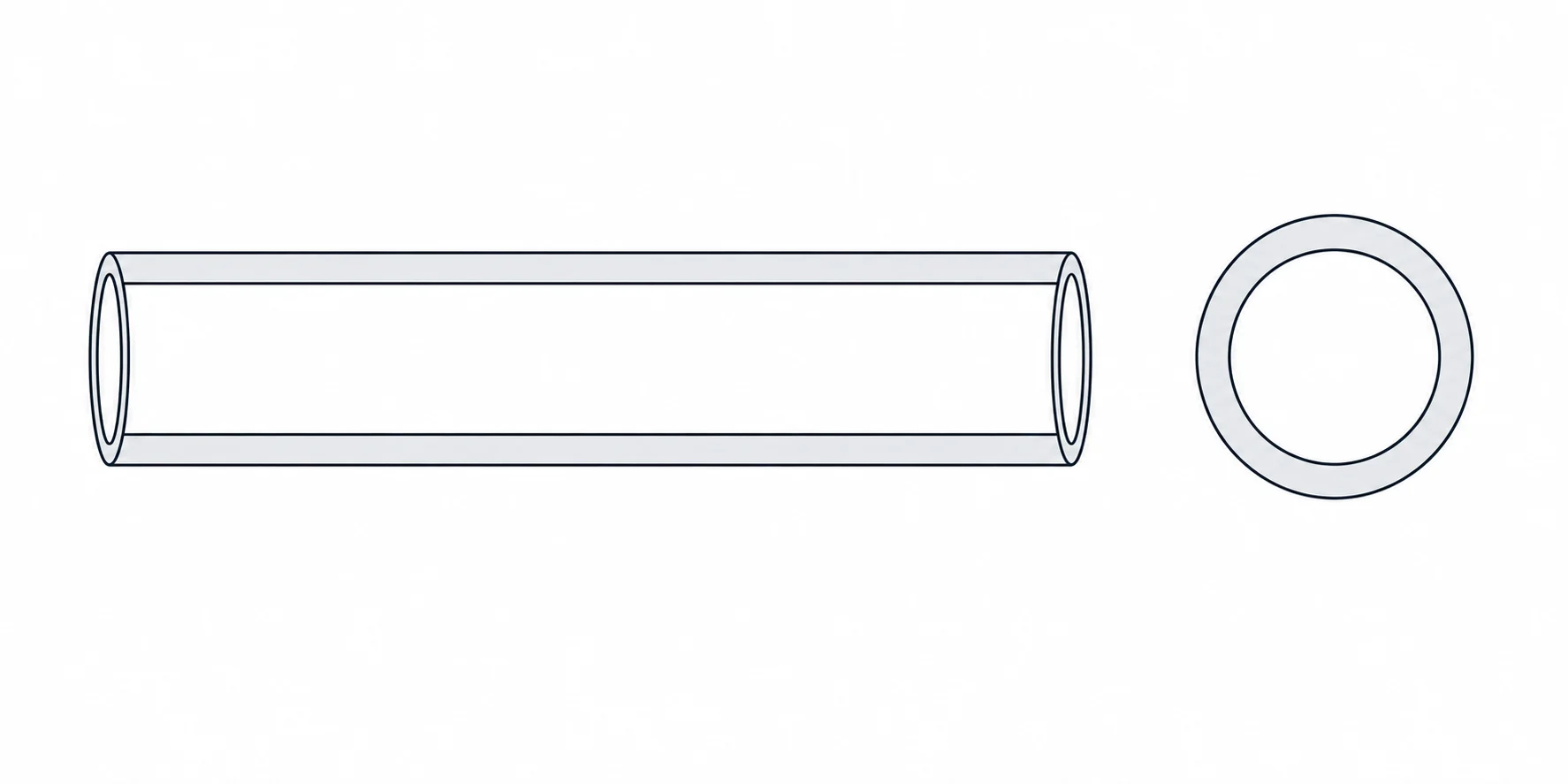
Size ranges and typical uses
| OD range | Typical uses | Points to specify |
|---|---|---|
| 5 – 25 mm (small diameter) | Thermocouple sheaths, small reaction and combustion tubes, lamp envelopes, gas feed lines. | OD and wall, length, closed or open end, any ground joint. |
| 25 – 150 mm | Laboratory tube furnaces, CVD reaction tubes, UV and heater sleeves, ported and bent process lines. | OD and ID, length, flange or thread, port positions, finish. |
| 150 – 1000 mm (large diameter) | Semiconductor diffusion and LPCVD tubes, solar POCl₃ diffusion tubes, large furnace chambers and liners. | OD, wall, length, sealing flange, support method, annealing and packing needs. |
Large-diameter tubes (up to OD 1000 mm) need support along their length and controlled heating, and are annealed and packed to suit their size. Ranges above are typical examples, not limits on what can be drawn.
How to choose a quartz glass tube
Selection guide
Start from the process condition, then match the grade, wall, and ends to it.
| If your process needs… | Specify |
|---|---|
| An optical path or UV exposure | Clear JGS2 fused quartz. Send the working wavelength so we can confirm it suits the optical path — see JGS1 vs JGS2 vs JGS3. |
| A thermal liner with no optical need | Opaque quartz tube, or a clear JGS2 tube in the wall thickness your process needs. |
| Vacuum or pressure service | Heavy wall (up to 20 mm+). Give the working pressure, temperature, and cycle so the wall can be calculated. |
| Fast heating and cooling | A thinner wall, which lowers the temperature gradient across it, and an annealed tube. |
| An O-ring or ground seal | A flanged tube, or a tube centerless-ground to the sealing OD. |
| Very low metallic contamination | SiO₂ ≥ 99.99% fused quartz, with any trace-metal limits stated in your RFQ. |
| A hot zone longer than 3000 mm | Welded sections, post-weld annealed. |
| Contact with HF, hot phosphoric acid, or hot strong alkali | Not quartz — choose another material. |
Quartz tube vs borosilicate vs alumina tube
| Property | Fused quartz tube | Borosilicate 3.3 tube | 99.7% alumina tube |
|---|---|---|---|
| Continuous use | ≈ 1200°C | ≈ 500°C | ≈ 1600°C or higher |
| Thermal expansion | ≈ 5.5 × 10⁻⁷ /°C | ≈ 3.3 × 10⁻⁶ /°C | ≈ 8 × 10⁻⁶ /°C |
| Thermal shock | Excellent | Moderate | Limited; heat slowly |
| Transparency | Transparent from UV to near IR (grade dependent) | Transparent in the visible; cuts off the deep UV | Opaque |
| Composition | SiO₂ ≥ 99.99% | SiO₂ with B₂O₃, Na₂O, Al₂O₃ | ≈ 99.7% Al₂O₃ plus sintering additives |
| Main limits | HF, hot phosphoric acid, hot alkali | Low maximum temperature; HF and hot alkali | No visual access; thermal-shock risk |
Typical handbook values for comparison. Exact figures depend on grade and supplier. More detail: quartz glass vs borosilicate glass.
Custom quartz glass tubes: flanged, threaded, ported, bent, and welded
Customization
Straight drawn stock is only the starting geometry. FGQuartz cuts, machines, flame-forms, and welds quartz tubes into process-ready parts and assemblies — from a single prototype to production, with no minimum order quantity. Process detail: thermal (flame) processing and cold (CNC and grinding) processing; non-tube parts are on the custom quartz glass page.
| Capability | Detail |
|---|---|
| Dimensional tolerance | Drawn tolerance or tighter OD control via centerless grinding, per drawing. |
| End configuration | Plain, chamfered, fire-polished, flanged, threaded, or sealed closed ends (domed / flat). |
| Holes and ports | Diamond core-drilled holes and ports for gas, sensor, thermocouple, and exhaust connections. Position and diameter are set from the drawing. |
| Slots and steps | CNC milling of slots, locating grooves, steps, and mating interfaces to the drawing. |
| Surface finishing | Fire polishing, grinding, and annealing after hot or cold work. |
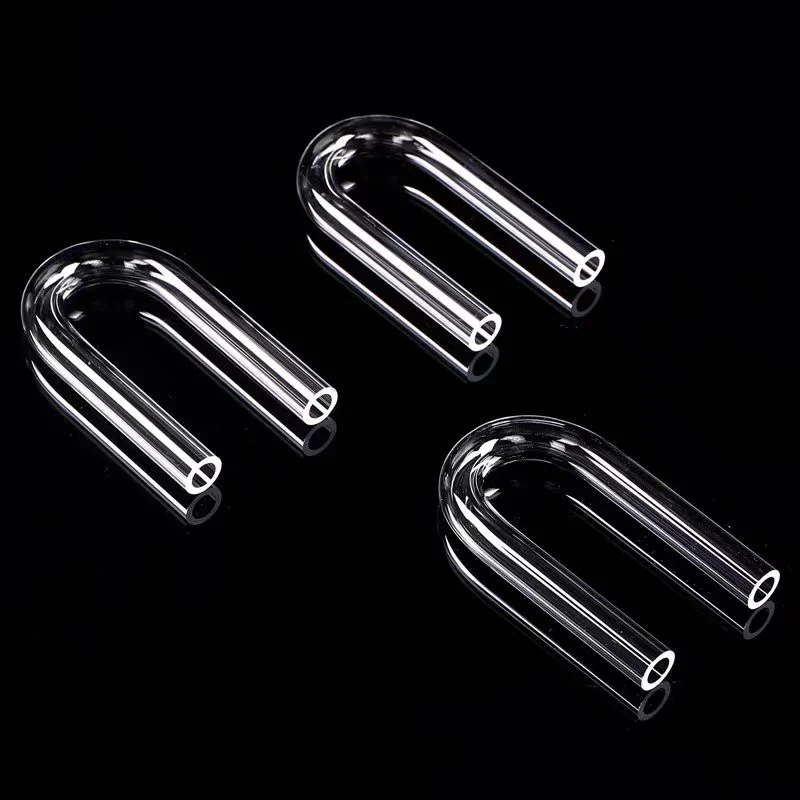
Flame-formed fused silica U-bends — precision bent and annealed in the same facility as the drawn tube for process and laboratory lines.
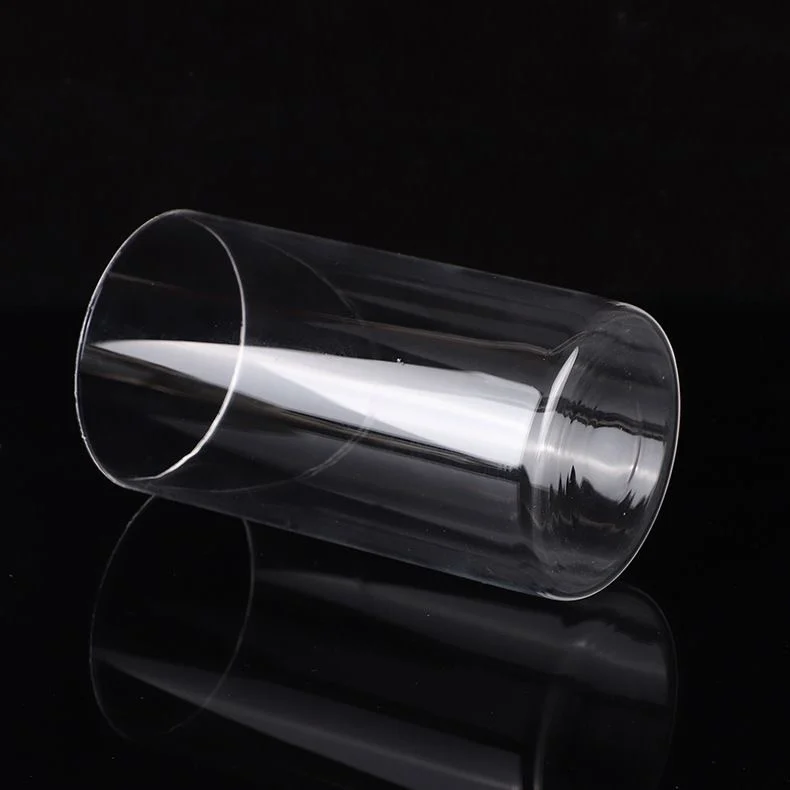
Closed-end fused silica tube — one end sealed by flame working, cut and annealed in the same facility as the drawn tube for process and laboratory use.
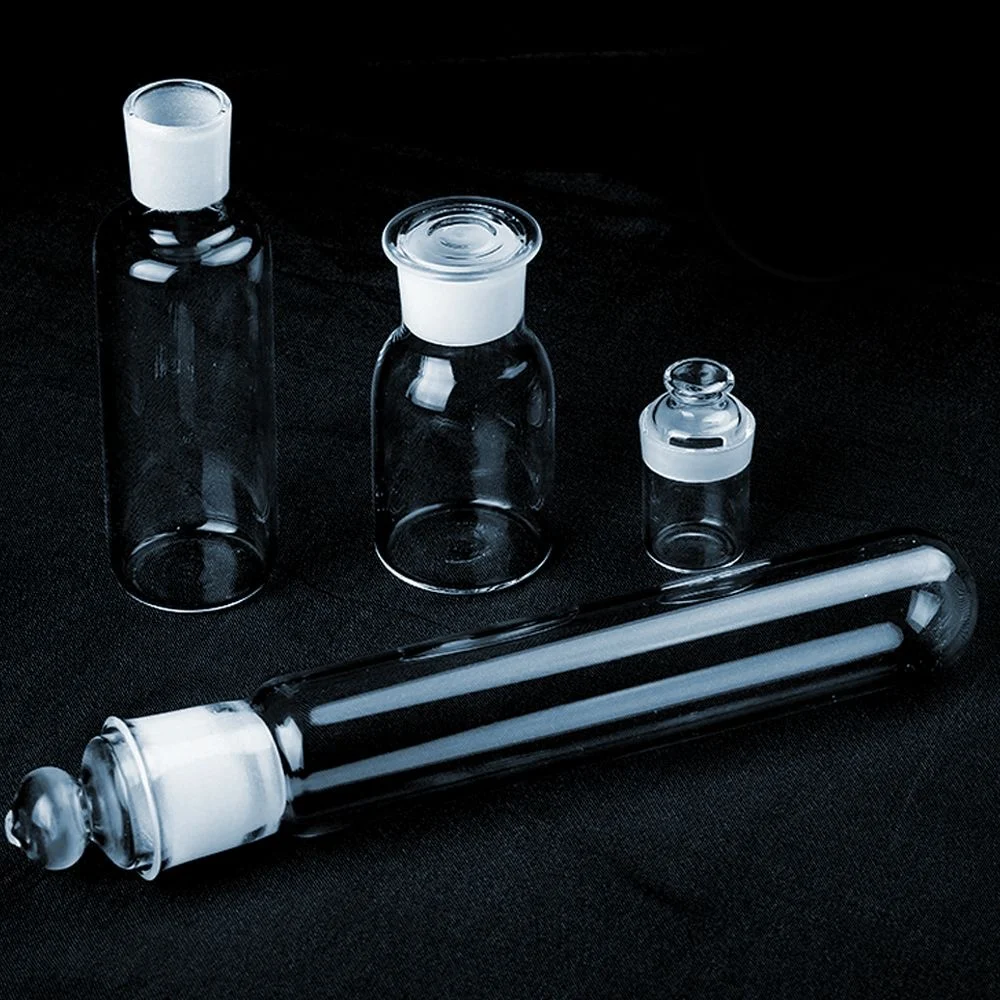
Custom fused silica labware with ground joints — bottles, vessels, and closed tubes fabricated and annealed in-house for laboratory and pilot use.
Quartz tube types we fabricate: shapes, ends, and features
| Tube type | Typical use | What is fabricated |
|---|---|---|
| Regular (standard) quartz tubes | Diffusion furnaces, tube furnaces, fiber preform sleeves, furnace cylinders | Continuous-drawn clear JGS2 fused quartz, cut to length with controlled OD/ID and concentricity. Thin-wall or heavy-wall. Ends left plain, chamfered, or fire-polished. Regular (non-custom) items: 7–14 days. |
| Opaque quartz tubes | Thermal liners and furnace parts where no optical path is needed | Opaque quartz tubes supplied plain-cut or fabricated to your drawing. |
| Small- and large-diameter tubes | Thermocouple sheaths and small reaction tubes; semiconductor, solar, and furnace process tubes | Small-diameter tubes from OD 5 mm; large-diameter process tubes up to OD 1000 mm, annealed and packed to suit their size. |
| Capillary quartz tubes | Fine-bore (small inner diameter) tubing | Available on request. Send the required OD, ID, and length and the engineering team confirms what can be made. |
| Flanged tubes | Process chambers, vacuum / UHV interfaces | Thermally fused or CNC-machined flanges with O-ring sealing faces, sized to the mating equipment on your drawing. Specify: flange OD and thickness, sealing-face type (for example an O-ring face), tube OD and wall, and whether the flange is fused on or CNC-machined. A drawing or sample of the mating part helps. |
| Threaded tubes | Modular ultra-pure assemblies in the hot zone | CNC-milled external or internal threads, including custom thread forms, for metal-free mechanical fastening. Specify: external or internal thread, thread form and pitch, thread length, and the mating part. |
| Tubes with holes and slots | Gas, sensor, and exhaust ports; locating and mating features | Diamond core-drilled holes and CNC-milled slots, grooves, and steps, finished and annealed. Specify: for holes, the diameter, position, and quantity; for slots, grooves, and steps, the width, length, depth, and position. |
| Side-arm tubes and port tubes | Gas injection and sensing on LPCVD / CVD tools | Side-arm tubes, tubes with ports, thermocouple sheaths, and gas injector tubes, with each arm or port placed as drawn. Specify: the number of arms or ports, their position along the tube, direction, OD and ID, and the length of each arm. |
| Multi-port manifolds | Gas distribution and sensing lines | Manifolds with several ports or branches, welded leak-tight and annealed after welding. Specify: the number of ports or branches, their positions and diameters, and the overall dimensions. |
| Bent tubes (U, L, and coil) | Compact layouts and non-straight gas or heat paths | Flame-formed U, L, coil, and custom bends with wall integrity held through the bend, annealed after forming. Specify: bend shape, radius, and angle, leg lengths, tube OD and wall thickness, and the end configuration of each leg. |
| Closed-end tubes | Reaction tubes and protective sheaths | One end sealed by flame working, then cut and annealed. Specify: the closed-end shape (domed, flat, or the shape on your drawing), which end is closed, and the open-end finish (plain, chamfered, fire-polished, or flanged). |
| Expanded-end, reduced-end, and tapered tubes | Diameter transitions, reducers, and nozzles | Flame-formed expanded ends, necked (reduced) ends, tapers, and nozzles, annealed after forming. Specify: the start and finish diameters, the transition length, and the final end geometry. |
| Laboratory tubes and labware | Test tubes, combustion and reaction tubes, vessels with ground joints | Custom fused quartz test tubes, closed tubes, bottles, and vessels with ground joints, fabricated and annealed in-house. Specify: the ground-joint size and the tube or vessel it fits. |
| Welded quartz tube assemblies | Integrated reactor-style structures | Tube-to-tube and tube-to-plate joints by oxy-hydrogen flame welding, post-weld annealing, and leak-tight multi-part geometry. Extended-length tubes are made from welded sections. Specify: an assembly drawing showing every joint location and the overall dimensions, plus any leak-tightness or annealing requirement. |
| Custom-fabricated quartz tubes | Sleeves, ICP torch tubes, and other non-standard parts | Quartz tubes cut, machined, flame-formed, and welded from a DXF, STEP, IGES, or PDF drawing, a sample, or a dimensioned sketch. The engineering team reviews the design before quoting. |
Tolerances are set to your requirement. Achievable bend radii, minimum hole and slot sizes, flange and thread dimensions, and straightness depend on OD, wall, length, and geometry, and are confirmed with our engineers in design-for-manufacture (DFM) review before quotation.
Representative tube builds
Project examples
Four typical custom tube projects, described by the requirement, the build route, and what is checked against the drawing. Customer names and confidential drawing data are withheld.
01 · Semiconductor
Flanged LPCVD process tube
Requirement. Large-OD process tube with an O-ring sealing flange, plus side ports for gas injection and a thermocouple.
How it is built. Drawn tube cut to length, ports core-drilled, flange fused on or CNC-machined with an O-ring face, then stress-relief annealed.
Checked against the drawing. OD, ID, wall thickness, concentricity, and flange-face geometry.
02 · Fiber optic
Preform substrate and jacketing tube
Requirement. Tube with tight concentricity and uniform wall for MCVD substrate use, or for jacketing and overcladding of preforms.
How it is built. Fused quartz tube selected to the process, OD brought to tolerance by centerless grinding where the drawn tolerance is not enough, ends cut and fire-polished.
Checked against the drawing. OD, ID, wall uniformity, and bow / concentricity (a class below 0.1 mm/m where specified).
03 · Laboratory and pilot
U-shaped process line
Requirement. Compact, non-straight gas or heat path inside a laboratory or pilot furnace.
How it is built. Flame-formed U bend at the specified radius with wall integrity held through the bend, annealed after the hot work.
Checked against the drawing. Bend radius, leg length, OD, and end configuration.
04 · Furnace equipment
Extended-length welded tube
Requirement. A furnace chamber tube longer than the 3000 mm standard run.
How it is built. Matched tube sections joined by oxy-hydrogen flame welding, then post-weld annealed and fire-polished at the ends.
Checked against the drawing. Straightness across the joints, overall length, and end features.
Drawn, machined, and flame-worked under one ISO 9001 system
Manufacturing and quality
FGQuartz operates a 15,000 m² facility in Lianyungang covering melting, CNC diamond machining, oxy-hydrogen flame forming, welding, fire polishing, and annealing, so industrial tube specifications are executed in-house rather than outsourced. Learn more about FGQuartz.
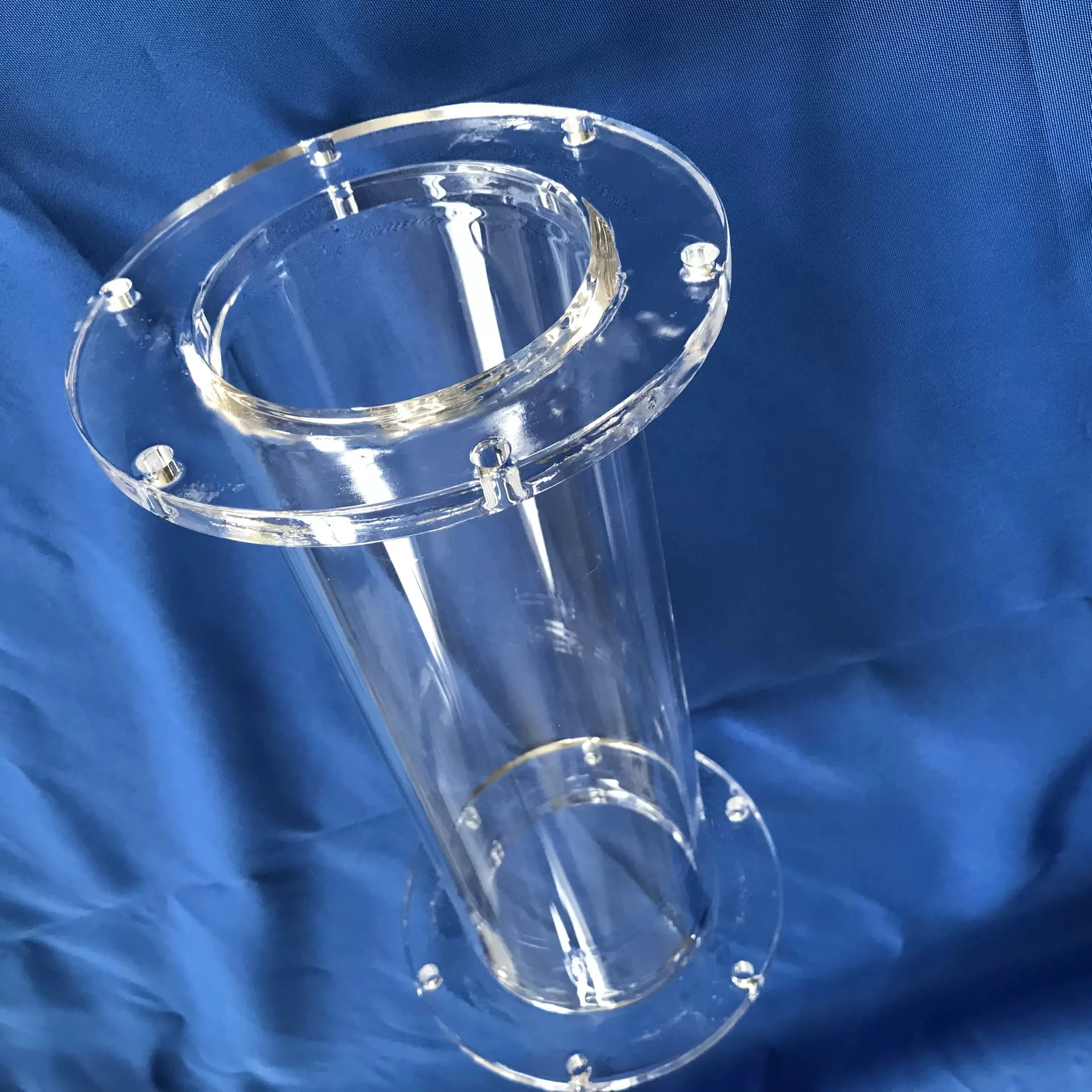
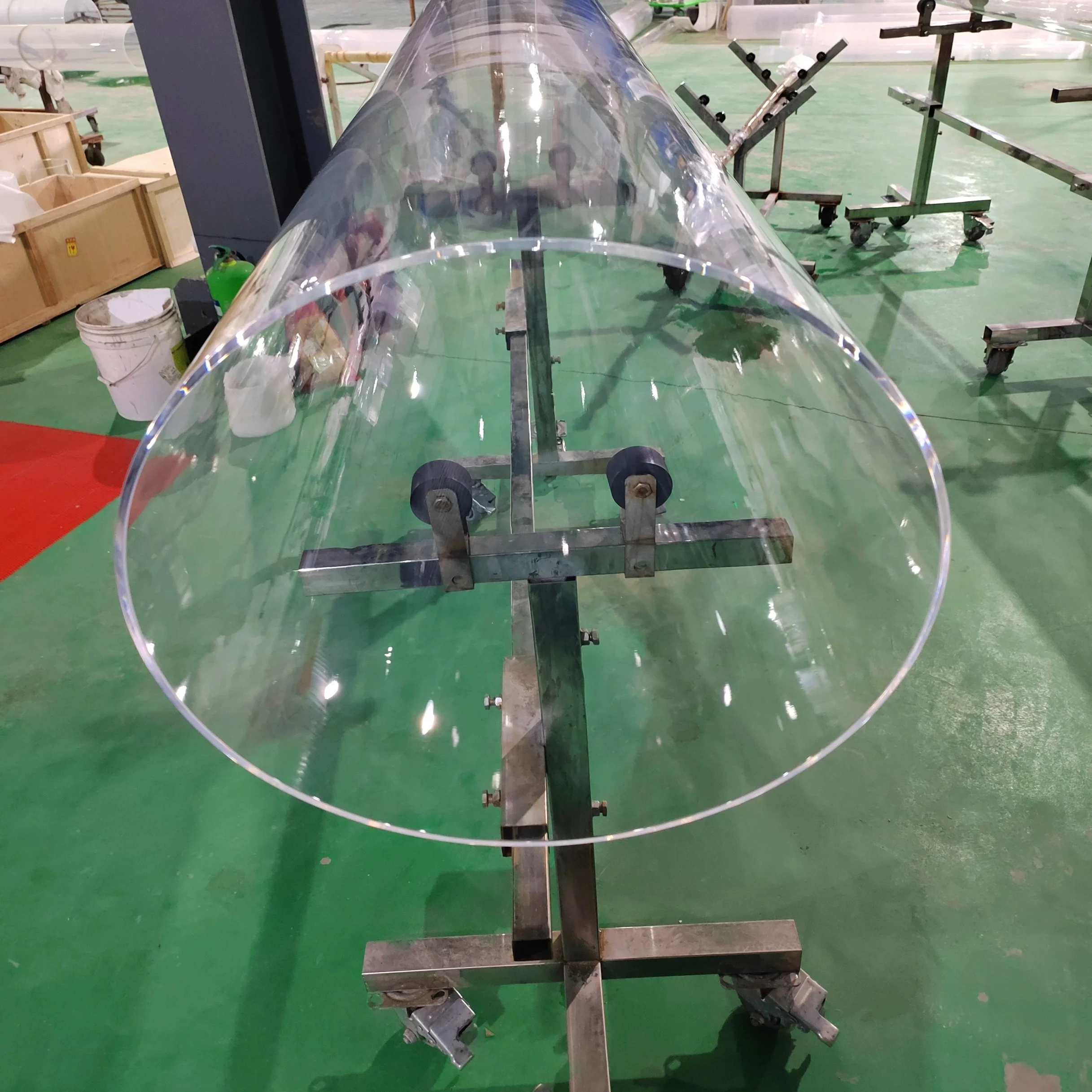
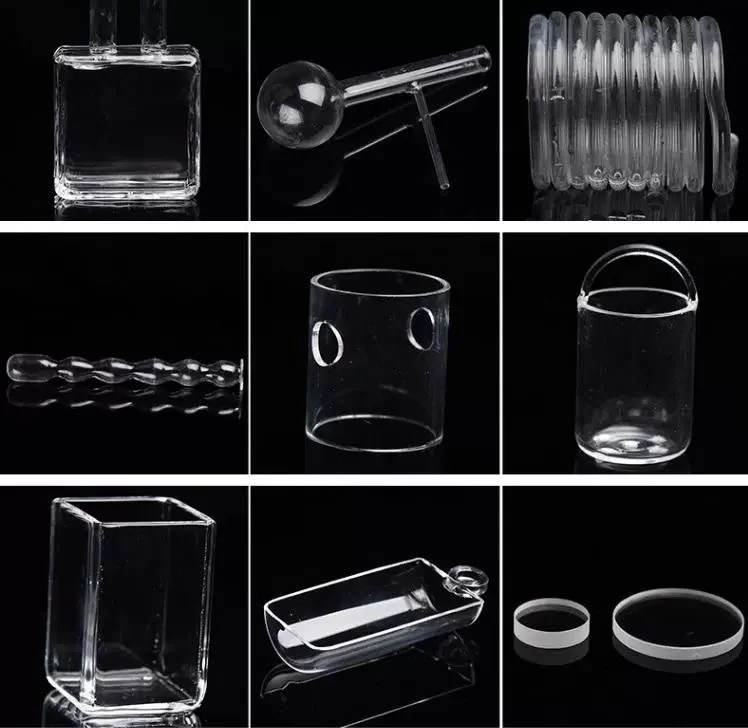
Handling: clean with an acid bath or alcohol wipe before high-temperature use. Alkali salts and fingerprints catalyze devitrification above roughly 1150°C. Support large-diameter or thin-wall tubes along their length.
Quartz glass tube applications
Applications
Why specify FGQuartz
Manufacturer
Procurement questions
FAQ
Yes, up to 1000 mm class outer diameter for large process equipment. See our dedicated large-diameter quartz tubes page for more detail.
Quartz tubes support continuous operation up to 1200°C and short-term exposure to 1300°C, with a softening point of approximately 1680°C.
Pricing depends on diameter, wall thickness, end features (flange, thread, ports), and tolerance requirements. A plain cut length is far less expensive than a flanged, threaded, or welded multi-port assembly.
Yes. FGQuartz flame-forms bends with controlled radius and wall integrity, and welds multi-part tube assemblies into leak-tight, complex geometries such as reactor vessels and multi-port manifolds.
A flanged tube has a fused or machined flange face designed for O-ring sealing against equipment, typically used in vacuum or UHV systems. A threaded tube has CNC-milled threads for metal-free mechanical fastening, often used in modular assemblies.
FGQuartz supplies quartz tubes from 5 mm to large-diameter process sizes up to 1000 mm class, with wall thickness from 0.5 mm to 20 mm+ and standard lengths up to 3000 mm, extendable via welded sections.
Quartz glass tubes carry gases, house wafers, contain reactions, or route heat through extreme-temperature process equipment in semiconductor, solar, fiber optic, and laboratory applications, without introducing contamination.