Home / Products / Quartz Glass Plate
Custom fused silica plates, discs, and windows · Up to 1200 × 1200 mm
Quartz Glass Plate
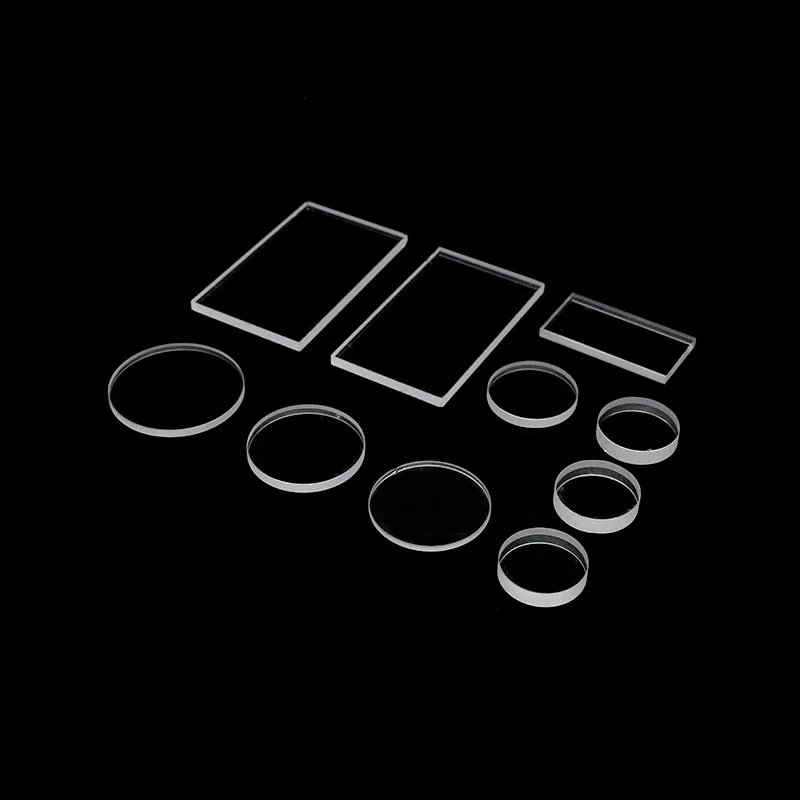
Quartz glass plates — also sold as quartz plates, fused quartz plates, quartz glass sheets, fused silica plates, discs, and fused quartz windows — are flat fused silica components used as process covers, viewports, optical windows, substrates, and high-temperature shields.
FGQuartz is a manufacturer and supplier of custom quartz plates: clear process-grade, UV-grade (JGS1), UV–visible (JGS2), IR-grade (JGS3), and opaque fused silica plates with SiO₂ ≥ 99.99%, in standard formats up to 1200 mm × 1200 mm. Plates are cut, ground, drilled, machined, and polished to the customer drawing, in round, square, rectangular, and custom outlines, with holes, slots, steps, and a specified edge and surface finish. Custom manufacturing is available from a single prototype, with no minimum order quantity. We export to the USA, Europe, and worldwide.
Quick answer
What is the difference between a quartz plate and a quartz window? Both are flat fused silica components. A plate prioritizes thermal and structural performance (covers, baffles, shields, fixtures). A window prioritizes light transmission and is typically polished on both sides.
Key takeaways
- JGS1 (synthetic) transmits about 185–2500 nm, JGS2 about 220–2500 nm, and JGS3 (low-OH, infrared) about 260–3500 nm.
- Optical-grade plates reach flatness down to λ/10 with parallelism under 30 arc seconds.
- Plates are made to your drawing, so there is no fixed size list; formats larger than 1200 mm × 1200 mm are evaluated case by case.
- Opaque fused silica plates block infrared and serve as furnace heat shields, baffles, and door assemblies.
Written by the FGQuartz Engineering Team · Updated October 2026
On this page: Specifications · Grade selection · Plate vs window · Plate types · Project examples · Applications · FAQ and quote
Lead time depends on size and drawing complexity; the quote confirms the schedule.
Features of high-purity fused quartz plates and windows
Product features
Quartz glass plate specifications
Technical specifications
Values below describe the standard build for fused silica plates. Critical dimensions, flatness, and surface quality are set from the drawing and confirmed in design-for-manufacture (DFM) review.
| Parameter | Specification |
|---|---|
| Material | High-purity fused silica / fused quartz (SiO₂ ≥ 99.99%). Optical grades JGS1 / JGS2 / JGS3 and opaque fused silica when specified. See JGS1 vs JGS2 vs JGS3. |
| Shape | Round discs, squares, rectangles, and custom outlines cut to drawing. |
| Size | Standard formats up to 1200 mm × 1200 mm. Larger monolithic formats are evaluated case by case during engineering review. |
| Thickness | Specified on the drawing, from thin windows to heavy structural plates. |
| Flatness and parallelism | Optical-grade plates: flatness down to λ/10 and parallelism under 30 arc seconds, verified by precision lapping metrology. Other classes set from the drawing. |
| Dimensional tolerance | Set from the drawing and confirmed in DFM review. Tighter tolerances via grinding or polishing. |
| Surface finish | As-cut, ground, or optically polished, including double-side polished (DSP) windows, to the surface class on the drawing. |
| Edge finish | Diamond-cut, chamfered, ground, or fire-polished edges. |
| Features | Core-drilled holes, CNC-milled grooves, slots, steps, pockets, notches, and countersinks, as used in vacuum flanges, gas showerheads, and wafer boat construction. |
| Working temperature | Continuous to 1200°C, short-term to 1300°C. |
| Processing | Diamond cutting, CNC machining, core drilling, edge grinding, polishing, oxy-hydrogen flame work, annealing. |
| Customization | Build-to-print from DXF, STEP, IGES, or PDF. Single prototypes through production. No MOQ. |
Full thermal, mechanical, optical, and chemical tables: Technical Specifications. Tolerances other than the optical-grade classes above are set per drawing.
Choosing the plate grade
Grade selection
The plate grade follows the job. Clear process-grade fused quartz suits covers, baffles, shelves, and shields where optical performance is not critical. JGS1, JGS2, and JGS3 are chosen by working wavelength when the plate is a window or optical path. Opaque fused silica is used when the plate is a thermal barrier or heat shield rather than a window.
Quartz glass, fused quartz, and fused silica all describe amorphous high-purity SiO₂. The distinction that matters is feedstock: natural quartz crystal for fused quartz, synthetic SiCl₄ for fused silica. Send the wavelength range, temperature, and surface requirement so the right grade and finish can be matched. For a fuller explanation, see What is quartz glass?
Typical properties of fused silica
Typical values for high-purity fused silica. Optical transmission and OH content vary by grade.
| Continuous service | 1200°C |
| Short-term maximum | 1300°C |
| Softening point | ≈ 1680°C |
| Annealing point | ≈ 1215°C |
| Strain point | ≈ 1120°C |
| Thermal expansion (20–300°C) | 5.5 × 10⁻⁷ /°C |
| Thermal conductivity (20°C) | ≈ 1.4 W/(m·K) |
| Density | ≈ 2.2 g/cm³ |
Quartz plate grades and plate vs window
Comparison
| Grade | Material | Transmission range | Typical use |
|---|---|---|---|
| Clear process grade | Fused quartz | Not specified for optical use | Covers, baffles, shelves, shields, fixtures. |
| JGS1 | Synthetic fused silica | ≈ 185–2500 nm | Deep-UV windows and optics. |
| JGS2 | High-purity natural quartz | ≈ 220–2500 nm | UV–visible windows. |
| JGS3 | Low-OH material | ≈ 260–3500 nm | Infrared windows. |
| Opaque fused silica | Milky, non-transparent | Blocks infrared | Thermal insulation, furnace heat shields, baffles, door assemblies. |
| Point | Quartz plate | Quartz window |
|---|---|---|
| Priority | Thermal and structural performance: covers, shields, baffles, shelves, fixtures. | Light transmission: viewports, UV and optical paths, sensor windows. |
| Finish | As-cut, ground, or polished as needed. | Typically double-side polished. |
Quartz plate types we fabricate: shapes, holes, and finishes
Customization
FGQuartz does not publish a fixed plate SKU list. Each plate is made to your outline, thickness, and finish, from a single prototype to production, with no minimum order quantity. Non-plate custom parts are on the custom quartz glass page.
| Plate type | Typical use | What is fabricated |
|---|---|---|
| Process plates | Furnace covers, baffles, shelves, and supports | Clear fused quartz plates, diamond-cut and edge-finished to drawing. Specify: outline or diameter, thickness, edge finish, and the service temperature. |
| Windows and viewports | Chamber viewports, sight glasses, and optical paths | JGS1 / JGS2 / JGS3 plates, ground or polished to the required surface class. Specify: the grade or working wavelength range, outline, thickness, surface class, and whether one or both sides are polished. |
| Discs and substrates | Round windows, wafers, and sample substrates | Round plates cut to diameter with chamfered or polished edges. Specify: diameter, thickness, edge treatment, and surface finish. |
| Drilled and slotted plates | Gas distribution, vacuum flanges, mounting, and fixtures | Core-drilled hole patterns, CNC-milled grooves, slots, steps, and pockets. Specify: hole diameters and positions, groove, slot, step, or pocket dimensions and positions, and countersink details. |
| Rings, frames, and slotted parts | Mounting rings, frames, and process fixtures | CNC-machined flat parts with mounting lugs, bolt circles, slots, and complex outlines. Specify: outer and inner diameters or the outline, lug and bolt-circle dimensions, slot widths and positions, and thickness. |
| Opaque plates | Heat shields and thermal barriers | Opaque fused silica plates cut and machined to drawing. Specify: outline, thickness, and any mounting holes or slots. |
| Welded plate assemblies | Trays, frames, and box structures | Plate-to-plate and plate-to-tube joints, annealed after welding. Specify: an assembly drawing showing every joint location and the overall dimensions. |
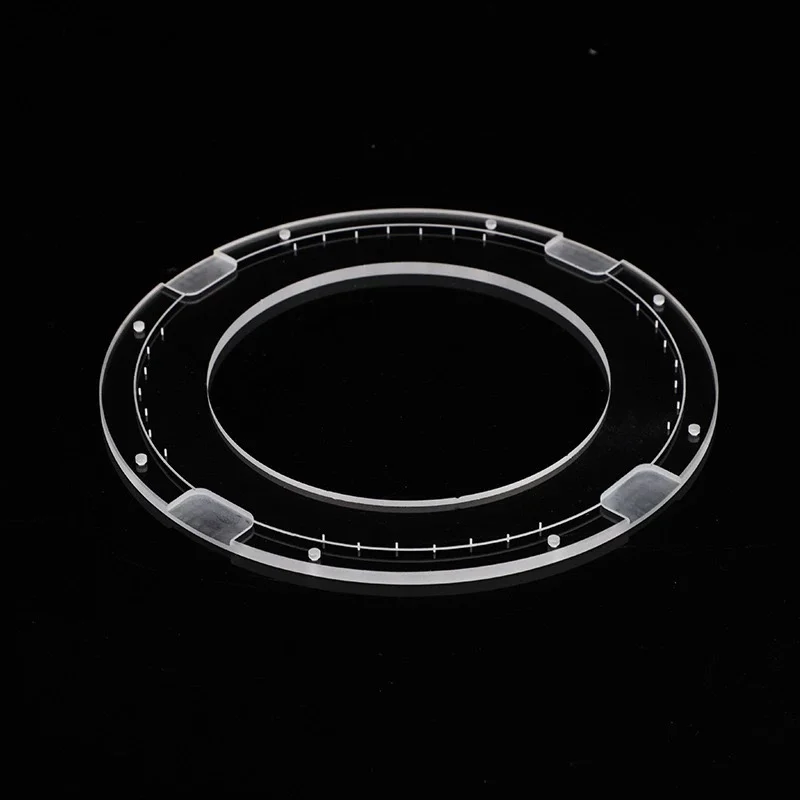
CNC-machined fused silica ring with mounting lugs and bolt circle, cut, drilled, and polished in the same facility as the flame work.
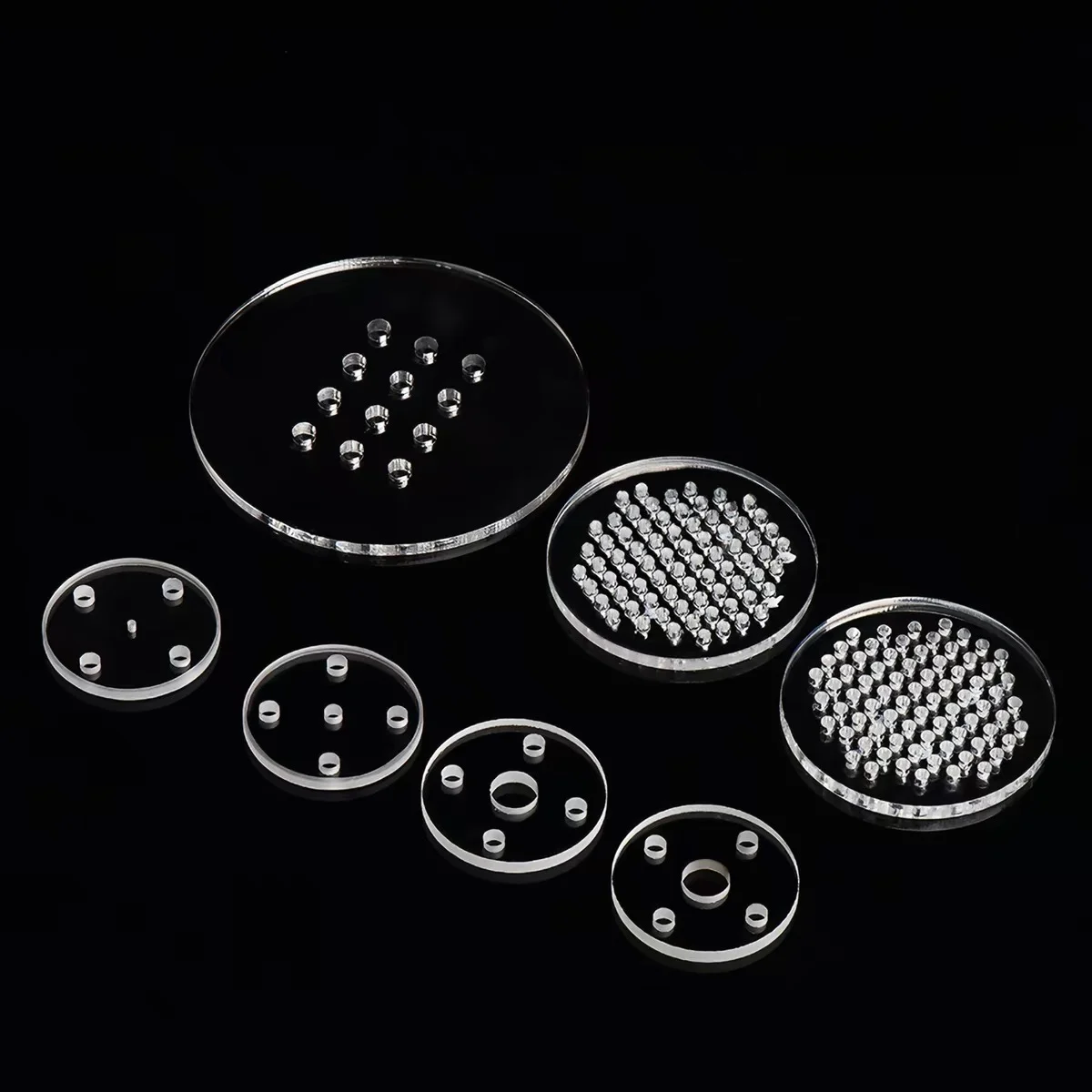
Precision-drilled fused silica discs and perforated plates for gas distribution, fixtures, and process hardware.
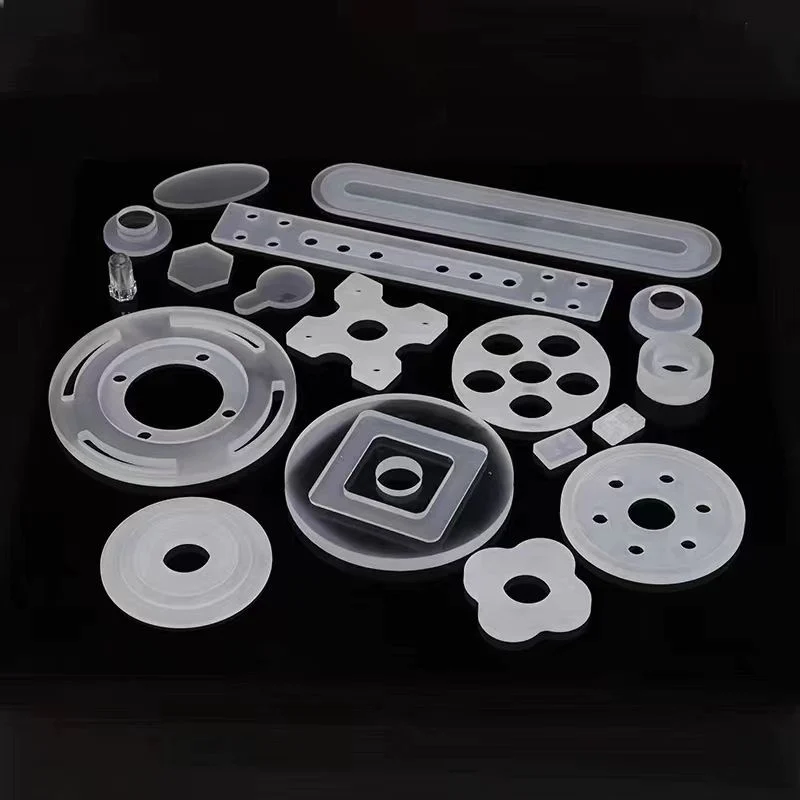
Custom CNC-machined fused silica flat parts: rings, frames, slotted bars, and complex outlines.
Representative plate builds
Project examples
Three typical custom plate projects, described by the requirement, the build route, and what is checked against the drawing. Customer names and confidential drawing data are withheld.
01 · Fixtures
Machined ring with mounting lugs
Requirement. A flat fused silica ring that bolts to process hardware.
How it is built. Plate blank diamond-cut, core-drilled for the bolt circle, CNC-milled for lugs, edges chamfered and polished.
Checked against the drawing. Outer and inner diameter, bolt-circle position, lug dimensions, and thickness.
02 · Gas distribution
Perforated disc
Requirement. A disc with a defined hole pattern to spread gas across a process zone.
How it is built. Disc cut to diameter, hole pattern core-drilled, edges and holes finished to the drawing.
Checked against the drawing. Hole positions and diameters, disc diameter, and thickness.
03 · Process hardware
Frame and slotted flat parts
Requirement. Flat fused silica frames and slotted bars with complex outlines.
How it is built. Blanks cut to outline, slots and steps CNC-milled, edges ground or fire-polished, annealed after hot work.
Checked against the drawing. Outline, slot width and position, and edge finish.
Cut, machined, and finished under one ISO 9001 system
Manufacturing and quality
FGQuartz operates a 15,000 m² facility in Lianyungang covering CNC diamond machining, grinding, polishing, oxy-hydrogen flame work, fire polishing, and annealing, so plate blanks are cut, machined, and finished in one plant. Learn more about FGQuartz.
Handling: clean with an acid bath or alcohol wipe before high-temperature use. Alkali salts and fingerprints catalyze devitrification above roughly 1150°C. Support large plates across their full face and avoid point loads on edges.
Quartz glass plate applications
Applications
Why specify FGQuartz
Manufacturer
Procurement questions
FAQ
Opaque (milky) fused silica plates block infrared radiation and provide thermal insulation, commonly used as furnace heat shields, baffles, and furnace door assemblies.
Pricing depends on optical grade, surface finish (as-cut vs. DSP), thickness, format size, and tolerance requirements.
Yes. FGQuartz performs diamond core drilling and multi-axis CNC milling for grooves, pockets, and tracking slots, commonly used in vacuum flanges, gas showerheads, and wafer boat construction.
Standard format sizes run up to 1200 mm × 1200 mm. Larger monolithic formats can be evaluated on a case-by-case basis during engineering review.
FGQuartz optical-grade plates achieve flatness down to λ/10 with parallelism under 30 arc seconds, verified through precision lapping metrology.
JGS1 is synthetic fused silica for deep-UV applications (185–2500 nm); JGS2 is high-purity natural quartz for UV-Vis transmission (220–2500 nm); JGS3 is low-OH material optimized for infrared transmission (260–3500 nm).
Both are flat fused silica components, but “plate” typically refers to a piece prioritizing thermal/structural performance, while “window” refers to an optical-grade piece prioritizing light transmission, typically double-sided polished.