Home / Applications / Laboratory
Laboratory and scientific applications
Laboratory Quartz Glass
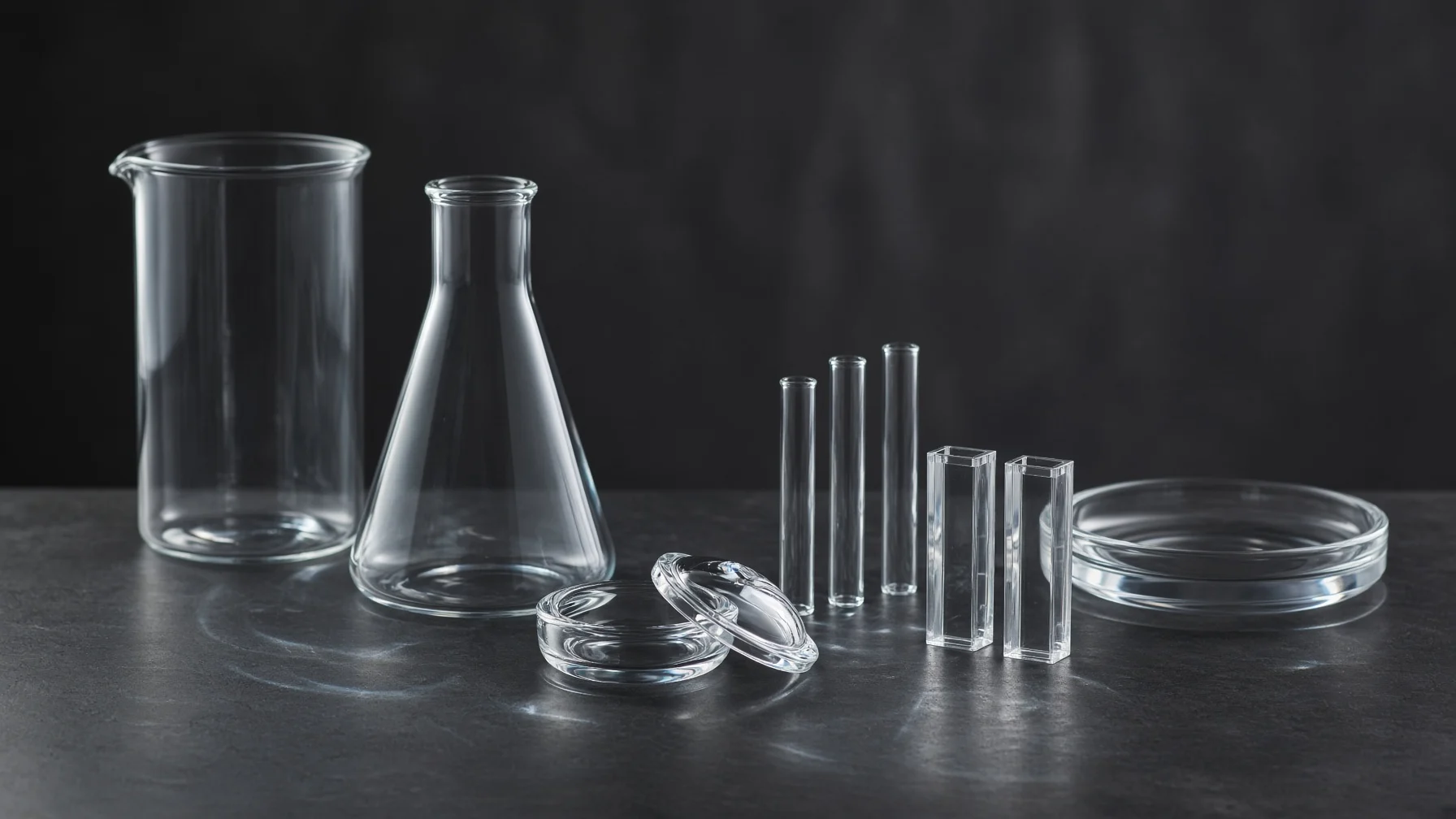
Laboratories use fused silica (quartz glass) wherever ordinary lab glass, porcelain, or plastic cannot take the temperature, the chemistry, or the blank requirement: ashing and calcination, trace-element sample preparation, hot-acid digestion, UV spectroscopy, and high-temperature synthesis. FGQuartz manufactures these quartz components from SiO₂ ≥ 99.99% fused silica.
If a standard item does not fit, FGQuartz builds fused silica parts to your drawing, a dimensioned sketch, or a sample, in any geometry that can be formed or machined from fused silica. Feasibility is confirmed in DFM review, prototypes start from one piece, and quotes are typically returned within 24 business hours.
Quick answer
Why do laboratories use quartz instead of borosilicate glass? Quartz tolerates continuous service to 1200°C against about 500°C for borosilicate, releases far less metal and alkali into trace-analysis samples, and transmits deep-UV light that borosilicate blocks. The limits are HF, hot concentrated phosphoric acid, and hot strong alkalis, which attack it.
Key takeaways
- Typical uses: ashing and calcination, ICP trace-element sample preparation, hot mineral-acid digestion, UV-Vis spectroscopy, high-temperature synthesis, and precious metal refining.
- For HF work use PTFE or another HF-compatible vessel; quartz is not suitable.
- Standard shapes and custom labware come from the same plant, so matched sets and one-off apparatus can be ordered together.
- Any fused silica part that can be formed or machined can be quoted from a drawing, sketch, or sample, from one piece.
Written by the FGQuartz Engineering Team · Updated October 2026
On this page: Why quartz · Lab workflows · Material choice · Find components · Custom labware · Care · Scenarios · FAQ · Quote
Lead time depends on size and drawing complexity; the quote confirms the schedule.
When does a lab need quartz instead of ordinary lab glass?
Why quartz
Five problems send laboratories to fused silica. Property data is on the technical specifications page and the comparison is in quartz vs borosilicate glass.
| Problem | Why ordinary materials struggle | How fused silica helps |
|---|---|---|
| Heat above borosilicate limits | Borosilicate is limited to roughly 500°C continuous use. | Fused silica runs continuously to 1200°C and short-term to 1300°C. |
| Sample contamination (blank) | Borosilicate and porcelain can release alkali, boron, and metals into trace samples. | High-purity fused silica (SiO₂ ≥ 99.99%, total metals below 20 ppm) keeps the blank low. |
| Thermal shock | Ordinary glass cracks on rapid heating or cooling. | Thermal expansion of 5.5 × 10⁻⁷ /°C lets quartz take rapid temperature change when handled correctly. |
| UV measurement | Borosilicate cuts off the deep UV. | Quartz transmits from 185 nm into the infrared, depending on grade, with over 90% at 254 nm (10 mm). |
| Hot mineral acids | Some materials corrode or leach in hot HCl, HNO₃, H₂SO₄, or aqua regia. | Fused silica is excellent against these acids and organic solvents. |
Quartz is not the answer to everything. It is attacked by HF, hot concentrated phosphoric acid, and hot strong alkalis, and it is brittle.
How do laboratories use quartz in practice?
Lab workflows
The five workflows below cover most laboratory quartz demand. Each shows where quartz sits in the process, why, and what to watch for.
Ashing, ignition, and calcination
Workflow
- Weigh the sample into a crucible
- Heat in a muffle or tube furnace
- Cool in a controlled way
- Weigh the residue or collect the calcined powder
| Point | Detail |
|---|---|
| Where quartz is used | Crucibles, lids, evaporating dishes, and combustion and sample boats. |
| Why quartz | High temperature with a low contamination contribution; clear crucibles let you see the sample, opaque ones insulate and heat evenly. |
| Watch-outs | Heat and cool at a controlled rate and lift with tongs that do not chip the rim. Clean before heating, because alkali salts and fingerprints promote devitrification above roughly 1150°C. Molten alkali fluxes such as NaOH and Na₂CO₃ attack quartz. |
Trace-element sample preparation and ICP analysis
Workflow
- Prepare and digest the sample in acid
- Dilute to volume
- Run the analysis, such as ICP
- Check the blank against the method limit
| Point | Detail |
|---|---|
| Where quartz is used | Digestion vessels, beakers, and flasks made to drawing in clear fused silica. |
| Why quartz | Low metal and alkali release, a clean inert surface, and tolerance of hot mineral acids keep the analytical blank down. |
| Watch-outs | Do not use quartz where HF is present. Clean vessels with acid before use and verify the blank for your own method. |
Acid digestion and chemical processing
Workflow
- Add sample and acid to the vessel
- Heat to digest
- Cool and transfer
| Point | Detail |
|---|---|
| Where quartz is used | Beakers, flasks, reaction vessels, and tubes. |
| Why quartz | Excellent resistance to HCl, HNO₃, H₂SO₄, aqua regia, and organic solvents. |
| Watch-outs | Not for hot concentrated phosphoric acid or hot strong alkalis. For silicate digestions that need HF, use PTFE or another HF-compatible vessel. |
UV-Vis spectroscopy and optical measurement
Workflow
- Choose the grade from the working wavelength
- Prepare the cell or window
- Measure
- Clean the optical surfaces
| Point | Detail |
|---|---|
| Where quartz is used | Cuvettes, flow cells, and windows. |
| Why quartz | Transmission from the deep UV into the infrared. JGS1 covers about 185–2500 nm, JGS2 about 220–2500 nm, and JGS3 about 260–3500 nm. |
| Watch-outs | Grade choice follows wavelength; path length and surface quality are set on the drawing. See the JGS1 / JGS2 / JGS3 guide. |
High-temperature synthesis and tube-furnace work
Workflow
- Load the sample into a boat or tube
- Heat under the chosen atmosphere
- Cool and unload
| Point | Detail |
|---|---|
| Where quartz is used | Reaction and combustion tubes, closed-end tubes sealed by flame working, and boats. |
| Why quartz | Continuous service to 1200°C, short-term to 1300°C, and a clear tube for observation. |
| Watch-outs | Stay below the temperature limits, confirm the atmosphere and chemistry with engineering, and support long tubes along their length. |
Other laboratory uses
Precious metal refining and other high-temperature, chemically demanding work also use fused silica crucibles and dishes. If your process is not listed here, describe it and the engineering team will advise whether quartz suits it.
Which material for which laboratory task?
Material choice
A qualitative guide. Check the exact chemistry, concentration, and temperature before choosing.
| Task | Quartz | Borosilicate | PTFE / PFA | Notes |
|---|---|---|---|---|
| Ashing and ignition to high temperature | Yes | No: exceeds the limit | No: temperature limited | Porcelain or alumina can be used but carry other trade-offs |
| Hot mineral acid digestion (not HF) | Yes | Possible at low temperature, can leach | Yes, within its temperature limit | — |
| Digestion that needs HF | No | No | Yes | — |
| UV measurement below about 300 nm | Yes | No | — | — |
| Molten alkali fusion | No | No | No | Use a crucible material suited to alkali fusion |
Find the right quartz component by laboratory task
Find components
This table points to the product pages that hold the specifications and sizes.
| Laboratory task | Where to look | What is available |
|---|---|---|
| Ashing, calcination, melts | Quartz crucibles | Crucibles, dishes, lids, and cylindrical forms |
| Sample and combustion work | Quartz boats | Open trough boats in custom lengths |
| Reaction and combustion tubes | Quartz glass tubes | Tubes, closed ends, ports, and bends |
| UV and optical access | Quartz plates and windows | Windows, discs, and substrates in JGS grades |
| Stirring and handling | Quartz glass rods | Rods with ball, paddle, or hooked ends |
| Small baths and soak vessels | Quartz tanks | Custom baths and soak tanks |
| Anything else | Custom quartz glass | Beakers, flasks, cuvettes, flow cells, and apparatus to drawing |
Can FGQuartz make my laboratory part if it is not on the list?
Custom labware
FGQuartz manufactures fused silica components to drawing in any geometry that can be formed or machined from fused silica, and confirms feasibility in DFM review. There are three paths:
- Use a standard item from the product pages.
- Modify a standard item: a different size, a lid, a spout, a port, a flange, or a ground joint.
- Build to your drawing, sketch, or sample: DXF, STEP, IGES, PDF, a dimensioned sketch, or a photo of an existing vessel with key dimensions.
Commonly requested
- Matched sets of crucibles, beakers, and lids made to one specification
- Non-standard capacities and multi-neck reaction vessels
- Closed-end and sealed tubes made by flame working
- Flow cells and cuvettes with a specified path length
- Ground joints, for example 14/20, 19/22, 24/40, and 29/42
- Replacements for discontinued or damaged apparatus, reproduced from a sample
Prototypes start from one piece. Simpler custom parts typically take 7–14 days and complex assemblies 3–6 weeks. See custom quartz glass fabrication, thermal processing, and cold processing.
How should quartz laboratory glassware be cleaned and handled?
Care
| Topic | Guidance |
|---|---|
| Clean before heating | Use an acid bath or an alcohol wipe. Alkali salts and fingerprints promote devitrification above roughly 1150°C. |
| Heating and cooling | Quartz tolerates rapid temperature change, but heat and cool at a controlled rate where you can, lift hot parts with tongs, and set them on a heat-resistant surface rather than wet or cold metal. |
| Handling | Avoid impact and point loads, especially on rims and thin walls. |
| Check compatibility first | HF and hot concentrated phosphoric acid are not suitable, and strong hot alkalis need caution. |
Illustrative laboratory scenarios
Scenarios
These are typical requests, not customer case studies.
| Situation | What FGQuartz builds | What to send |
|---|---|---|
| A QC lab wants low-blank crucibles for ashing | A matched set of clear quartz crucibles with lids | Sample crucible or dimensions, peak temperature, quantity |
| A research group needs a reaction vessel with two ports | A custom flame-worked vessel with side ports | Sketch with key dimensions, the chemistry, and the temperature |
| A lab needs a replacement for a discontinued part | A part reproduced from a sample | The sample or photos, with key dimensions and the intended use |
| A UV method needs a flow cell | A cell in a JGS grade with a specified path length | Wavelength range, path length, and connection type |
Frequently asked questions
FAQ
More answers are in the full quartz glass FAQ.
Yes. We can manufacture matched sets of labware (crucibles, beakers, lids) to a consistent specification for a research or analytical workflow.
High-temperature ashing, calcination, trace-element analysis (ICP), acid digestion, and precious metal refining, where low contamination and chemical inertness matter.
Yes, this is one of quartz’s key advantages — its near-zero thermal expansion allows rapid temperature changes that would crack ordinary glass.
Yes. Submit a drawing, dimensioned sketch, or even a photo of an existing vessel, and our engineering team will evaluate manufacturability.
Quartz tolerates continuous service to 1200°C versus borosilicate’s ~500°C limit, has far lower metal/alkali leaching for trace analysis, and transmits deep-UV light that borosilicate blocks.
No. Hydrofluoric acid etches the SiO2 network irreversibly — quartz should never be used to hold or process HF. PTFE vessels are the standard alternative for HF work.