Home / Applications / High Temperature
Fused silica for continuous high-temperature service
High Temperature Quartz
High-temperature quartz is fused silica used where ordinary glass softens or cracks: furnace and tube-furnace tubes, liners, heating-element supports and insulators, observation windows, thermocouple protection tubes, and structural parts. Fused silica (SiO₂ ≥ 99.99%) runs continuously to 1200°C, tolerates short-term peaks to 1300°C, softens near 1680°C, and has near-zero thermal expansion, in clear or opaque grade.
FGQuartz builds fused silica components to drawing in any geometry that can be formed or machined from fused silica, and confirms feasibility in DFM review. Prototypes start from one piece, and quotes are typically returned within 24 business hours.
Quick answer
How hot can quartz glass go in a furnace? Fused silica supports continuous service to 1200°C and short-term peaks to about 1300°C, and its softening point is near 1680°C. Its very low thermal expansion lets properly designed parts survive fast ramps, door openings, and local hot spots that crack ordinary glass.
Key takeaways
- Clear fused silica transmits infrared and allows optical access; opaque fused silica scatters radiation, insulates, and lowers emissivity. Many assemblies use both.
- Quartz works well in air, inert gas, vacuum, and many mildly reducing atmospheres. Strongly reducing atmospheres, alkali vapors, and some fluorine chemistries can attack it and should be flagged early.
- Cleanliness matters: alkali salts and fingerprints promote devitrification above roughly 1150°C.
- Quartz is not suitable for hot concentrated phosphoric acid, HF, or hot strong alkalis, and not for continuous service above about 1200°C.
Written by the FGQuartz Engineering Team · Updated October 2026
On this page: Why quartz · Furnace uses · Clear or opaque · What to specify · Find components · Limits · Custom parts · Scenarios · FAQ · Quote
Lead time depends on size and drawing complexity; the quote confirms the schedule.
Why do furnaces use fused silica?
Why quartz
Property data is on the technical specifications page.
| Problem | Why ordinary materials struggle | How fused silica helps |
|---|---|---|
| Heat above ordinary glass limits | Borosilicate is limited to roughly 500°C continuous use. | Fused silica runs continuously to 1200°C, with short-term peaks to about 1300°C. |
| Thermal shock | Ordinary glasses and many ceramics crack on rapid ramps or quenches. | Thermal expansion of 5.5 × 10⁻⁷ /°C tolerates cycling, door openings, and hot spots in properly designed parts. |
| Contamination of the process zone | Metal parts oxidize and release metal; lower-purity ceramics can contaminate. | SiO₂ ≥ 99.99% keeps the hot zone clean. |
| Electrical isolation | Metal supports can short or oxidize near heating elements. | Fused silica insulates, so it works as element supports and sleeves. |
| Optical or radiative access | Opaque ceramics block pyrometry and visual checks. | Clear fused silica transmits infrared and visible light through the hot zone. |
Where is high-temperature quartz used?
Furnace uses
The four uses below cover most high-temperature quartz demand.
Furnace and tube-furnace systems
Workflow
- Load the work into the hot zone
- Heat under the chosen atmosphere
- Cool and unload
| Point | Detail |
|---|---|
| Where quartz is used | Process and furnace tubes, clear or opaque liners, and supporting rods and plates. |
| Why quartz | Continuous service to 1200°C with thermal shock resistance and dimensional stability. |
| Watch-outs | Stay within the temperature limits, confirm the atmosphere, support long tubes along their length, and plan annealing for flame-worked parts. |
Infrared heating and curing
Workflow
- Select the heater envelope
- Install and power the element
- Heat or cure the work
| Point | Detail |
|---|---|
| Where quartz is used | Heater envelopes and protection tubes made of clear fused silica. |
| Why quartz | Transmits infrared, insulates electrically, and resists thermal shock. |
| Watch-outs | Clear grade where radiation must pass; keep the surface clean to avoid devitrification. |
Thermocouple and sensor protection
Workflow
- Choose the tube length and end
- Seal or close the end
- Insert the sensor
| Point | Detail |
|---|---|
| Where quartz is used | Closed-end and open-end tubes, with flame-sealed ends. |
| Why quartz | Chemical inertness, fast thermal response, and electrical insulation. |
| Watch-outs | Confirm the atmosphere and maximum temperature; avoid alkali contamination. |
Custom high-temperature assemblies
Workflow
- Define the thermal role
- Specify the geometry
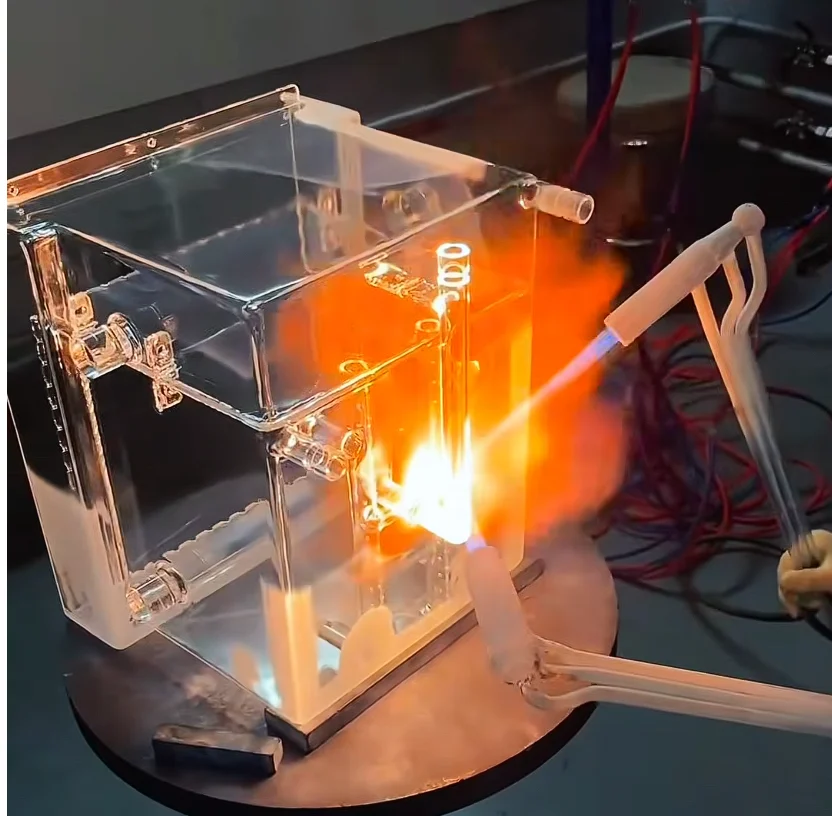
- Form, weld, machine, and anneal
| Point | Detail |
|---|---|
| Where quartz is used | Bent tubes, multi-port vessels, flanged tubes, baffles, and structural frames. |
| Why quartz | Geometry can be flame-formed and machined from one material, then annealed for stress relief. |
| Watch-outs | Send the maximum and peak temperature, atmosphere, and a drawing or sketch. |
Clear or opaque: transmit or insulate?
Clear or opaque
Choosing the wrong grade produces the opposite of the intended behavior: a clear tube where an opaque liner is needed lets heat escape, and an opaque window blocks monitoring.
| Grade | Use it for | Typical parts |
|---|---|---|
| Clear fused silica | Infrared transmission and optical access | Infrared heater tubes, observation windows, pyrometry access, and zones that must radiate or be inspected |
| Opaque fused silica | Insulation and heat retention | Furnace liners, thermal baffles, spacers, and furniture where heat retention matters |
What should I specify on the RFQ?
What to specify
Service life depends on more than temperature: atmosphere, ramp rate, mechanical load, contact materials, and cleaning all matter. Mechanical design should avoid point loads and sharp stress concentrators, and annealing after flame work reduces fabrication stress.
| Input | Why it matters |
|---|---|
| Maximum continuous temperature | Sets the grade and the wall. |
| Peak temperature, if different | Confirms short-term limits. |
| Atmosphere composition | Flags strongly reducing, alkali, or fluorine conditions early. |
| Dimensions or a drawing | Starts the engineering recommendation. |
| Clear or opaque preference | Sets optical access or insulation. |
| Sealing or optical requirements | Sets ends, flanges, and finish. |
With these inputs a first engineering recommendation and a firm quotation are usually possible.
Find the right quartz component by furnace role
Find components
This table points to the product pages that hold the specifications and sizes.
| Furnace role | Where to look | What is available |
|---|---|---|
| Process and furnace chambers | Quartz glass tubes | Plain, flanged, ported, and bent tubes |
| Element supports and insulators | Quartz glass rods | Rods, rails, and machined supports |
| Shelves, shields, and windows | Quartz glass plates | Plates, baffles, and observation windows |
| Boats and sample carriers | Quartz wafer boats | Boats and trays |
| Crucibles and dishes | Quartz crucibles | Heating vessels |
| Anything else | Custom quartz glass | Assemblies, liners, and parts to drawing |
When quartz is not the right choice
Limits
Quartz is chosen for purity, thermal stability, and chemical inertness. It is not suited to every environment.
| If your process involves… | Quartz suitability | Consider |
|---|---|---|
| HF (hydrofluoric acid) | Not suitable. HF attacks fused silica. | An HF-compatible material, such as a fluoropolymer |
| Hot concentrated phosphoric acid | Not suitable. | A compatible material for the bath |
| Hot strong alkalis (for example hot KOH or NaOH) | Not suitable; quartz is attacked. | A compatible material for the bath |
| Continuous service above about 1200°C | Beyond the continuous working limit of fused silica. | A higher-temperature ceramic |
Strongly reducing atmospheres, alkali vapors, and some fluorine-containing chemistries can attack the surface. Flag them early.
Can FGQuartz make my high-temperature part if it is not on the list?
Custom parts
FGQuartz builds fused silica components to drawing in any geometry that can be formed or machined from fused silica, and confirms feasibility in DFM review. There are three paths:
- Use a standard item from the product pages.
- Modify a standard item: a different size, a port, a flange, a lid, or a changed slot or hole pattern.
- Build to your drawing, sketch, or sample: DXF, STEP, IGES, PDF, a dimensioned sketch, or a worn sample with key dimensions.
Commonly requested
- Flanged, ported, or bent furnace tubes for a specific platform
- Opaque liners, baffles, and spacers cut and formed to drawing
- Closed-end thermocouple protection tubes in custom lengths
- Replacement parts for discontinued furnaces, reproduced from a sample
Prototypes start from one piece. Simpler custom parts typically take 7–14 days and complex assemblies 3–6 weeks. See custom quartz glass fabrication, thermal processing, and cold processing.
Illustrative scenarios
Scenarios
These are typical requests, not customer case studies.
| Situation | What FGQuartz builds | What to send |
|---|---|---|
| A furnace needs a flanged tube for its interface | A flanged tube with the specified sealing face | Flange drawing, temperature, and atmosphere |
| A heater assembly needs electrical isolation | Fused silica supports and sleeves | Element layout, temperatures, and drawing or sketch |
| A process needs a closed-end sensor tube | A flame-sealed protection tube in the required length | Length, diameter, maximum temperature, and atmosphere |
| A zone needs both infrared access and insulation | A clear window and an opaque liner as a matched set | Temperatures, atmosphere, and optical requirements |
Frequently asked questions
FAQ
More answers are in the full quartz glass FAQ.
Yes. A worn sample, photographs, or key dimensions are typically sufficient to reverse-engineer a replacement component.
Clean components with an acid bath or alcohol wipe before high-temperature service to remove alkali salts and contaminants that accelerate surface crystallization above ~1150°C.
Yes. FGQuartz flame-forms bends and welds side ports, flanges, and multi-port configurations to your drawing.
Standard fused quartz supports continuous service up to 1200°C, with short-term exposure to 1300°C.
Clear quartz is used when optical access (visual monitoring, pyrometry) is required. Opaque quartz blocks infrared radiation and provides better thermal insulation where transparency isn’t needed.
Furnace and tube-furnace process tubes (clear and opaque), IR heater envelopes, thermocouple protection sheaths, and custom high-temperature assemblies such as bent tubes and multi-port vessels.