Optical Quartz Glass2026-05-14T08:15:32+00:00

Optical · Photonics · UV & Laser Systems

Quartz Glass Engineered for Light Itself

FGQuartz has specialized in manufacturing precision optical quartz glass components since 2005, serving laser systems, spectroscopy instruments, UV lithography, and advanced scientific research. Our high-purity fused silica optics deliver reliable transmission across the full photonic spectrum — from deep ultraviolet (150 nm) to near-infrared beyond 3 µm — available in JGS1 and JGS2 grades.

FUSED SILICA TRANSMISSION WINDOW ~150 nm
20 YRS
OPTICAL QUARTZ
150 nm 350 nm 550 nm 750 nm 1.5 μm 3.5 μm
ArF · 193 nm
Excimer lithography, laser annealing
JGS1
KrF · 248 nm
UV lithography, laser marking
JGS1
355 nm
UV laser processing, harmonic generation
JGS1 / JGS2
532 nm
Green laser optics, DPSS systems
JGS2
1064 nm
Nd:YAG lasers, fiber laser transmission
JGS2
1550 nm
Telecom wavelength, LIDAR and sensing
JGS2

Est. 2005
Lianyungang, Jiangsu, China

Global Export
Americas · Europe · Asia-Pacific

Precision Polishing
Optical surfaces to drawing spec

JGS1 & JGS2
Full grade range available

Custom CNC
Prototype to production

Product Range

Optical Quartz Glass Components

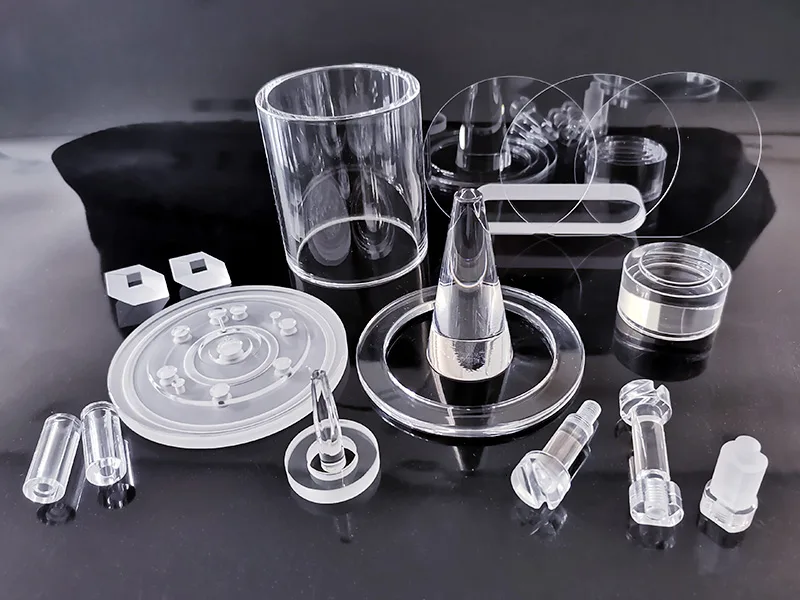
FGQuartz manufactures a broad range of optical fused silica components for UV, visible, and infrared systems. Standard catalogue items ship from stock; custom geometries are produced to customer drawings from the same facility in Lianyungang.

UV & Optical Windows

Plane-parallel windows in fused silica for viewports, beam entry and exit windows, pressure barriers, and environmental protection for optical systems. The defining characteristic of a good optical window is minimum wavefront distortion — a function of glass homogeneity, surface flatness, and parallelism between the two faces. FGQuartz windows are ground and polished to customer-specified surface quality and figure requirements, with both standard circular and rectangular geometries plus custom shapes available. AR coatings for UV, visible, and NIR bands can be applied on request through partner coating houses.

Circular & rectangularViewport gradePressure-ratedAR coating ready

Lenses: Plano-convex, Plano-concave & Cylindrical

Fused silica lenses are specified wherever UV transmission, laser damage resistance, or environmental durability rules out conventional optical glass. Plano-convex lenses focus or collimate beams; plano-concave lenses diverge beams. Cylindrical lenses focus light to a line — essential for laser scanning, barcode reading, and laser sheet illumination. FGQuartz produces all three types in JGS1 and JGS2 grades, with diameters from a few millimetres to several hundred millimetres. Custom radii and aspherical surfaces are available on request.

Plano-convexPlano-concaveCylindricalJGS1 & JGS2

Prisms

Optical prisms redirect, invert, or disperse light through total internal reflection or refraction. Common types in fused silica include right-angle prisms for beam deflection and retro-reflection, equilateral prisms for dispersion and wavelength separation, Dove prisms for image rotation, and Porro prisms for optical path folding. Because fused silica has low chromatic dispersion across the visible and near-UV, it produces less chromatic aberration than flint glass alternatives when used as a dispersing element. FGQuartz machines and polishes prisms with the number of optically active faces required by the application.

Right-angleEquilateralDovePorroCustom geometry

Mirror Blanks & Substrate Discs

Telescope mirrors, laser cavity mirrors, and interferometer reference flats all begin as optically polished glass blanks before the reflective coating is applied. Fused silica is favoured as a mirror substrate for precision applications because its near-zero thermal expansion means the mirror surface figure changes negligibly as ambient temperature fluctuates — critical for astronomical telescopes, ring-laser gyroscopes, and high-stability optical systems. FGQuartz supplies polished mirror blanks and substrate discs in circular and rectangular formats, with both solid and lightweight core-drilled options for large astronomical applications.

Telescope mirrorsLaser cavityInterferometer flatsLightweight designs

Optical Flats & Etalons

An optical flat is a window polished to exceptionally tight flatness, used as a reference surface in interferometric metrology, as the reference mirror in Fabry-Pérot cavities, and as the output window in etalon filters. Etalons are parallel-plate Fabry-Pérot cavities used for laser linewidth narrowing, wavelength selection, and spectral filtering. The cavity spacing must be stable against temperature changes — which makes the low thermal expansion of fused silica a fundamental advantage over other glass types. FGQuartz produces optical flats and etalon substrates with the parallelism and surface figure required by the application.

Fabry-Pérot etalonsReference flatsLaser linewidthSpectral filtering

Cuvettes, Flow Cells & Spectroscopy Vessels

Analytical spectroscopy instruments measure the absorption, emission, or scattering of light by samples in precisely dimensioned transparent cells. The optical path length directly determines analytical sensitivity, so dimensional precision of the light-path walls is analytically critical. Fused silica cuvettes transmit far further into the UV than quartz-blend or borosilicate glass cells, enabling spectroscopy at analytical wavelengths used for proteins, nucleic acids, and aromatic compounds. FGQuartz produces standard 10 mm path-length cuvettes plus custom flow cells, high-pressure cells, and micro-volume cells for specialised applications.

UV cuvettesFlow cellsHigh-pressure cellsCustom path length

UV Lamp Envelopes & Discharge Tubes

UV germicidal lamps, excimer lamps, and deuterium arc lamps rely on fused silica envelopes that transmit the short-wavelength UV generated inside the discharge without absorbing it. Standard silica glass and borosilicate glass are opaque below approximately 280 nm, making them unsuitable for germicidal 254 nm UV-C lamps. Only fused silica or very high-purity natural quartz glass transmits these critical wavelengths. FGQuartz manufactures lamp envelope tubes, dome-end discharge vessels, and custom envelope geometries for UV lamp and plasma discharge applications.

UV-C envelopesGermicidal lampsExcimer lampsDeuterium arc

Optical Rods, Light Guides & Diffusers

Solid quartz rods act as efficient light guides through total internal reflection, coupling light from a source to a remote location or homogenising the spatial profile of a beam. Ground and polished rod diffusers convert the concentrated output of a laser diode or fibre optic into a uniform line or area illumination. For UV applications — stage lighting, curing systems, and photolithographic alignment — fused silica rods transmit wavelengths that plastic or standard glass waveguides absorb. FGQuartz produces polished rods from 1 mm diameter upward and custom light guide geometries to drawing.

Solid light guidesLine diffusersBeam homogenisersUV compatible

Custom CNC-Machined Optical Components

Not every optical application fits a standard catalogue shape. Instrument designers frequently need optical components with mounting holes, flanges, slots, or non-standard profiles that cannot be produced by polishing alone. FGQuartz combines precision CNC grinding and milling with optical polishing to produce complex optical assemblies from a single piece of fused silica, eliminating adhesive joints that would introduce scatter or stress birefringence. Customers supply drawings in DXF, STEP, or IGES format; prototype quantities down to a single piece are accepted with no minimum order constraint.

DXF / STEP / IGSReverse engineeringCNC + polishingPrototype welcome

Application Fields

Optical Quartz Glass Across Photonics & Science

Select an application field to understand which quartz components are used, why fused silica is the material of choice, and what FGQuartz supplies into that market.

Nd:YAG · Excimer · CO₂ · Fiber Laser

Laser Systems & High-Power Optics

Laser optics face demands that eliminate most optical materials from consideration: high instantaneous power density, repetitive pulsed thermal load, possible UV exposure, and the need for virtually zero absorption. Even a small fraction of a high-power beam absorbed by a window or lens heats the optic, distorts its shape, and shifts focus. Fused silica survives where other optical materials fail because its broad transparent window from deep-UV to near-infrared means there is no nearby absorption edge, and its low thermal expansion minimises thermally induced wavefront distortion.

For Nd:YAG laser systems, fused silica windows, lenses, and beam expanders serve at the fundamental 1064 nm wavelength and the harmonics at 532 nm, 355 nm, and 266 nm. For excimer lasers at 248 nm (KrF) and 193 nm (ArF), synthetic high-OH fused silica is the standard optical material. For CO₂ lasers at 10.6 µm, fused silica is not suitable — ZnSe or similar mid-infrared materials are used instead.

FGQuartz produces laser-grade optical windows, beam expander lenses, focusing optics, and turning mirrors in fused silica for Q-switched, pulsed, and CW laser systems across the UV, visible, and NIR. AR and HR coatings can be applied through partner coating facilities.

Key components for laser systems

  • Laser windows
  • Focusing lenses
  • Beam expander elements
  • Turning prisms
  • Etalons
  • Output couplers

DUV · EUV · Photomask · Wafer Steppers

UV & Deep-UV Lithography

Photolithography defines the circuit patterns on semiconductor wafers, and the resolution of those patterns is fundamentally limited by the wavelength of light used. The semiconductor industry has progressively moved to shorter wavelengths — from visible mercury G-line (436 nm) and I-line (365 nm) in older processes, to KrF excimer (248 nm) for 90 nm nodes, and ArF excimer (193 nm) for sub-32 nm features in modern fabs.

For all lithography below approximately 360 nm, fused silica is the dominant lens material. The transition to ArF placed even tighter demands on quartz homogeneity, birefringence, and radiation hardness — because the deep-UV photons have enough energy to gradually modify the glass network through compaction or rarefaction over millions of pulses.

FGQuartz supplies optical blanks, flat windows, photomask substrates, and illumination system components for lithography equipment manufacturers and research institutions developing next-generation patterning tools.

Key components for lithography

  • Photomask substrates
  • Stepper windows
  • Illumination lenses
  • Beam homogeniser rods
  • Reticle blanks

UV-Vis · FTIR · Raman · Fluorescence · ICP-OES

Spectroscopy & Analytical Instruments

Analytical spectroscopy encompasses dozens of techniques — UV-Vis absorption, fluorescence, Raman scattering, infrared absorption, atomic emission, and more — but they share a common requirement: optical components and sample cells must not absorb, scatter, or fluoresce at the analytical wavelengths. Fused silica is the universal choice for UV spectroscopy because it is transparent across the entire UV-Vis working range of conventional spectrometers, and its intrinsic fluorescence background is negligible.

In ICP-OES and ICP-MS instruments, the plasma torch is a quartz glass assembly — the outer, intermediate, and inner injector tubes through which the argon plasma gas and sample aerosol flow are all fused silica, chosen for their ability to survive extremely high plasma temperatures. In fluorescence spectrometers, fused silica cuvettes ensure no UV absorption by the cell wall suppresses the excitation beam.

FGQuartz manufactures spectroscopy cuvettes, ICP torch assemblies, monochromator windows, fibre optic spectroscopy probes, and custom flow cells for online process monitoring in chemical, pharmaceutical, and environmental analysis.

Key components for spectroscopy

  • UV cuvettes
  • ICP torch tubes
  • Flow cells
  • Monochromator windows
  • Fibre probe tips
  • ATR cell windows

Telescope Mirrors · Space Instruments · LIDAR

Astronomy, Space Optics & Precision Metrology

Astronomical telescopes and space instruments operate over temperature ranges that would change the figure of ordinary glass mirrors beyond acceptable limits. The surface of a mirror that must focus light to a diffraction-limited point must retain its shape to a fraction of the observation wavelength across the full thermal excursion of a night’s observation or a satellite’s passage through Earth’s shadow. Fused silica’s near-zero coefficient of thermal expansion is what makes this possible.

In geodesy and metrology, ring-laser gyroscopes used for inertial navigation require cavity mirrors mounted on a fused silica block whose optical path length must remain stable to sub-picometer level over the operating temperature range. The same property that makes fused silica useful for telescope mirrors — thermal dimensional stability — makes it the only practical choice for these extreme-precision applications.

FGQuartz manufactures telescope mirror blanks, optical flat substrates, etalon plates, and structural optical mounts in fused silica for ground-based observatory programmes and space instrument development projects.

Key components for astronomy and metrology

  • Mirror blanks
  • Etalon substrates
  • Reference flats
  • Gyroscope blocks
  • LIDAR windows

Ophthalmology · Endoscopy · Bioimaging · Flow Cytometry

Medical Devices & Biotechnology

Medical optical instruments combine stringent performance requirements with biocompatibility and sterilisability. Fused silica components must transmit the wavelengths used for diagnosis or treatment, survive repeated autoclave sterilisation cycles without surface degradation, and not leach biologically active ions into the surrounding environment.

In ophthalmological laser systems for corneal refractive surgery (LASIK, SMILE, PRK), excimer laser delivery optics must handle the 193 nm ArF wavelength with minimal wavefront distortion and consistent dose delivery per pulse. Flow cytometers use focused laser illumination and fluorescence detection to identify cell populations; the sample-interrogation region uses quartz flow cells because UV-Vis transparency of fused silica does not limit the choice of fluorescent labels or excitation wavelengths.

FGQuartz supplies ophthalmic laser delivery windows, flow cytometry cells, fluorescence microscopy component blanks, and custom bioanalytical flow cells with specific path geometries for microfluidic and macrofluidic instrument designs.

Key components for medical and biotech

  • Laser delivery windows
  • Flow cytometry cells
  • Fluorescence cells
  • Endoscope windows
  • Microfluidic chips

UV-C · Germicidal · Water Treatment · Air Purification

UV Sterilisation & Photochemical Processing

Germicidal UV at 254 nm is the most energy-efficient wavelength for inactivating bacteria, viruses, and other microorganisms by damaging their DNA. Achieving the required germicidal dose requires the full 254 nm output to pass through the lamp envelope without absorption. Standard soda-lime glass is completely opaque at 254 nm. Borosilicate glass transmits poorly. Only high-purity fused silica and selected grades of natural quartz glass transmit this wavelength with sufficient efficiency to be practical.

FGQuartz produces UV-C transparent lamp envelopes, sleeving tubes for UV water treatment reactors, quartz windows for UV curing stations, and custom UV-transparent vessels for photochemical research reactors.

The growing adoption of UV-C LED sources at 265–280 nm for portable water purification and surface sterilisation is expanding the market for small-format UV-transparent quartz optical elements — an area where FGQuartz’s precision CNC and polishing capabilities allow cost-effective production of custom LED cover windows and concentrating optics.

Key components for UV sterilisation

  • Lamp envelopes
  • Sleeving tubes
  • UV-C windows
  • Reactor vessels
  • LED cover optics

Telecom · Sensing · Power Delivery · Specialty Fiber

Optical Fiber & Fiber Optic Systems

The optical fiber industry consumes large quantities of high-purity fused silica in the form of preform substrate tubes, synthetic silica soot for cladding deposition, and the fiber itself. The core of a standard single-mode telecommunications fiber is germanium-doped fused silica; the cladding is pure fused silica. The preform from which the fiber is drawn is a precision-machined quartz glass cylinder whose refractive index profile determines every optical property of the finished fiber.

Beyond telecommunications fiber, specialty fibers for high-power laser delivery, UV sensing, fluorescence spectroscopy, and distributed temperature sensing use quartz glass components at every stage of manufacture. Fiber pigtail assemblies, collimating lenses, beam combiners, and coupling optics are all fused silica components that interface between the fiber world and free-space optics.

FGQuartz supplies preform substrate tubes for MCVD fiber manufacture, optical coupling lenses and collimators for fiber systems, and custom optical components for specialty fiber instruments and sensors.

Key components for fiber optics

  • Preform substrate tubes
  • Collimating lenses
  • Coupling optics
  • Fiber-end caps
  • Sensor probes

Material Grades

Choosing the Right Fused Silica Grade for Your Application

Fused silica is manufactured by several different routes that produce different optical properties. The right grade depends on your wavelength range, laser exposure, and application environment.

JGS1 — Deep-UV Grade

JGS1 is a synthetic fused silica produced by flame hydrolysis of a silicon-containing precursor, resulting in a material with high hydroxyl content. The high-OH network structure extends UV transmission deeper into the ultraviolet than any natural quartz glass, making JGS1 the standard choice for applications at or below 250 nm. It is the default grade for excimer laser optics at 193 nm and 248 nm, for UV spectroscopy instruments measuring nucleic acid and protein absorption at 260–280 nm, and for germicidal UV lamps at 254 nm. The trade-off is that the high-OH content introduces an absorption feature in the near-infrared around 2.7 µm, making JGS1 unsuitable for applications requiring transmission in that wavelength region.

ArF 193 nm excimer KrF 248 nm excimerUV-C germicidalDNA/protein spectroscopyDeep-UV microscopy

JGS2 — Visible & NIR Grade

JGS2 is manufactured from high-purity natural quartz crystals melted in an electrically heated furnace, producing a material with much lower hydroxyl content than synthetic grades. The lower OH concentration reduces absorption in the near-infrared, making JGS2 the right choice for near-infrared laser applications — Nd:YAG at 1064 nm and 1550 nm telecom wavelength windows — and for any application where transmission beyond 2.5 µm matters. JGS2 transmits usably from approximately 260 nm through to beyond 2.5 µm. Its UV cut-off is slightly less deep than JGS1, which generally does not matter for applications above 260 nm. Most general-purpose optical quartz components — windows, lenses, prisms for visible and NIR systems — are manufactured from JGS2.

Nd:YAG 1064 nm 532 nm green laser1550 nm telecomNIR spectroscopy General UV-Vis optics

Excimer-Grade — High-Fluence UV

Standard JGS1 fused silica undergoes a slow densification or rarefaction process under extended excimer laser irradiation — particularly at ArF 193 nm — because the high-energy photons break and reform Si-O bonds, gradually changing the glass network density. This compaction manifests as a slow change in refractive index that introduces wavefront error accumulating over millions of pulses. Radiation-hardened grades of synthetic fused silica are produced with controlled impurity balance — specifically the ratio of OH content to dissolved oxygen and reactive sites — to minimise the magnitude of the compaction effect under excimer laser irradiation. FGQuartz can supply these grades and advise on expected compaction rate for a given fluence exposure profile.

ArF immersion litho High-rep-rate excimerLaser microfabricationStepper projection optics

Technical Knowledge

Working with Optical Quartz Glass

Specifying and applying optical quartz glass correctly requires understanding how grade, form, surface condition, and environment interact with each other and with your optical system.

Why Fused Silica Has No Birefringence — and Why That Matters

Birefringence means a material has a different refractive index for two orthogonal polarisation states — caused by a non-isotropic crystal structure. Crystalline quartz (α-SiO₂) is birefringent. Fused silica is amorphous — its silicon dioxide network has no long-range order — and therefore has essentially zero intrinsic birefringence. This makes fused silica the correct choice for any application where polarisation state must be preserved through an optical element, including polarimetry instruments, interferometers, ellipsometers, and polarisation-sensitive laser systems. It is also why fused silica is used for retardation plates in the near-UV, where crystal quartz would introduce large retardance from its birefringence.

Surface Quality Notation: What Scratch-Dig and Surface Roughness Mean

Optical surface quality is specified in two complementary ways. Scratch-dig notation (such as 40-20 or 10-5) is a legacy US military standard describing the visual appearance of surface defects under controlled illumination — a lower number means fewer and smaller visible defects. Surface roughness, measured by interferometry or atomic force microscopy and quoted as Ra or RMS roughness in nanometres, measures the statistical height variation of the polished surface at a microscopic scale. Both matter because they affect scattered light at different spatial frequencies — scratches scatter at large angles; nanometre-scale roughness generates forward-directed scatter that reduces the Strehl ratio of an optical system. FGQuartz polishes optical surfaces to customer-specified scratch-dig and roughness requirements appropriate to the application.

Stress Birefringence from Thermal Processing

Even in an amorphous glass with no intrinsic birefringence, stress-induced birefringence can be introduced by uneven cooling during glass fabrication, by mechanical grinding stress not subsequently relieved, or by temperature gradients during use. Stress birefringence in an optical window or lens is equivalent to a spatially varying waveplate — it rotates the polarisation of transmitted light by different amounts at different points on the aperture, degrading the polarisation purity of the transmitted beam. For polarisation-critical applications, optical blanks should be annealed to release residual stress, and residual stress birefringence measured by polarimetry before components enter the finishing process. FGQuartz uses annealed blanks for optical components and can arrange polarimetric inspection for applications requiring low-birefringence assurance.

Fluorescence Background: Why It Matters for Raman and Fluorescence Spectroscopy

All optical materials produce some fluorescence when illuminated by UV or visible light, as impurity centres absorb excitation light and re-emit at longer wavelengths. This fluorescence background sits underneath the signal of interest in Raman spectroscopy and can obscure weak fluorescence signals in biological assays. Fused silica has an exceptionally low fluorescence background compared to other glass types because the SiO₂ network itself has few intrinsic fluorescence centres, and because the high-purity grades used for optical components contain minimal levels of transition metal impurities — iron, chromium, cobalt — which are the most common fluorescence sources in optical glass. This is why fluorescence cuvettes, Raman spectroscopy probe windows, and fluorescence microscope components are routinely made from fused silica rather than standard optical glass.

Cleaning Optical Quartz Surfaces Correctly

Optical quartz surfaces are sensitive to contamination that would be trivial on a structural component. Hydrocarbon contamination from fingerprints or pump oils deposits a film that absorbs UV laser radiation, heating the surface and eventually causing catastrophic laser-induced surface damage. The standard cleaning sequence is solvent wipe with acetone followed by isopropanol, then dry with clean filtered-air or nitrogen blower — never use lens tissue in a dragging motion, which deposits fibres and scratches the surface. For deep-UV components exposed to excimer lasers, even molecular-level organic contamination can cause damage; these optics should be handled only in class-100 environments with gloves and stored in sealed containers purged with dry nitrogen or argon. Any UV-exposed surface showing clouding, pitting, or deposits should be immediately removed from service.

Fused Silica vs. Borosilicate Glass for Optical Applications

Borosilicate glass is frequently used for viewports, cuvettes, and protective windows in non-demanding applications because it is significantly cheaper than fused silica. The relevant differences are transmission, thermal stability, and homogeneity. Borosilicate transmits adequately from approximately 300 nm, covering the visible range and near-UV. Below 300 nm it absorbs strongly. Borosilicate also has a much higher coefficient of thermal expansion than fused silica, making it more susceptible to thermal shock and to figure change with temperature. For applications requiring UV performance below 300 nm, laser exposure, high-temperature environments, or consistent optical figure across a temperature range, the performance advantage of fused silica justifies its higher unit cost.

Manufacturing Capabilities

Optical Fabrication From Blank to Finished Component

Precision Grinding & CNC Shaping

Optical components begin as sawn blanks shaped by grinding — removing material with progressively finer diamond abrasive until the component reaches its target geometry. FGQuartz operates CNC grinding centres with diamond wheels for both surface and cylindrical grinding of fused silica. CNC control enables consistent reproduction of complex shapes across a production run. Compound curves, non-circular apertures, mounting flats, and integrated structural features are achievable in the grinding step before the part moves to polishing.

Classical & CNC Optical Polishing

Polishing converts a ground surface — with a rough, light-scattering structure at the nanometre scale — into an optically smooth surface with the required surface figure. Classical polishing using pitch laps and cerium oxide or colloidal silica slurry is still used for the highest-quality surfaces because a well-controlled pitch lap self-corrects surface errors through selective material removal. CNC subaperture polishing tools allow deterministic material removal from specific surface regions, converging on the target figure much faster than classical polishing when surface errors are localised.

Optical Testing & Metrology

Every polished optical surface is measured before shipment. Surface figure is characterised by interferometry using a Fizeau interferometer against a reference flat or sphere. Surface roughness is measured by phase-shifting or white-light interferometry. Defect inspection is performed under controlled dark-field illumination. FGQuartz provides measurement data sheets with finished optical components on request, documenting as-measured wavefront error, surface roughness, and defect map for incoming inspection at the customer facility.

FAQ

Optical Quartz Glass: Frequently Asked Questions

Common questions from optical designers, instrument engineers, and procurement specialists sourcing fused silica optical components from FGQuartz.

What laser wavelengths are fused silica optical components compatible with?2026-05-14T06:40:32+00:00

Fused silica works across a very wide laser wavelength range. For UV lasers: ArF excimer at 193 nm, KrF excimer at 248 nm, XeCl excimer at 308 nm, and Nd:YAG fourth harmonic at 266 nm (all requiring JGS1 grade). For visible and NIR lasers: Nd:YAG third harmonic at 355 nm, second harmonic at 532 nm, and fundamental at 1064 nm; and telecom lasers at 1310 nm and 1550 nm (JGS2 for NIR applications). For CO₂ lasers at 10.6 µm, fused silica is not transparent — ZnSe, germanium, or other mid-infrared materials must be used instead.

Can FGQuartz supply optical components from customer drawings or sketches?2026-05-14T06:40:22+00:00

Yes. FGQuartz accepts formal drawings in DXF, STEP, or IGES format and also works from dimensioned sketches, photographs of sample parts, or verbal descriptions of the required optical function. For new designs, the FGQuartz engineering team produces a manufacturing drawing for customer approval before production begins. Prototype quantities starting from a single piece are accepted with no minimum order requirement on custom components.

What optical quartz components does FGQuartz manufacture?2026-05-14T06:40:14+00:00

FGQuartz manufactures UV and optical windows in standard and custom geometries; plano-convex, plano-concave, and cylindrical lenses; right-angle, equilateral, Dove, and Porro prisms; mirror blanks and etalon substrates; optical flats and reference surfaces; UV cuvettes and spectroscopy flow cells in standard and custom path lengths; UV lamp envelopes and discharge tube bodies; optical rods and line diffusers; ICP plasma torch tube assemblies; and fully custom CNC-machined optical assemblies from customer drawings. The same facility also manufactures structural quartzware, so mixed orders can be fulfilled from a single source.

What is the difference between JGS1 and JGS2 fused silica grades?2026-05-14T06:40:03+00:00

JGS1 is a synthetic high-OH fused silica with the deepest UV transmission, produced by flame hydrolysis of a silicon precursor. The high hydroxyl content enables good transmission at wavelengths below 250 nm, making it the standard for excimer laser optics, deep-UV spectroscopy, and germicidal UV applications. The trade-off is a near-infrared absorption feature around 2.7 µm from the OH groups. JGS2 is natural fused silica with much lower OH content, providing good transmission from approximately 260 nm through to beyond 2.5 µm and lower near-infrared absorption. JGS2 is the standard for Nd:YAG laser optics, telecom wavelength components, NIR spectroscopy, and general-purpose visible optics. FGQuartz stocks both grades and advises on grade selection based on the operating wavelength.

Why is fused silica preferred over other optical glasses for UV applications?2026-05-14T06:39:56+00:00

Fused silica transmits deep ultraviolet light at wavelengths where standard optical glasses are completely opaque. Its transmission window extends from approximately 150 nm in the deep UV through the visible spectrum and into the near infrared — a breadth that no common optical glass matches. Standard borosilicate glass becomes opaque below approximately 300 nm, ruling it out for germicidal UV, excimer laser systems, and deep-UV spectroscopy. Combined with very low chromatic dispersion, exceptional resistance to laser-induced damage, near-zero thermal expansion, and high chemical purity, fused silica is the default choice for any optical system that must function below 300 nm or that will be exposed to high-power laser radiation.

Source Optical Quartz Glass
Built for Your Wavelength

Tell us your application wavelength, geometry requirements, and quantities. FGQuartz’s optical engineering team will respond with grade recommendations and a detailed quote within 24 hours.

Go to Top