Custom Quartz Glass Manufacturer
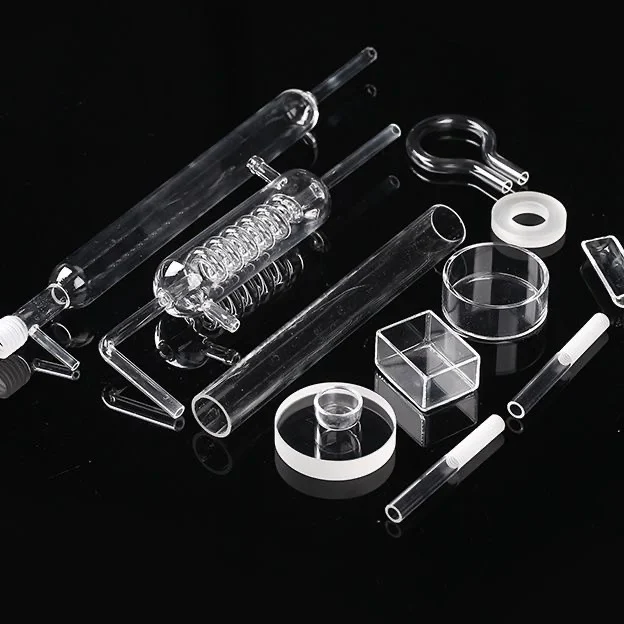
Custom quartz glass fabrication is the manufacture of high-purity fused silica components to a customer CAD drawing, dimensioned sketch, or sample, rather than from a fixed catalogue of sizes. The result can be a single quartz part, custom quartz glassware, or a welded multi-part assembly.
Using in-house CNC diamond machining, oxy-hydrogen flame forming, welding, fire polishing, and annealing, FGQuartz is a manufacturer and supplier of custom quartz components, including non-standard tubes, flanged and multi-port vessels, optical windows, quartz glassware and laboratory components, heater chambers, wafer boats, and replacement parts, from a single prototype to production, with no minimum order quantity. Drawings in DXF, STEP, IGES, or PDF are accepted, and a sketch, sample, or written functional description is enough to start. We export to the USA, Europe, and worldwide.
Quick answer
What is custom quartz glass fabrication? Making fused silica parts to your drawing when a standard catalogue size will not fit: a non-standard dimension, an added feature such as a flange or port, a specific optical or purity grade, a multi-part welded assembly, or a reproduction of a legacy part.
Key takeaways
- No minimum order quantity: single prototypes are a normal request. Free engineering DFM review and NDA protection are available.
- Two fabrication routes work together: cold processing (CNC machining, grinding, polishing) and thermal processing (flame forming, welding, annealing).
- Grades include natural fused quartz, synthetic fused silica, JGS1 / JGS2 / JGS3, and opaque fused silica. Quartz is not suitable for HF, hot concentrated phosphoric acid, or hot strong alkalis.
Written by the FGQuartz Engineering Team · Updated October 2026
On this page: What is custom fabrication · Product families · Capability matrix · Fabrication routes · Examples · Typical requests · Materials and grades · Tolerances and quality · How to order · FAQ and quote
Lead time depends on size and drawing complexity; the quote confirms the schedule.
What is custom quartz glass fabrication?
Overview
Custom quartz glass fabrication covers everything from a non-standard length of tube, through multi-port reactor vessels with precision-machined flanges, optical-grade polished windows, and flame-welded gas inlet assemblies, to one-off replacement parts for equipment whose original supplier no longer supports it. It is essential whenever application geometry, dimensional constraints, or equipment interfaces cannot be met by any stock product.
At FGQuartz, custom does not mean a narrow menu of approved variations. The engineering and production teams start from your drawing or functional requirement and work out the right combination of raw material, forming process, and machining operations to build it, whether or not it resembles anything made before.
Why fused silica for custom components?
Fused silica (amorphous silicon dioxide) combines high-temperature stability, near-zero thermal expansion, broad UV-to-IR optical transmission, and chemical inertness to most industrial process environments. That makes custom quartz components hard to replace in high-temperature, chemically aggressive, or optically critical applications where polymers, metals, and ordinary glasses fail. Fused silica can also be ground, drilled, turned, and polished with diamond tooling to the geometrical accuracy that precision process equipment demands. Background: What is quartz glass? and quartz glass vs borosilicate glass.
When to choose custom over standard
- A non-standard outer diameter, wall thickness, or length not found in any catalogue.
- Flanges, ports, closed ends, or other fabricated features on a tube or vessel.
- Complex hollow geometries: tees, crosses, multi-arm manifolds, bent sections.
- Optical elements such as windows or cuvettes with specific dimensions or surface quality.
- Several quartz components assembled into one integrated unit.
- A broken or discontinued part with no drawing to reproduce.
- A specific purity grade, optical grade, or trace-impurity limit.
Quartz product families we customize
Product families
The standard product pages cover the main product lines; the families below also include parts that have no standard page.
| Product family | Examples of custom work |
|---|---|
| Tubes, rods, and plates | Non-standard dimensions, flanges, ports, bends, threads, and welds beyond the standard tubes, rods, and plates. |
| Wafer boats and carriers | Custom slot pitch, half-shell designs, and non-standard wafer formats beyond the standard wafer boats. |
| Crucibles | Non-standard capacity, pouring spouts, and flanged necks beyond the standard crucibles. |
| Tanks and process baths | Multi-chamber, megasonic-integrated, or custom-ported designs beyond the standard tanks. |
| Quartz glassware and laboratory components | Quartz beakers, flasks, cuvettes, flow cells, reaction vessels, and other labware built to a specific analytical or research requirement. |
| Heater chambers and thermal parts | Chambers for inline and immersion heaters, IR heater envelopes, thermocouple protection tubes, and dielectric standoff insulators. |
| Optical and photonic components | Precision windows, lenses, prisms, beam splitters, laser cavity components, and UV / IR transmission elements in JGS1 / JGS2 / JGS3 grades. |
| Fiber optic components | MCVD / VAD substrate tubes, preform target and starting rods, and jacketing and overcladding tubes. |
| Manifolds and gas delivery hardware | Multi-port injectors, showerheads, gas distribution manifolds, side-arm and thermocouple sheaths. |
| Structural and mechanical parts | Push paddles, support columns, electrical isolation elements, and threaded quartz fasteners. |
| Reverse-engineered and legacy parts | Replacements for discontinued equipment, reproduced from a sample, photographs, or partial dimensions when no drawing exists. |
If your requirement does not fit a row, describe the function it must perform and the engineering team will work out how to build it in fused silica.
Industrial quartz customization capability matrix
Capability matrix
Customization has several independent axes that combine within one part. The table lists each axis.
| Customization axis | What we customize |
|---|---|
| Starting form | Tube, rod, plate, block, or ingot, or a combination welded together as a starting point for further machining. |
| Overall dimensions | Length, diameter, wall thickness, and plate format specified on your drawing; sizes beyond the standard product page ranges are evaluated case by case. |
| Geometric features | Flanges, ports, side arms, tees, crosses, manifolds, bends, tapers, closed or domed ends, internal and external threads, grooves, slots, chamfers, counterbores. |
| Material grade and purity | Natural fused quartz, synthetic fused silica, JGS1 / JGS2 / JGS3 optical grades, opaque grade, and specific trace-impurity limits on request. |
| Surface and optical finish | As-cut, fine-ground, fire-polished, single- or double-side optically polished (DSP), specified flatness and parallelism, defined surface roughness (Ra). |
| Assembly complexity | Single-piece components through multi-part welded assemblies combining several product forms, for example tube + flange + side ports + internal baffle in one unit. |
| Tolerance level | Commercial (as-formed) tolerances through tight, metrology-verified tolerances for optical or vacuum-critical interfaces. |
| Volume | A single R&D prototype (no MOQ) through OEM blanket production orders. |
| Documentation | Certificates of conformance, dimensional metrology reports, NDA protection, and export documentation. |
In practice most inquiries are one combination of these rows, for example: a JGS2 tube, 45 mm OD, with two flanged ports and one domed closed end, quantity 12. If you can describe a requirement like that, or attach a drawing, the engineering team can evaluate it directly.
Two fabrication routes: thermal processing and cold processing
Fabrication routes
Complex custom projects use two complementary routes, and advanced parts often need both to hold tolerance and reach a complex geometry.
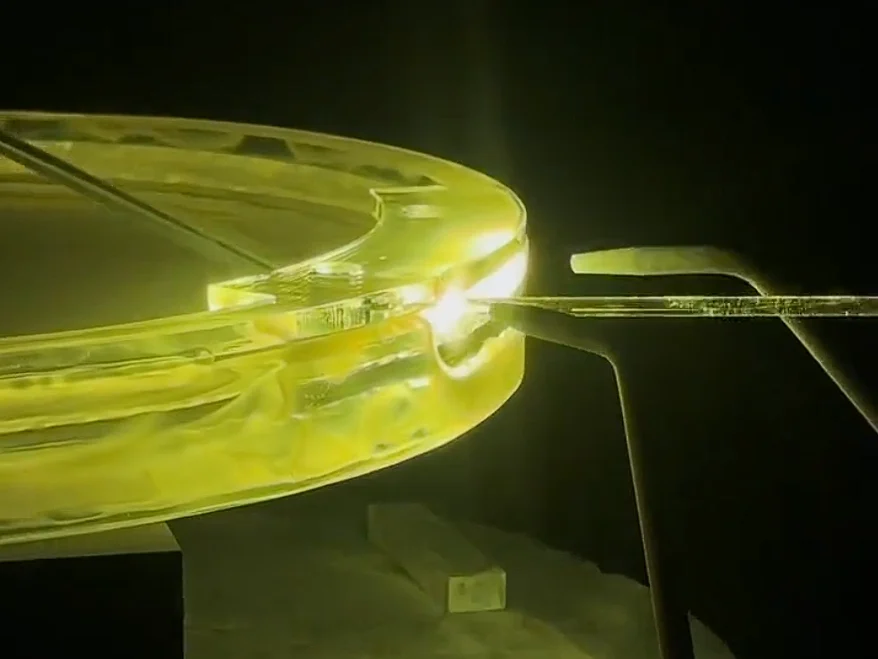
Thermal processing: quartz flame forming and welding
Oxy-hydrogen flames soften, bend, fuse, and seal fused silica, which builds complex hollow structures and seamless joints. This route makes shapes that have no straight-line CNC path at all: curves, branches, and sealed hollow chambers.
Key capabilities
- Flame welding for tube-to-tube and tube-to-flange joints.
- Tube bending, stretching, and diameter expansion or reduction.
- Domed or flat end-sealing and side-arm additions.
- Fire polishing for clean, particle-free surfaces.
- Controlled annealing to relieve localized weld stress.
Typical components
- Multi-chamber reactor vessels and chemical baths.
- Sealed thermocouple protection tubes and heating envelopes.
- Multi-port gas manifolds (tees, crosses, Y-joints).
- U-shaped, L-shaped, and serpentine process tubes.
Cold processing: fused quartz CNC machining and grinding
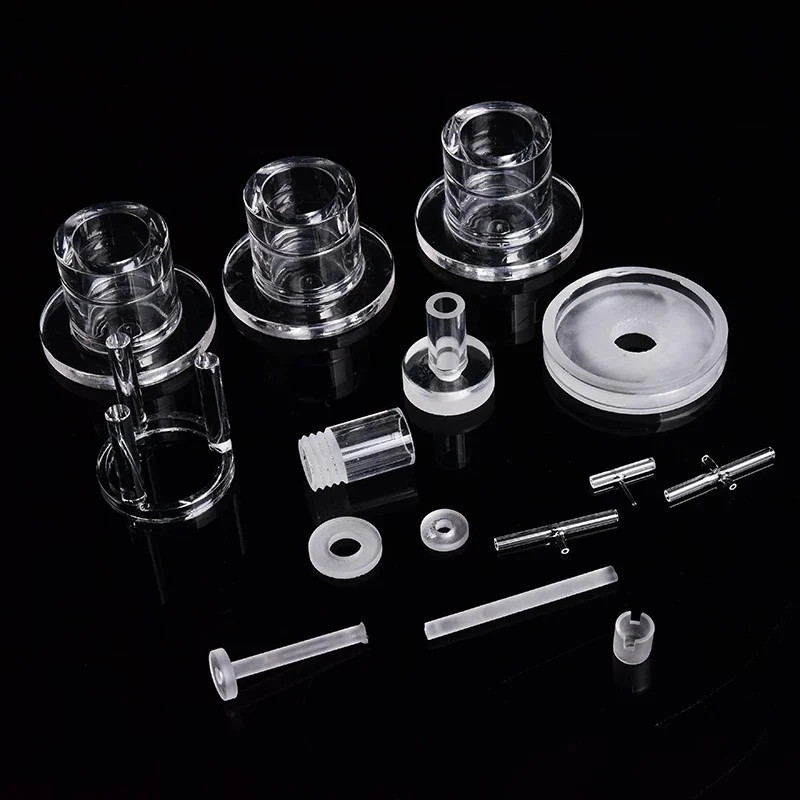
Multi-axis CNC centers and diamond tooling reach micro-tolerances and geometries that thermal forming alone cannot. This is the route for anything that needs a flat face, a precise hole, a thread, or an optically polished surface.
Key capabilities
- CNC turning and centerless grinding.
- Multi-axis milling of slots, pockets, and freeform profiles.
- Diamond core drilling, through and blind holes.
- Internal and external thread machining, edge chamfering.
- Lapping and optical-grade polishing to a controlled Ra.
Typical components
- Process tubes with machined steps, tapers, or O-ring grooves.
- Solid support rods, push paddles, and isolation elements.
- Optical windows, cuvettes, and vacuum substrates.
- Wafer boats with accurate pitch slotting, and CNC-machined flanges and base plates.
Custom quartz capability in practice
Examples
Every custom part is different, so no single product photo represents this page. These examples show the process and the range of output.
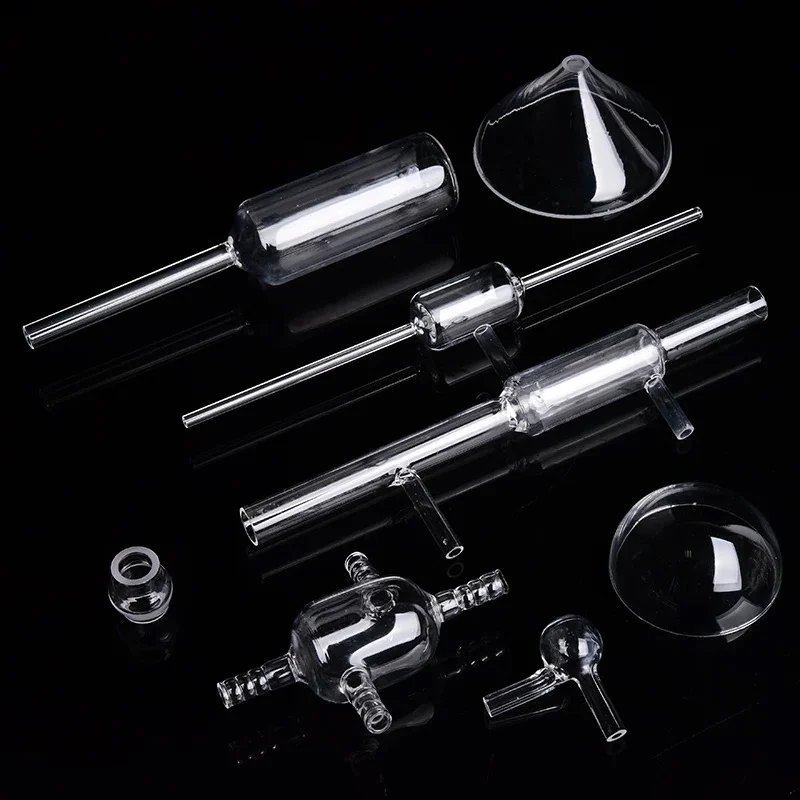
Flame-worked fused silica assemblies: funnels, joints, and multi-port fittings.
Custom fused silica parts: coils, bends, crucibles, and vessels from one fabrication set.
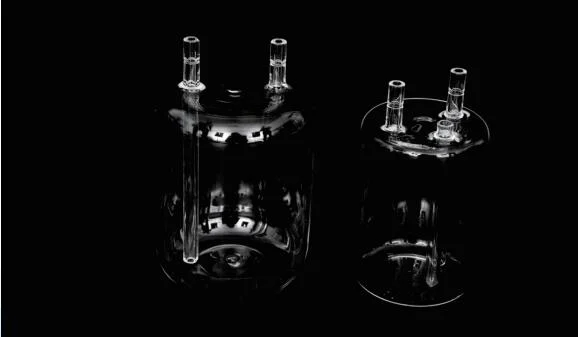
Multi-port fused silica process vessels with top connections for laboratory and pilot systems.
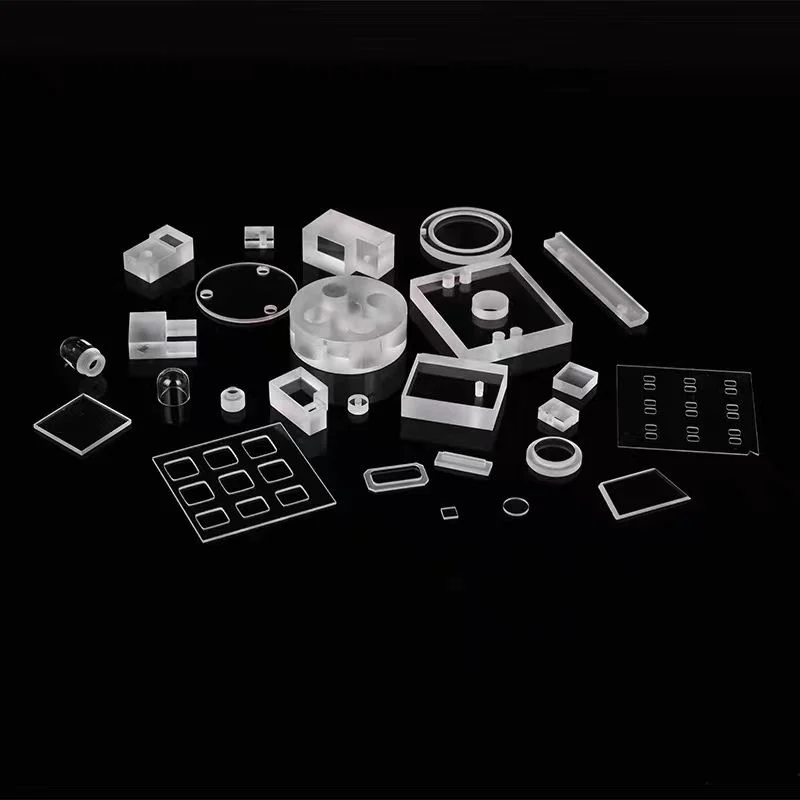
CNC-machined fused silica flat parts: plates, frames, grids, and complex outlines cut to drawing.
The kinds of problems customers bring us
Typical requests
It is often easier to recognize your own situation in a scenario than in a spec sheet. These are illustrative requests, not a list of fixed products.
Materials and grades we work with
Materials
Custom fabrication starts with the right base material. Choosing it up front avoids paying for purity you do not need, or under-specifying a material for an optically or chemically demanding process.
| Grade | Material | Transmission range | Typical use |
|---|---|---|---|
| Natural fused quartz | Melted from natural quartz crystal | Process grade | Process tubes, boats, crucibles, and general high-temperature parts. |
| Synthetic fused silica | Synthetic, usually from SiCl₄ | Grade dependent | Higher purity and optical homogeneity needs. |
| JGS1 | Synthetic fused silica | ≈ 185–2500 nm | Deep-UV windows and optics. |
| JGS2 | High-purity natural quartz | ≈ 220–2500 nm | UV–visible windows, sight glasses, and UV sleeves. |
| JGS3 | Low-OH material | ≈ 260–3500 nm | Infrared windows and IR sensing components. |
| Opaque fused silica | Milky, non-transparent | Blocks infrared | Thermal insulation, furnace heat shields, and baffles. |
Not sure which grade fits? Describe the operating temperature, chemical exposure, and any wavelength requirement and the engineering team will recommend one. Full comparison: JGS1 / JGS2 / JGS3 grade guide.
Tolerances and quality standards
Quality
Not every feature needs the same precision, and tight tolerances everywhere only add cost. During DFM review the engineers identify which dimensions are functionally critical (sealing faces, optical surfaces, mating interfaces) and which can run to standard commercial tolerance, so you pay for precision only where it matters.
Finished components are verified under the ISO 9001 quality system using coordinate measuring machines (CMM) for dimensional accuracy, polarizing microscopy for residual stress in welds and thermally formed sections, and surface metrology for optical-grade parts. For critical or first-run OEM designs, a First Article with a dimensional metrology report can be produced before volume production. Certificates of conformance and, where required, non-disclosure agreements are available on request.
How to order custom quartz glass from FGQuartz
Process
The same workflow applies whether you order a single R&D prototype or a volume OEM program.
Why specify FGQuartz
Manufacturer
Procurement questions
FAQ
Yes. Provide a physical sample, photographs, or key dimensions, and our engineering team will reproduce the part, verifying fit and function before production.
Yes. Beyond tubes, rods, plates, boats, crucibles, and tanks, FGQuartz fabricates laboratory glassware, immersion/inline heater chambers, optical and photonic components, fiber-optic preform parts, and manifolds.
Yes. NDA protection is available prior to drawing submission for customers who require it.
Yes. Send a sample, photographs, and any known dimensions, and our team will reproduce the part.
Our free DFM review identifies any features that need adjustment before production.
Yes — combining features from different standard categories is a common type of custom request.
Standard custom components typically ship in 7–14 days; more complex custom assemblies take approximately 3–6 weeks.
Yes. A dimensioned sketch, a written functional description, or even a sample of a legacy part is enough to start a feasibility review.
No. FGQuartz accepts single-piece prototype orders with no MOQ.
Anything that doesn’t match a standard catalogue size or shape — a non-standard dimension, an added feature like a flange or port, a specific optical/purity grade, or a multi-part welded assembly.