Home / Applications / Semiconductor
Quartz components for front-end wafer processing
Semiconductor Quartz Glass
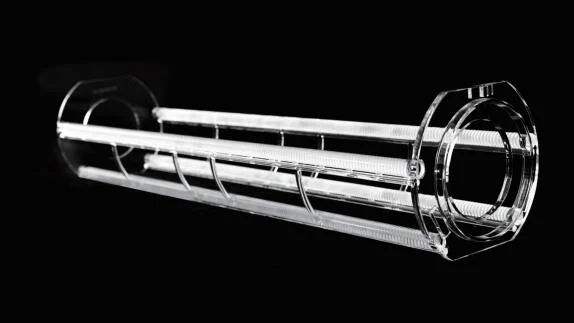
Semiconductor front-end processing runs wafers through high-temperature and chemical steps under strict contamination limits. Fused silica (quartz glass) is the standard material for furnace process tubes, wafer boats, gas injectors, liners, and wet-bench vessels because it combines thermal stability, low metallic impurity levels, and chemical resistance. FGQuartz makes these parts from SiO₂ ≥ 99.99% fused silica for horizontal and vertical furnaces.
FGQuartz builds fused silica components to drawing in any geometry that can be formed or machined from fused silica, and confirms feasibility in DFM review. When a furnace platform changes or a catalog part does not fit, prototypes start from one piece, and quotes are typically returned within 24 business hours.
Quick answer
Why is quartz glass used in semiconductor manufacturing? Quartz combines high-temperature stability, low thermal expansion, chemical inertness, and the purity needed to avoid contaminating wafers. Unlike opaque ceramics, clear quartz also lets in-situ pyrometry and visual monitoring read through the wall.
Key takeaways
- Quartz parts appear in diffusion, oxidation, anneal, LPCVD and PECVD, and wet cleaning and etching steps.
- Clear fused silica is chosen where optical access or pyrometry is needed; opaque fused silica is chosen for insulation, liners, and baffles.
- Wafer boats are made for 2–12 inch wafers including 200 mm and 300 mm, with slot counts such as 25, 50, 100, and 150+.
- Quartz is not suitable for HF, hot concentrated phosphoric acid, or hot strong alkalis.
Written by the FGQuartz Engineering Team · Updated October 2026
On this page: Why quartz · Process modules · Clear or opaque · Find components · Limits · Custom parts · Scenarios · FAQ · Quote
Lead time depends on size and drawing complexity; the quote confirms the schedule.
What problems does quartz solve in a fab?
Why quartz
Property data is on the technical specifications page. Other materials, such as alumina and silicon carbide, match some of these properties individually but rarely all of them together.
| Problem | Why ordinary materials struggle | How fused silica helps |
|---|---|---|
| Metal contamination at temperature | Metal ions can enter the wafer at furnace temperature and degrade devices. | High-purity fused silica (SiO₂ ≥ 99.99%) with controlled metallic impurities protects the wafer environment. |
| Process monitoring | Opaque ceramics block pyrometry and visual checks. | Clear fused silica transmits, so monitoring can read through the tube wall. |
| Repeated thermal cycling | Expansion mismatch distorts or cracks parts and shifts slot positions. | Thermal expansion of 5.5 × 10⁻⁷ /°C keeps boat slots and tube concentricity stable. |
| Wet chemistry | Acids and cleaning solutions corrode many materials and leach metals into the bath. | Fused silica resists HCl, HNO₃, H₂SO₄, and aqua regia with minimal metal contribution. |
| Particle generation | Rough or chipped contact surfaces shed particles. | Contact edges and slot entries can be fire-polished to reduce particles. |
Where does quartz sit in each process module?
Process modules
The four modules below cover most semiconductor quartz demand.
Diffusion, oxidation, and annealing
Workflow
- Load wafers into a boat
- Push the boat into the furnace tube
- Run the thermal recipe
- Unload
| Point | Detail |
|---|---|
| Where quartz is used | Process tubes, wafer boats, gas injectors, push paddles, and supporting rods. |
| Why quartz | Thermal shock resistance, dimensional stability under repeated cycling, and low particle generation. |
| Watch-outs | Wall thickness and concentricity affect temperature uniformity. Slot pitch and finish affect particles and wafer contact. |
LPCVD and PECVD
Workflow
- Load wafers
- Introduce process gas through the injector
- Deposit the film
- Purge and unload
| Point | Detail |
|---|---|
| Where quartz is used | Process tubes, liners, injectors, and carriers. |
| Why quartz | Gas compatibility, clean surfaces, and a controlled wall thickness. |
| Watch-outs | Injector hole patterns and boat design influence film thickness uniformity along the load. Send the platform and recipe context. |
Wet cleaning and etching
Workflow
- Load carriers into the bath
- Run the chemical step at temperature
- Rinse and dry
| Point | Detail |
|---|---|
| Where quartz is used | Quartz tanks, inline heaters, carriers, and vessels. |
| Why quartz | Resistance to acids and cleaning solutions, with minimal metal contribution to the bath. |
| Watch-outs | Not for HF, hot concentrated phosphoric acid, or hot strong alkalis. |
Furnace fixtures and tool-specific parts
Workflow
- Identify the tool geometry
- Specify the part from a drawing or sample
- Fit and qualify
| Point | Detail |
|---|---|
| Where quartz is used | End caps, baffles, pedestals, thermocouple protection tubes, liners, and flanged tubes. |
| Why quartz | Matches the furnace platform and the thermal role: clear for access, opaque for insulation. |
| Watch-outs | Often needs CNC machining or flame forming when the platform geometry is non-standard. |
Clear or opaque: which grade for the thermal role?
Clear or opaque
Opaque fused silica contains closed voids that scatter radiation and lower emissivity. The wrong grade gives non-uniform temperature or blocks monitoring.
| Grade | Use it for | Typical parts |
|---|---|---|
| Clear fused silica | Pyrometry through the wall and optical access | Process tubes with in-situ pyrometry, RTP windows, UV lamp envelopes |
| Opaque fused silica | Insulation and heat shielding | Furnace liners, baffles, spacers, and parts where heat retention matters |
Find the right quartz component by process module
Find components
This table points to the product pages that hold the specifications and sizes.
| Process module | Where to look | What is available |
|---|---|---|
| Thermal chamber | Quartz glass tubes | Process and diffusion tubes, plain or flanged |
| Wafer carrying | Quartz wafer boats | Horizontal boats and vertical towers, 2–12 in wafers |
| Wet processing | Quartz tanks | Baths and overflow tanks |
| Heated chemistry | Quartz inline heaters | Flow-through heater chambers |
| Supports and handling | Quartz glass rods | Boat rails, paddles, and fixtures |
| Covers and windows | Quartz glass plates | Plates, windows, and process covers |
| Anything else | Custom quartz glass | Injectors, liners, end caps, baffles, and parts to drawing |
When quartz is not the right choice
Limits
Quartz is chosen for purity, thermal stability, and chemical inertness. It is not suited to every environment.
| If your process involves… | Quartz suitability | Consider |
|---|---|---|
| HF (hydrofluoric acid) | Not suitable. HF attacks fused silica. | An HF-compatible material, such as a fluoropolymer |
| Hot concentrated phosphoric acid | Not suitable. | A compatible material for the bath |
| Hot strong alkalis (for example hot KOH or NaOH) | Not suitable; quartz is attacked. | A compatible material for the bath |
| Continuous service above about 1200°C | Beyond the continuous working limit of fused silica. | A higher-temperature ceramic |
Can FGQuartz make my semiconductor part if it is not on the list?
Custom parts
FGQuartz builds fused silica components to drawing in any geometry that can be formed or machined from fused silica, and confirms feasibility in DFM review. There are three paths:
- Use a standard item from the product pages.
- Modify a standard item: a different size, a port, a flange, a lid, or a changed slot or hole pattern.
- Build to your drawing, sketch, or sample: DXF, STEP, IGES, PDF, a dimensioned sketch, or a worn sample with key dimensions.
Commonly requested
- Boats with a new slot pitch or count for a different wafer size
- Injectors with a changed hole pattern, pitch, or insertion depth
- End caps, baffles, pedestals, and thermocouple protection tubes for a specific furnace
- Replacements for legacy tools, reproduced from a sample measured by coordinate measuring machine
Prototypes start from one piece. Simpler custom parts typically take 7–14 days and complex assemblies 3–6 weeks. See custom quartz glass fabrication, thermal processing, and cold processing.
Illustrative scenarios
Scenarios
These are typical requests, not customer case studies.
| Situation | What FGQuartz builds | What to send |
|---|---|---|
| A fab introduces a new wafer size | A boat with deeper slots and matched supports | Wafer diameter and thickness, furnace tube ID, slot count and pitch |
| A legacy furnace has no drawings | A part reproduced from a sample | The sample or photos with key dimensions |
| A process change alters gas distribution | An injector with a new hole pattern | Hole pattern, pitch, clocking, and insertion depth |
| A wet bench needs a heated bath | A tank and a quartz inline heater chamber matched at the ports | Chemistry, bath temperature, volume, and port layout |
Frequently asked questions
FAQ
More answers are in the full quartz glass FAQ.
Yes. Wafer boats, tubes, and tanks are engineered to your specific wafer size and furnace platform, whether 200mm, 300mm, or another format.
Yes. A sample, photographs, or key dimensions are usually enough to reproduce a legacy component for an existing tool.
Yes. FGQuartz fabricates custom end caps, baffles, pedestals, and thermocouple protection tubes when standard platform geometry doesn’t fit a specific tool.
Typically SiO2 ≥99.99% with controlled trace metal impurities, since even small amounts of alkali or transition metals can diffuse into silicon wafers and affect device performance.
Metals introduce ion contamination at process temperature; ceramics are typically opaque, blocking process monitoring. Quartz combines thermal stability, purity, and transparency that neither alternative offers together.
Process tubes, wafer boats, wet-bench tanks, gas injectors, and furnace liners for diffusion, oxidation, LPCVD, and wet cleaning steps.