Introduction to High-Temperature Laboratory Equipment
High-temperature laboratory applications require specialized equipment capable of withstanding extreme conditions. In settings where temperatures can soar beyond standard limits, conventional materials often fall short of ensuring the integrity and reliability required for accurate experimentation. This is where quartz test tubes and combustion tubes come into play.
Quartz test tubes are particularly notable for their excellent thermal resistance and low thermal expansion properties. They can endure temperatures up to approximately 1,000 degrees Celsius without deforming or releasing impurities, which is critical in high-temperature experiments where accuracy and purity of results are paramount. Additionally, the transparency of quartz allows researchers to visually monitor reactions, thus providing ease in assessing experimental progress.
Combustion tubes serve a different but equally important role in high-temperature laboratory settings. These tubes are designed to facilitate combustion reactions under controlled conditions, enabling accurate analysis of combustion products. Their construction often includes materials such as fused quartz that provide durability and resistance to chemical attack, especially when handling reactive substances at elevated temperatures.
High-temperature experiments typically encompass various fields, including materials science, chemistry, and physics, where precise temperature control and consistency are vital. Conventional glass or plastic materials would not suffice in many of these scenarios, as they can potentially lead to contamination or structural failure, compromising the overall experiment.
In light of this, the significance of using quartz test tubes and combustion tubes in high-temperature applications becomes evident. Their ability to withstand harsh conditions while maintaining performance makes them indispensable in modern laboratory practices that demand high standards of precision and reliability. High-purity quartz tubes are widely used for these purposes.
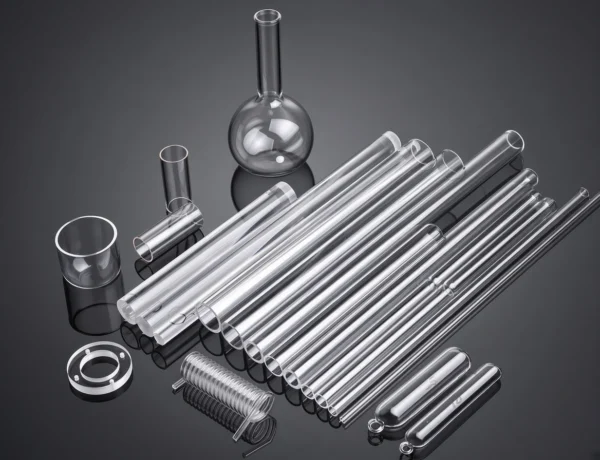
High-purity quartz test tubes and combustion tubes designed for high-temperature laboratory experiments
Properties of Quartz in Laboratory Use
Quartz is a mineral composed of silicon dioxide (SiO2) and is widely recognized for its exceptional properties, making it an ideal choice for laboratory applications, particularly those involving high temperatures. One of the most notable characteristics of quartz is its thermal stability. Unlike many other materials, quartz can withstand extreme temperatures without undergoing structural changes. This property ensures its reliability in experiments that require heating, making quartz test tubes and combustion tubes invaluable in various scientific processes.
Another significant advantage of quartz is its resistance to chemical corrosion. In laboratory environments, samples are often subjected to harsh chemicals, and materials used in these settings must maintain their integrity over time. Quartz displays excellent resistance to a wide range of acids and bases, which allows it to be used in experiments involving reactive substances. This resistance contributes to the accuracy and reliability of results, as contamination from tube degradation is minimized.
In addition to its thermal and chemical properties, quartz possesses unique optical characteristics. It is transparent to a wide range of wavelengths, including ultraviolet (UV) light. This transparency enables scientists to utilize quartz test tubes in various optical experiments and analyses. The ability to observe samples in quartz containers under UV light can lead to significant advancements in fields such as spectroscopy and analytical chemistry.
When compared to alternative materials, such as glass or ceramics, quartz holds distinct advantages. For example, while glass can be susceptible to thermal shock and chemical attack, quartz maintains its structural integrity under similar conditions. Additionally, ceramics may crack under high temperatures, whereas quartz can endure these environments without failure. In summary, the combination of thermal stability, chemical resistance, and optical clarity positions quartz as an essential material in high-temperature laboratory applications, offering researchers a reliable medium for experimentation.
Applications of Quartz Test Tubes in High-Temperature Experiments
Quartz test tubes have emerged as vital components in high-temperature laboratory applications due to their unique properties, which make them ideal for various experimental setups. One significant use case is in chemical reactions where precise thermal conditions are necessary. Quartz boasts a high melting point and excellent thermal stability, ensuring that it can withstand extreme temperatures without deteriorating or altering the chemical composition of the substances within. This characteristic is particularly crucial in reactions that require elevated temperatures to achieve desired outcomes.
Moreover, quartz test tubes are frequently utilized in the synthesis of materials, such as nanomaterials and advanced compounds. The controlled environment provided by quartz allows for consistent heating and minimizes contamination, which is essential when experimenting with sensitive and reactive chemicals. This ability to maintain purity and provide an inert atmosphere significantly enhances the reliability of experimental results. High-quality quartz tubes are preferred for these demanding applications.
Another important application of quartz test tubes is in catalytic processes. In many advanced reactions, catalysts play a critical role in accelerating the reaction rates without undergoing any chemical change themselves. Using quartz tubes for these processes ensures that the catalysts remain effective, as they are less likely to react with the test tube material compared to traditional glass. Furthermore, quartz is chemically inert, which means it does not interact with the substances being tested, ultimately contributing to the accuracy of the experimental data obtained.
In addition to chemical reactions and synthesis, quartz test tubes are beneficial in thermal analysis techniques such as thermogravimetric analysis (TGA) and differential thermal analysis (DTA). Their compatibility with high temperatures allows for accurate monitoring of material properties under varying thermal conditions. Overall, the application of quartz test tubes in high-temperature lab work not only enhances the efficacy of experiments but also ensures safety and reliability, establishing their importance in scientific research.
Combustion Tubes: Design and Importance in High-Temperature Research
Combustion tubes play a critical role in high-temperature laboratory applications, where efficient gas flow and precise combustion measurement are vital. Unlike standard test tubes, combustion tubes are specifically engineered to withstand extreme thermal conditions. Their design typically incorporates materials such as quartz or alumina, which can endure prolonged exposure to high temperatures while maintaining structural integrity.
One distinctive feature of combustion tubes is their elongated shape, which facilitates the mixing of reactants and ensures the uniform distribution of heat. This design is crucial for high-temperature reactions, as it promotes optimal combustion conditions and enhances experimental accuracy. Furthermore, most combustion tubes are equipped with open-ended designs to allow for the escape of gases, thus preventing pressure buildup that could otherwise lead to hazardous situations in a laboratory environment.
The interior of a combustion tube is often coated or treated to minimize contamination and enhance thermal stability. This treatment is especially important in high-temperature research, where any foreign substances could interfere with the combustion process and yield unreliable results. The smooth, inert surfaces of well-designed combustion tubes significantly contribute to the reliability and repeatability of experiments by reducing the risk of unwanted reactions.
Additionally, the materials used in the construction of combustion tubes influence their thermal conductivity, which is essential for effective heat management during experiments. By ensuring rapid heat transfer, these tubes contribute to more controlled combustion processes, allowing researchers to achieve specific reaction conditions more efficiently.
In summary, the specialized design and material composition of combustion tubes differentiate them from standard test tubes, making them indispensable for conducting high-temperature research. Their role in managing gas flow and facilitating accurate combustion measurements underscores their significance in a wide array of laboratory applications. For specialized dimensions or unique designs, custom products can be manufactured to meet exact experimental requirements.