Custom fused silica process tanks · Wall 3–15 mm
Quartz Tanks
Quartz tanks — also called quartz baths, quartz cleaning tanks, or quartz wet-bench tanks — are welded fused silica vessels used for wet cleaning, acid etching, rinsing, and high-purity chemical holding. They stay inert to mineral acids, add no metal ions to the bath, and tolerate far higher temperatures than plastic tanks.
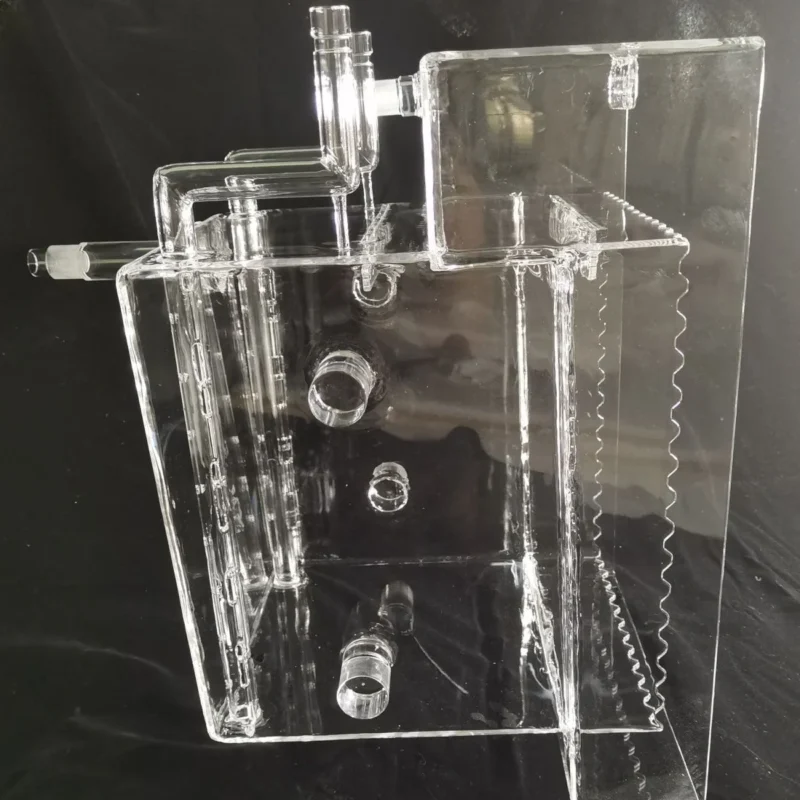
FGQuartz manufactures rectangular process tanks, overflow tanks, double-wall (inner and outer) tanks, rinse tanks, and megasonic or ultrasonic cleaning tanks from clear fused quartz with SiO₂ ≥ 99.99% and wall thickness of 3–15 mm (0.12–0.59 in), from small laboratory baths of about 1 L (0.26 US gal) to industrial tanks over 200 L (about 53 US gal). Plates are diamond-cut, flame-welded, and annealed into leak-tight tanks with custom drain, inlet, overflow, and weir features. Custom manufacturing is available from a single prototype, with no minimum order quantity.
Quick answer
What is a quartz tank used for?
Quartz tanks hold aggressive chemicals and process baths in semiconductor wet benches, solar wafer cleaning lines, and laboratory chemical processing, where chemical purity and high-temperature resistance matter and HF is not in the bath.
Key takeaways
- FGQuartz makes tanks from about 1 L to over 200 L (dimensions from 50 mm to 1500 mm+), wall 3–15 mm, to your drawing.
- Drains, inlets, overflow weirs, sensor ports, flanges, threaded fittings, and heater or sparger interfaces are built in.
- Megasonic and ultrasonic cleaning tanks are available with transducer mounting plates, side windows, and cooling jackets.
- Quartz is not suitable for HF, hot concentrated phosphoric acid, or hot strong alkalis.
Written by the FGQuartz Engineering Team · Updated November 2026
On this page: Specifications · Tank design · Quartz vs plastic · Tank types · Project examples · Applications · FAQ and quote
Lead time depends on size and drawing complexity; the quote confirms the schedule.
Key features of quartz tanks
Product features
Quartz tank specifications
Technical specifications
Values below are FGQuartz published ranges for fused silica tanks. Dimensions, ports, and tolerances are set from the drawing and confirmed in design-for-manufacture (DFM) review.
| Parameter | Specification |
|---|---|
| Material | High-purity clear fused quartz / fused silica (SiO₂ ≥ 99.99%). |
| Wall thickness | 3 mm – 15 mm (0.12 – 0.59 in), selected by tank size, liquid depth, and temperature. |
| Tank size | From small laboratory baths (about 1 L / 0.26 US gal) to industrial tanks over 200 L (about 53 US gal); dimensions from 50 mm to 1500 mm+ (2.0 to 59 in+), made to drawing. |
| Tank type | Single-wall process tanks, overflow tanks, inner and outer (double-wall) tanks, rinse tanks, megasonic and ultrasonic cleaning tanks. |
| Ports and features | Drain, inlet, outlet, overflow weirs, sensor ports, flanges, threaded fittings, and heater or sparger interfaces, fused or core-drilled. |
| Megasonic / ultrasonic | Integrated transducer mounting plates, side windows, and cooling jackets. |
| Internal supports | Cassette rails, boat supports, and false bottoms to drawing. |
| Surface finish | Fire-polished edges and weld seams, annealed after welding. |
| Chemical compatibility | DI water, HCl, HNO₃, H₂SO₄, aqua regia, organic solvents. Not for HF, hot concentrated phosphoric acid, or hot strong alkalis. |
| Processing | Diamond cutting, core drilling, CNC machining, oxy-hydrogen flame welding, fire polishing, annealing. |
| Customization | Build-to-print from DXF, STEP, IGES, or PDF. Single prototypes through production. No MOQ. |
Full thermal, mechanical, optical, and chemical tables: Technical Specifications. Wall thickness and support layout are confirmed per drawing for the liquid depth and temperature.
Choosing the quartz tank design
Tank selection
The process decides the design. A static soak tank is a simple welded box. A recirculating or overflow tank adds inlet ports and a weir so the bath stays filtered and level. A double-wall tank puts a process tank inside a catch tank to contain spills or carry a heating or cooling medium. A megasonic or ultrasonic tank adds a transducer mounting plate, side window, and cooling jacket.
Wall thickness rises with tank size and liquid depth, because a full quartz tank carries hydrostatic load on flat plates. Send the chemistry, bath temperature, and liquid volume so wall, corner radius, and support layout can be sized together. For heated baths, see quartz inline heaters; for background on the material, What is quartz glass?
Typical properties of fused silica
Typical values for high-purity fused silica. Optical transmission and OH content vary by grade.
| Continuous service | 1200°C (2192°F) |
| Short-term maximum | 1300°C (2372°F) |
| Softening point | ≈ 1680°C (3056°F) |
| Annealing point | ≈ 1215°C (2219°F) |
| Strain point | ≈ 1120°C (2048°F) |
| Thermal expansion (20–300°C) | 5.5 × 10⁻⁷ /°C |
| Thermal conductivity (20°C) | ≈ 1.4 W/(m·K) |
| Density | ≈ 2.2 g/cm³ |
Chemical note: excellent resistance to HCl, HNO₃, H₂SO₄, aqua regia, and organic solvents. Attacked by HF, hot concentrated phosphoric acid, and hot strong alkalis.
Quartz tank vs plastic (PP / PVDF) tank
Comparison
Both are used for chemical baths. The choice turns on temperature, purity, and whether HF is present.
| Point | Quartz tank | Plastic tank (PP / PVDF) |
|---|---|---|
| Bath temperature | Much higher; set by the chemistry and heater design. | Lower; limited by the polymer. |
| Purity | Chemically inert, with no risk of leaching organics. | Polymer additives and organics can be a concern in ultra-pure baths. |
| Hydrofluoric acid | Not suitable. HF attacks fused silica. | Some plastics can hold HF. |
| Transparency | Clear; liquid level and flow are visible. | Usually translucent or opaque. |
| Cost | Higher. | Lower. |
| Handling | Rigid and brittle; needs full-face support and care at edges. | Tougher and more impact tolerant. |
General comparison for orientation; check the exact chemistry, concentration, and temperature for any real design. Quartz is the right choice when purity and temperature matter and HF is not in the bath.
Quartz tank types we fabricate
Customization
FGQuartz does not publish a fixed tank size list. Each tank is made to your chemistry, wafer or part size, and equipment layout, from a single prototype to production, with no minimum order quantity. Non-tank custom parts are on the custom quartz glass page.
| Tank type | Typical use | What is fabricated |
|---|---|---|
| Process tanks | Wet cleaning and acid soak baths | Welded rectangular quartz tanks with drain and inlet ports. |
| Overflow tanks | Recirculating and filtered baths | Weir or cascade overflow edges, return ports, and bottom inlets. |
| Double-wall tanks | Spill containment and jacketed baths | Inner process tank inside an outer catch tank, welded as one assembly. |
| Rinse tanks | DI water rinse and quick-dump stations | Tanks with bottom drains, spray or inlet ports, and cassette supports. |
| Megasonic and ultrasonic tanks | Transducer-driven cleaning systems | Tanks with integrated transducer mounting plates, side windows, and cooling jackets. |
| Heater-ready tanks | Heated chemical baths | Ports and flanges sized for quartz inline heaters, immersion heaters, or circulation loops. |
| Custom assemblies | OEM and non-standard bath designs | Build-to-print tanks with custom baffles, supports, and multi-chamber layouts. |
Representative quartz tank builds
Project examples
Three typical custom tank projects, described by the requirement, the build route, and what is checked against the drawing. Customer names and confidential drawing data are withheld.
01 · Semiconductor wet cleaning
Overflow chemical tank
Requirement. A recirculating bath that stays level and filtered, with a weir and ports for the circulation loop.
How it is built. Quartz plates diamond-cut, core-drilled for ports, flame-welded with a weir edge, fire-polished and stress-relief annealed.
Checked against the drawing. Overall dimensions, weir height, port positions and sizes.
02 · Wet bench
Square process tank
Requirement. A clear, inert vessel for a chemical cleaning step with drain and inlet ports.
How it is built. Welded rectangular tank with fused or core-drilled ports and fire-polished edges, annealed after welding.
Checked against the drawing. Length, width, depth, wall thickness, and port layout.
03 · Cleaning line
Rinse tank with cassette supports
Requirement. A DI water rinse station that holds cassettes or boats clear of the base.
How it is built. Tank with bottom drain, inlet ports, and internal cassette rails or false bottom welded in, then annealed.
Checked against the drawing. Support positions, drain location, and overall dimensions.
Cut, welded, and annealed under one ISO 9001 system
Manufacturing and quality
FGQuartz operates a 15,000 m² facility in Lianyungang covering CNC diamond machining, oxy-hydrogen flame welding, fire polishing, and annealing, so cutting, welding, and stress relief of the tank happen in one plant. Learn more about FGQuartz.
Handling: support the full flat base of the tank and avoid point loads or impact on edges. Fill and drain gradually with baths at similar temperature to limit thermal shock. Clean with acid or alcohol before service; alkali salts and fingerprints promote devitrification at high temperature.
Quartz tank applications
Applications
Quartz tank manufacturer: why specify FGQuartz
Manufacturer
Quartz tank FAQ
Procurement questions
What is a quartz tank used for?
Quartz tanks hold aggressive chemicals and process baths in semiconductor wet benches, solar wafer cleaning lines, and laboratory chemical processing, where chemical purity and high-temperature resistance matter and HF is not in the bath.
What sizes and wall thicknesses do you make?
FGQuartz makes tanks from small laboratory baths of about 1 L (0.26 US gal) to industrial tanks over 200 L (about 53 US gal), with dimensions from 50 mm to 1500 mm+ (2.0 to 59 in+) and wall thickness of 3–15 mm (0.12–0.59 in). Wall and support layout are sized to the tank, liquid depth, and temperature.
Can a quartz tank hold hydrofluoric acid (HF)?
No. HF attacks fused silica. Quartz is also not suitable for hot concentrated phosphoric acid or hot strong alkalis, so hot KOH or NaOH texturing baths are not a quartz application.
When should I choose a quartz tank instead of a plastic (PP / PVDF) tank?
Choose quartz when purity and bath temperature matter and HF is not present: quartz tolerates much higher temperatures, is chemically inert, and is clear so liquid level can be seen. Plastic tanks cost less and tolerate impact better, and some plastics can hold HF.
What types of quartz tank can you build?
Single-wall process tanks, overflow tanks with weirs, double-wall tanks (inner process tank inside an outer catch tank), rinse tanks with cassette supports, megasonic and ultrasonic cleaning tanks with transducer mounting plates, heater-ready tanks, and custom multi-chamber assemblies.
Can the tank be built to fit a heater or circulation loop?
Yes. Ports and flanges can be sized for quartz inline heaters, immersion heaters, spargers, or circulation loops, and FGQuartz inline heaters are designed to match.
How should a quartz tank be handled and filled?
Support the full flat base and avoid point loads or impact on edges. Fill and drain gradually with baths at similar temperature to limit thermal shock. Clean with acid or alcohol before service, because alkali salts and fingerprints promote devitrification at high temperature.
What are the minimum order quantity, lead time, and quote process?
There is no minimum order quantity; single prototypes are welcome. Custom builds typically take 3–6 weeks depending on size and drawing complexity, and the quote confirms the schedule. Send a drawing (DXF, STEP, IGES, or PDF), or the chemistry, bath temperature, and volume; replies typically arrive within 24 business hours.
Related pages
Keep reading
Quartz inline heaters
Heaters that match tank ports and flanges for heated baths.
Quartz glass plates
The fused silica plate stock that tanks are cut and welded from.
Quartz glass tubes
Custom fused silica tubes, OD 5–1000 mm, built to your drawing.
What is quartz glass?
How quartz glass, fused quartz, and fused silica relate.
Technical specifications
Thermal, mechanical, optical, and chemical tables for fused silica.
Custom quartz glass
Build-to-print quartz parts from a single prototype to production.