What Is Quartz Glass? Definition, Composition & Properties
Introduction
Quick Answer
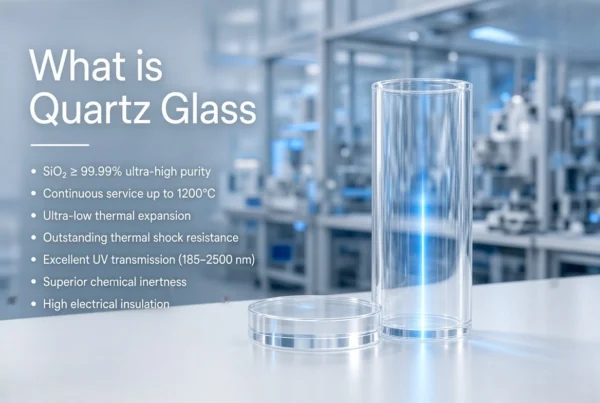
Quartz glass is an amorphous high-purity silica glass (SiO₂ ≥ 99.99%) produced by melting natural quartz crystals or synthetic silica precursors at extreme temperatures (>1700°C) without fluxing agents. It features a continuous working temperature of 1200°C, an extremely low coefficient of thermal expansion (5.5 × 10⁻⁷/°C), high UV transmission (185–2500 nm), and chemical inertness unmatched by conventional glasses. It serves as a vital structural and optical material for semiconductor wafer processing, UV disinfection systems, and high-temperature thermal chambers.
Key Takeaways
- Ultra-High Purity: Composed of ≥ 99.99% SiO₂ with total trace metal contamination typically < 20 ppm.
- Extreme Thermal Performance: Continuous operation at 1200°C, short-term capability up to 1300°C, and a softening point of ≈ 1680°C.
- Thermal Shock Resistance: Low coefficient of thermal expansion (5.5 × 10⁻⁷/°C) prevents cracking during sudden temperature changes.
- Broad Spectrum Optical Transmission: High transmittances from deep-UV (185 nm) through visible to near-infrared spectrums.
- Standardized Grade Systems: Ranging from industrial structural grades to high-precision optical grades (JGS1, JGS2, JGS3 equivalents).
- Cost-to-Performance Ratio: Higher initial procurement cost is balanced by extended component operating life and process reliability.
- Operating Constraints: Inherently brittle and subject to surface devitrification under high heat combined with alkali contamination.
Core Composition & Material Structure
What is quartz glass made of?
Quartz glass consists almost entirely of pure silicon dioxide (SiO₂ ≥ 99.99%). Unlike conventional commercial glass formulations, it contains no intentional additions of soda (Na₂O), lime (CaO), or boron oxide (B₂O₃). Metallic trace impurities (such as Al, Fe, Na, K) and hydroxyl groups (OH⁻) are strictly regulated during synthesis, as even parts-per-million (ppm) variations dramatically impact optical absorption, thermal viscosity, and devitrification behavior. For the complete baseline property dataset, see our Technical Specifications page.
Raw Material Feedstocks: Natural vs. Synthetic
Industrial quartz glass manufacturing relies on two distinct raw material feedstocks:
- Natural Quartz Crystal: Processed from high-purity natural silica deposits. Used predominantly for general industrial components, standard furnace tubes, lighting sleeves, and mid-tier optical windows.
- Synthetic Silica Precursors: Synthesized chemically (e.g., silicon tetrachloride gas deposition via CVD). Used for ultra-high-purity applications requiring optical homogeneity, zero internal bubble inclusions, and high deep-UV transmission (such as semiconductor photolithography).
Amorphous Microstructure & Isotropic Behavior
At the atomic level, quartz glass exhibits an amorphous (non-crystalline) three-dimensional network structure. Rapid cooling during the solidification process prevents the silica molecules from forming a crystalline lattice (such as α-quartz or cristobalite). This random, fully bonded SiO₄ tetrahedral network grants the material isotropic physical properties—meaning thermal expansion, mechanical strength, and refractive index remain uniform in all directional axes.
Quartz Glass Properties at a Glance
Thermal Performance
Quartz glass handles continuous thermal exposure up to 1200°C and transient short-term operations up to 1300°C. The material’s annealing point is approximately 1215°C, with a softening point near 1680°C. Its exceptionally low coefficient of thermal expansion (5.5 × 10⁻⁷/°C between 20°C and 300°C) provides unmatched thermal shock resistance, allowing red-hot quartz components to be quenched in water without catastrophic fracturing. Thermal conductivity at 20°C is 1.4 W/(m·K).
Optical Transmission Properties
The operational transmission window spans from 185 nm in the deep ultraviolet up to 2500 nm in the near-infrared spectrum. High-grade clear quartz glass achieves over 90% inline optical transmission at the 254 nm UV wavelength (10 mm sample thickness). The nominal refractive index is 1.4585 at 589 nm (Sodium D line).
Chemical Inertness & Corrosion Resistance
Quartz glass demonstrates superior chemical stability against water, neutral solutions, organic solvents, and concentrated acids (including nitric, sulfuric, and hydrochloric acids at elevated temperatures). Minimal ion leaching ensures process contamination stays near zero in semiconductor and pharmaceutical environments. Its primary chemical vulnerabilities are hydrofluoric acid (HF), phosphoric acid above 150°C, and strong alkaline solutions at high temperatures, which attack and etch the silica matrix.
Electrical & Mechanical Characteristics
Quartz glass functions as an exceptional electrical insulator across wide temperature ranges, with electrical volume resistivity exceeding 10¹⁸ Ω·cm at 20°C and a dielectric constant of approximately 3.75 at 1 MHz. Density is 2.2 g/cm³, with a Mohs hardness rating of 5.5–6.5. Compressive strength is high (≈ 1100 MPa), though tensile and flexural strength are limited by typical ceramic brittleness. A full parameter table—including acoustic, radiation, and surface properties—is available on our Specifications page.
Standard Quartz Glass Grades & Classifications
Natural vs. Synthetic Quartz Glass
Categorizing material by its origin directly establishes its baseline purity, internal defect density, optical transmission profile, and cost structure:
- Natural Fused Quartz: Economical material for structural furnace applications, process piping, and standard UV sleeves where ultra-high DUV optical transmission is not mandatory.
- Synthetic Fused Silica: Premium material offering maximum chemical purity, extremely low trace metal counts (< 1 ppm), and minimal bubble inclusions. Essential for DUV lasers, semiconductor optics, and precision optical windows.
Optical Grade Classifications (JGS Series & Global Standards)
In global industrial markets and Asian standard designations (GB/T 4121), optical quartz glass is commonly categorized using the JGS system. For the full breakdown of transmittance curves and equivalent international grades, see our dedicated JGS1 / JGS2 / JGS3 grade guide. In short:
- JGS1 (Synthetic Fused Silica / Deep UV Grade): Equivalent to Suprasil / Corning 7980. Synthetic raw material free of bubbles and inclusions. Optimized for DUV applications (185–2500 nm) with high hydroxyl (OH) content.
- JGS2 (Natural Fused Quartz / UV-Visible Grade): Equivalent to Homosil. Made from high-purity natural quartz grain. Provides high transmission across UV and visible light bands (220–2500 nm). Ideal for UV sterilization sleeves and sight glasses.
- JGS3 (Low-OH / Infrared Grade): Low-OH content (< 5 ppm) achieved via specialized vacuum processing. Eliminates water absorption bands at 2720 nm, delivering maximum clarity in visible and IR spectrums (260–3500 nm).
How Quartz Glass Is Made
Industrial manufacturing uses four primary thermal processing techniques depending on required geometry and purity standards: electric fusion/arc melting for mass-produced tubes and plates, flame fusion (Verneuil process) for seamless tubes and rods, chemical vapor deposition (CVD) for ultra-pure optical-grade synthetic boules, and vacuum sintering for specialized opaque shapes. All finished components then undergo secondary processing—cold machining, flame polishing, stress-relief annealing, and chemical etching.
This extreme-temperature process (>1700–2000°C, versus ~1000°C for standard glass) is why quartz glass costs more to produce than soda-lime or borosilicate glass: specialized refractories, high energy consumption, diamond tooling, and cleanroom handling are all required.
Primary Industrial Applications of Quartz Glass
Semiconductor Wafer Fabrication
Quartz glass is a critical material in semiconductor fab environments. Components such as diffusion furnace tubes, chemical vapor deposition (CVD) process chambers, wafer carriers (boats), bell jars, and pedestal assemblies rely on quartz glass due to its ultra-high purity and thermal stability, preventing metallic ion cross-contamination on silicon wafers. See our Semiconductor Quartz Glass page for the full component range.
Ultraviolet Lighting & Water Disinfection
Because common glass formulations block UV light below 300 nm, high-purity quartz glass is the standard material choice for UV lamp jackets, water sterilization sleeves, surface curing chambers, and photochemical reactors requiring 185 nm and 254 nm optical transmission.
High-Temperature Industrial Furnaces
Quartz glass tubes, sight windows, muffle liners, and melting crucibles are extensively installed in heat-treatment furnaces, solar cell processing lines, and chemical reaction chambers operating up to 1200°C. Learn more on our High-Temperature Quartz page.
Precision Optics & Photonics Systems
Optical grade fused silica is machined into precision mirrors, lens elements, optical windows, beam splitters, and laser cavity components where optical homogeneity, low thermal expansion distortion, and minimal laser-induced damage are required. See Optical Quartz Glass and Fiber Optic Quartz.
Laboratory Ware & Chemical Testing
High-purity laboratory glassware, cuvettes, combustion boats, and analytical test tubes utilize quartz glass for thermal shock resistance and chemical non-reactivity during analytical testing. Explore our Laboratory Quartz product range.
Quartz Glass Manufacturer & Sourcing: What to Look For
Sourcing finished quartz glass components is a different exercise from simply understanding the raw material. Purity data alone does not guarantee a usable part — dimensional tolerance, fabrication capability, and supply reliability matter just as much. When evaluating a quartz glass manufacturer, look for:
- Integrated processing capability: Suppliers who handle both hot forming (flame welding, bending) and cold machining (CNC, grinding, polishing) in-house avoid tolerance stack-up from multiple vendors.
- Material traceability: Full certificates of conformance (CoC) confirming SiO₂ purity and raw material source (natural vs. synthetic).
- Low or no minimum order quantity: Essential for R&D prototypes and low-volume specialty components.
- Transparent, fast quoting: A 24–48 hour turnaround on quotations signals an efficient engineering review process.
- Export experience: Established international shipping and documentation for cross-border procurement.
FGQuartz has supplied precision quartz glass components to customers in 40+ countries since 2005, combining in-house thermal and cold processing under one ISO 9001-certified roof. See our custom fabrication capabilities or request a quote directly.
Quartz Glass Pricing: What Drives the Cost?
Quartz glass pricing varies considerably depending on four main factors:
- Raw material type — synthetic fused silica costs significantly more than natural fused quartz due to its production process.
- Optical grade requirement — JGS1 optical-grade material commands a premium over industrial-grade quartz glass.
- Fabrication complexity — a simple cut tube or rod is far less costly than a CNC-machined, flame-welded, or optically polished assembly.
- Order volume — unit costs decrease at higher production volumes, though FGQuartz supports single-piece prototypes with no MOQ.
As a general guide, standard tubes, rods, and plates are relatively economical, while custom optical windows, multi-port assemblies, and precision-machined components cost more due to labor-intensive processing and tighter tolerances. For an accurate quote, submit your drawing or dimensional requirements via our contact page — quotations are typically returned within 24 business hours.
Quartz Glass vs. Common Alternative Materials
At a glance, quartz glass outperforms conventional glass on temperature range, thermal shock resistance, and UV transmission—at a higher cost than soda-lime or borosilicate:
| Property / Metric | Quartz Glass (Fused Silica) | Borosilicate Glass | Soda-Lime Glass |
|---|---|---|---|
| Max Continuous Temp (°C) | 1200°C (Short 1300°C) | ≈ 500°C | ≈ 120–150°C |
| Thermal Expansion | 5.5 × 10⁻⁷ /°C | 3.3 × 10⁻⁶ /°C | 9.0 × 10⁻⁶ /°C |
| UV Transmission (254 nm) | > 90% | < 10% | Near 0% |
| Relative Cost Index | Medium–High | Low | Very Low |
For a deeper side-by-side comparison against borosilicate glass—including chemical resistance, optical clarity, and application-specific guidance—see our full Quartz Glass vs. Borosilicate Glass guide.
Quartz Glass vs. Sapphire & Technical Ceramics
For applications demanding even higher mechanical hardness or thermal conductivity, engineers sometimes weigh quartz glass against sapphire (crystalline Al₂O₃) or technical ceramics such as alumina:
| Property | Quartz Glass | Sapphire (Al₂O₃) | Alumina Ceramic |
|---|---|---|---|
| Optical Transparency | Excellent (UV–IR) | Excellent, higher hardness | Opaque |
| Mohs Hardness | 5.5–6.5 | 9 | 9 |
| Relative Material Cost | Medium | Very High | Medium–High |
| Typical Use Case | Process tubes, optics, labware | Scratch-resistant windows, watch crystals | Insulators, wear-resistant parts |
Industry Standards & Quality Specifications
International Engineering Standards
Manufacturing and engineering verification for commercial quartz components conform to established global specifications across the semiconductor, optical, and high-temperature manufacturing industries, including GB/T 4121 (optical grade classification) and ASTM C1173 (fused quartz test methods).
Factory Inspection & QC Verification
Quality assurance includes rigorous non-destructive testing before shipment: dimensional measurement using a coordinate measuring machine (CMM), verification of surface micro-scratches, and residual stress measurement using a polarizing microscope.
Limitations & Practical Considerations
High Temperature Devitrification Risk
When exposed to sustained high temperatures (>1150°C), quartz glass can undergo devitrification—a phase transformation where the amorphous glass structure reorganizes into crystalline cristobalite. Surface contamination from alkali salts (Na, K), fingerprints, or airborne dust acts as a catalyst for this process. Devitrification causes structural micro-cracking, loss of optical transparency, and mechanical failure. Proper cleaning with acid baths and alcohol wipes prior to high-temperature service is essential.
Mechanical Brittleness & Handling
Despite its compressive strength, quartz glass possesses standard ceramic brittleness. It exhibits low impact and tensile strength, making components vulnerable to physical mechanical shock or localized point-loading stress. Mechanical mounting design should incorporate expansion gaps and compliant gasket buffers.
Grade Selection Framework for Engineers
Follow this three-step selection methodology to optimize engineering performance against material cost:
- Define Non-Negotiable Operational Parameters: Identify peak operating temperature, maximum thermal ramp rate, target optical wavelength (e.g., 254 nm vs 1064 nm), chemical exposure type, and required dimensional tolerances.
- Select Baseline Purity & Grade:
- For high-temperature structural use (furnace tubes, liners): Choose Natural Quartz Glass (Industrial Grade).
- For UV sterilization and standard semiconductor tooling: Choose JGS2 Clear Quartz Glass.
- For deep-UV lithography and precision laser optics: Choose JGS1 Synthetic Fused Silica.
- For infrared sensing and thermal imaging: Choose JGS3 Low-OH Quartz Glass.
- Calculate Total Cost of Ownership (TCO): Evaluate operating lifetime against component cost. Premium quartz components reduce unplanned furnace downtime, reduce wafer scrap rates, and lower maintenance labor overhead.
Need help applying this framework to your project? Our engineering team reviews CAD drawings and process parameters at no cost — request a consultation.
Frequently Asked Questions
What is quartz glass made of?
Is glass made from quartz?
Is quartz glass the same as fused silica?
Why is quartz glass used in semiconductor manufacturing?
How is quartz glass different from regular glass?
Can quartz glass withstand high temperatures?
Is quartz glass chemically resistant?
What are the main grades of quartz glass?
Why is quartz glass more expensive than regular glass?
How much does quartz glass cost?
Can quartz glass be custom fabricated?
How long does quartz glass last in service?
Conclusion
Quartz glass remains an indispensable engineering material for critical industrial processes that exceed the physical limits of conventional glass. Its combination of 1200°C thermal stability, ultra-low expansion, high UV-to-IR optical transparency, and chemical purity enables key operations across semiconductor, UV disinfection, thermal processing, and photonics industries.
By understanding material properties, grade classifications, sourcing considerations, and practical operational constraints, engineering and procurement specialists can specify optimal quartz grades that balance operational reliability against total lifecycle cost. As industrial manufacturing demands higher processing temperatures, tighter purity controls, and smaller mechanical tolerances, quartz glass remains a foundational material for high-tech manufacturing.