Custom fused silica flow-through heater chambers · Built to drawing
Quartz Inline Heaters
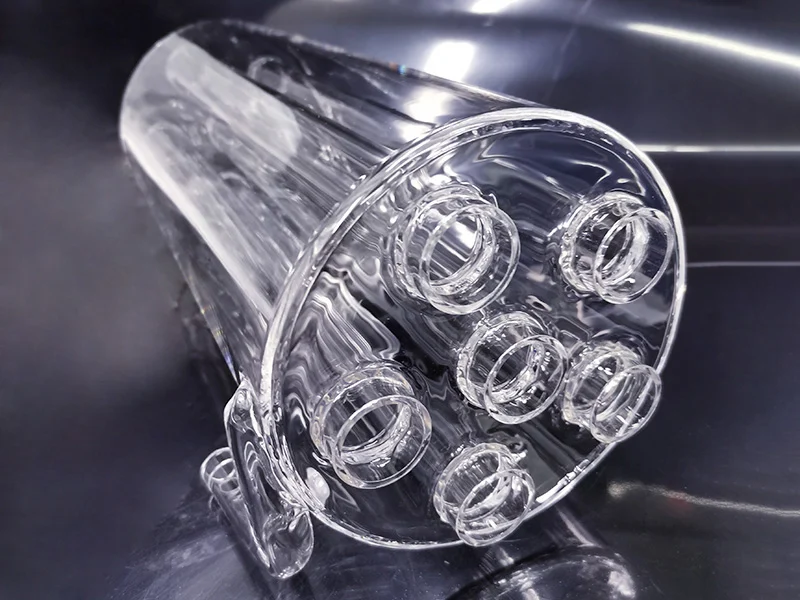
A quartz inline heater — also called a quartz flow-through heater or quartz circulation heater — heats a process liquid or gas as it flows through a chamber made of high-purity fused silica. The fluid touches only quartz, never a metal surface, so ion pickup and particle shedding stay low.
FGQuartz manufactures the fused quartz (SiO₂ ≥ 99.99%) heater chamber to your drawing: straight, coiled, multi-pass, or custom flow paths, with inlet, outlet, side-arm, flange, and threaded connections. Typical uses are semiconductor wet benches, high-purity chemical and DI water heating, gas preheating, and laboratory process loops. Custom manufacturing is available from a single prototype, with no minimum order quantity.
Quick answer
What is a quartz inline heater?
A flow-through heater whose wetted chamber is high-purity fused silica. Process fluid or gas passes through the quartz chamber and is heated as it flows, so it contacts only quartz. FGQuartz makes the quartz chamber to your drawing; the heat source and controls are typically supplied by your equipment integrator.
Key takeaways
- There is no fixed heater catalog: chamber size, flow path, ports, flanges, and threads are built around your fluid, flow rate, and space.
- Quartz suits DI water, HCl, HNO₃, H₂SO₄, aqua regia, organic solvents, and process gases.
- Quartz is not suitable for HF, hot concentrated phosphoric acid, or hot strong alkalis such as concentrated KOH or NaOH.
- Quartz is rigid and brittle, so chamber geometry, support, and heat-up rate are designed together before any glass is cut.
Written by the FGQuartz Engineering Team · Updated November 2026
On this page: Specifications · How it works · Quartz vs other heaters · Configurations · Project examples · Applications · FAQ and quote
Lead time depends on size and drawing complexity; the quote confirms the schedule.
Key features of quartz inline heaters
Product features
Quartz inline heater specifications
Technical specifications
Inline heater chambers are engineered per application. The values below describe the standard build; flow, power, and dimensions are set from your process data and confirmed in design-for-manufacture (DFM) review.
| Parameter | Specification |
|---|---|
| Chamber material | High-purity fused quartz / fused silica (SiO₂ ≥ 99.99%). Clear grade as standard. |
| Scope of supply | FGQuartz manufactures the quartz chamber. Heating elements, lamps, and control systems are typically supplied by your equipment integrator; the chamber is designed to suit them. |
| Fluid media | DI water, mineral acids (HCl, HNO₃, H₂SO₄), aqua regia, organic solvents, and process gases. Not for HF, hot concentrated phosphoric acid, or hot strong alkalis. |
| Heating power | Sized from flow rate, inlet and outlet temperature, and fluid, and set with the heat source in your design. |
| Flow rate | Set from process requirement. Chamber diameter and flow path are designed to match. |
| Outlet temperature | Set by process and fluid. Quartz itself is rated to 1200°C (2192°F) continuous, so the fluid and heat source define the working limit. |
| Chamber geometry | Straight tube, coiled path, multi-pass, or custom flow path, to drawing. |
| Connections | Plain quartz tube ends, side-arm ports, fused or machined flanges, or threaded ends. Interface to your fittings confirmed in DFM. |
| Pressure rating | Calculated per drawing from chamber OD, wall, temperature, and end closures. It is not a catalog number. |
| Processing | Diamond cutting, core drilling, CNC machining, oxy-hydrogen flame forming and welding, fire polishing, annealing. |
| Customization | Build-to-print from DXF, STEP, IGES, or PDF. Single prototypes through production. No MOQ. |
Full thermal, mechanical, optical, and chemical tables: Technical Specifications. Leak-test requirements and interface details are agreed with you per order.
Why quartz for inline heating
How it works
In an inline heater, the process fluid enters a fused silica chamber, passes the heat source, and leaves at the target temperature. Because the wetted parts are quartz, there is no metal contact, so ion pickup and particle shedding stay low. That matters for semiconductor wet processing and high-purity chemistry, where a stainless or coated heater could contaminate the bath.
The trade-off is design discipline. Quartz is rigid and brittle, so chamber geometry, support, and heat-up rate must be designed together. FGQuartz reviews flow, power density, and mounting with you before cutting glass. For background on the material, see What is quartz glass?
Typical properties of fused silica
Baseline for high-purity fused silica.
| Continuous service | 1200°C (2192°F) |
| Short-term maximum | 1300°C (2372°F) |
| Softening point | ≈ 1680°C (3056°F) |
| Strain point | ≈ 1120°C (2048°F) |
| Thermal expansion (20–300°C) | 5.5 × 10⁻⁷ /°C |
Chemical note: excellent resistance to HCl, HNO₃, H₂SO₄, and aqua regia. Attacked by HF, hot concentrated phosphoric acid, and hot strong alkalis.
Quartz inline heater vs immersion heater
Comparison
An immersion heater places a heating element directly in a static tank of fluid. An inline (flow-through) heater heats the fluid as it circulates through a chamber, usually in a recirculation loop.
| Point | Quartz inline heater | Immersion heater in the tank |
|---|---|---|
| Where heating happens | In a separate chamber on the circulation loop. | Inside the bath itself. |
| Bath footprint | No heater inside the tank; the heater sits beside it. | Takes space and wetted surface in the tank. |
| Wetted material | Fused silica only. | Depends on the heater sheath or coating. |
| Heat distribution | Fluid is heated in a defined flow path, then returned to the bath. | Relies on convection or stirring in the tank. |
| Needs | A pump and loop. | A tank with room for the heater. |
Choosing the wetted material
| Point | Fused quartz | Stainless steel | Fluoropolymer (PFA / PTFE) |
|---|---|---|---|
| Metal ion release | None from the chamber (SiO₂ ≥ 99.99%). | A risk in ultra-pure water and acids. | None from the polymer itself. |
| Temperature ceiling | High; the fluid and heat source set the limit. | High. | Lower than quartz. |
| Mineral acids | Excellent (HCl, HNO₃, H₂SO₄, aqua regia). | Limited in many acids. | Excellent. |
| HF | Not suitable. | Not suitable. | Suitable. |
| Visual inspection | Clear grade allows it. | No. | Limited. |
| Main trade-off | Rigid and brittle; needs careful support. | Contamination risk. | Lower temperature limit. |
General material comparison for orientation; check the exact fluid, concentration, and temperature for any real design. Quartz is the right choice when purity, temperature, and mineral-acid resistance matter and HF is not in the process.
How to choose a quartz inline heater chamber
Selection guide
Start from the fluid and the loop, then match the flow path and connections to it.
| If your process needs… | Specify |
|---|---|
| Low pressure drop on a DI water or chemical line | A straight-through chamber. |
| Compact size with long residence time | A coiled or multi-pass flow path. |
| A recirculating wet-bench bath | A circulating chamber with inlet and outlet ports sized for the pump and bath. |
| A serviceable joint to existing equipment | Fused or CNC-machined flanges, or threaded ends, matched to your drawing. |
| Preheating process gas | A gas-path chamber ahead of the process zone. |
| To see the flow path | Clear grade quartz, which is the standard. |
| HF, hot concentrated phosphoric acid, or hot strong alkali in the fluid | Not quartz — choose another material. |
Quartz heater configurations we build
Customization
FGQuartz does not publish a fixed heater catalog. Each chamber is designed around your fluid, flow rate, target temperature, and available space, from a single prototype to production, with no minimum order quantity. Non-heater custom parts are on the custom quartz glass page.
| Configuration | Typical use | What is fabricated |
|---|---|---|
| Straight-through heaters | DI water and chemical lines needing low pressure drop | Quartz tube chamber with inlet and outlet ends, built to suit the heat source in your design. |
| Coiled-path heaters | Compact units needing long residence time | Flame-formed spiral or multi-pass quartz flow path around or beside the heat source. |
| Circulating heaters | Recirculating wet bench and chemical baths | Loop-ready chambers with inlet and outlet ports sized for the pump and bath. |
| Flanged heaters | Equipment interfaces and serviceable assemblies | Fused or CNC-machined quartz flanges with sealing faces. |
| Gas preheaters | Process gas lines for CVD and furnace tools | Quartz gas-path chambers that heat the gas before it enters the process zone. |
| Custom assemblies | OEM and non-standard heater designs | Build-to-print from CAD or a qualified sample, with welded multi-part quartz structures. |
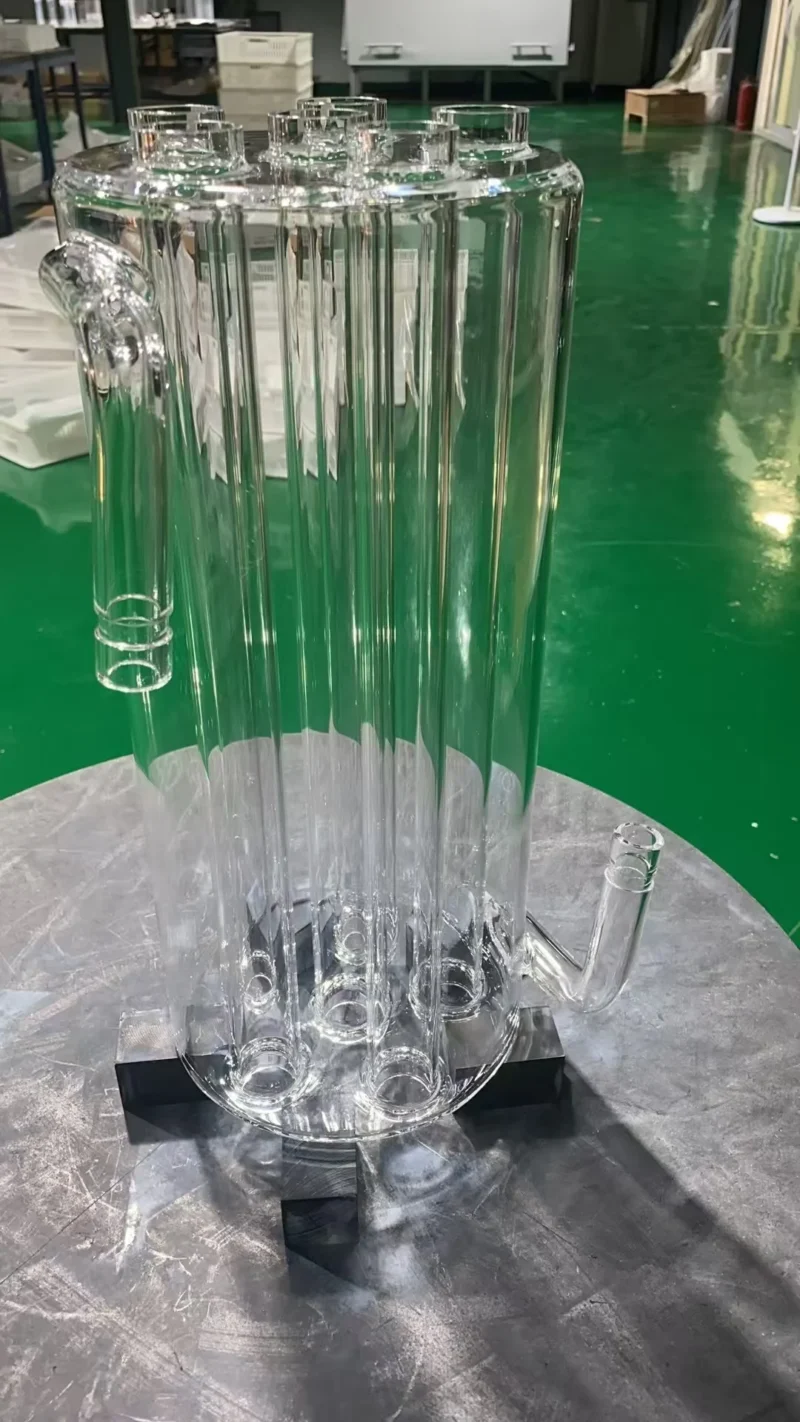
Flow chambers are flame-formed, welded, and annealed in the same facility as the drawn tube.
Representative heater chamber builds
Project examples
Three typical custom heater chamber projects, described by the requirement, the build route, and what is checked against the drawing. Customer names and confidential drawing data are withheld.
01 · Semiconductor
Wet-bench circulation chamber
Requirement. A heated chemical loop with side ports sized for the circulation pump and bath.
How it is built. Quartz chamber with core-drilled side ports, flame-welded joints, fire-polished and stress-relief annealed.
Checked against the drawing. Chamber dimensions, port positions, and port size.
02 · High-purity fluid
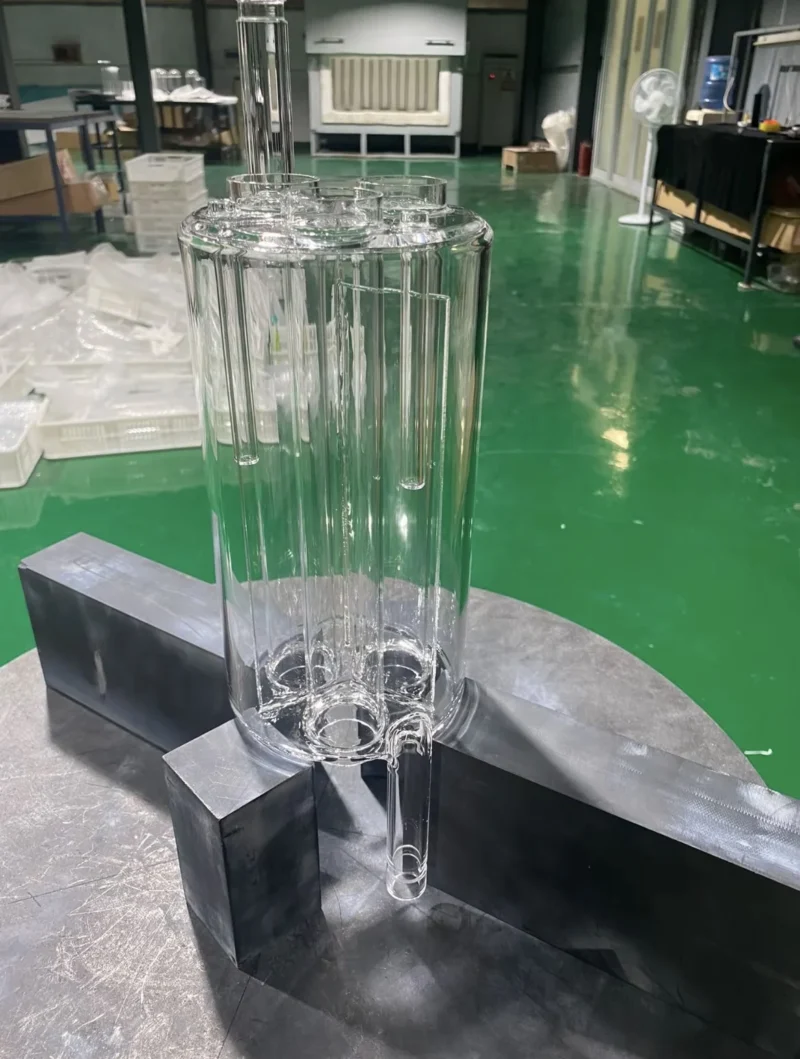
Multi-tube flow chamber
Requirement. Longer residence time in a compact body, with top inlet and outlet ports.
How it is built. Several quartz tube passes welded into one chamber with top ports, then annealed to relieve weld stress.
Checked against the drawing. Pass layout, overall envelope, and port locations.
03 · Fluid and gas lines
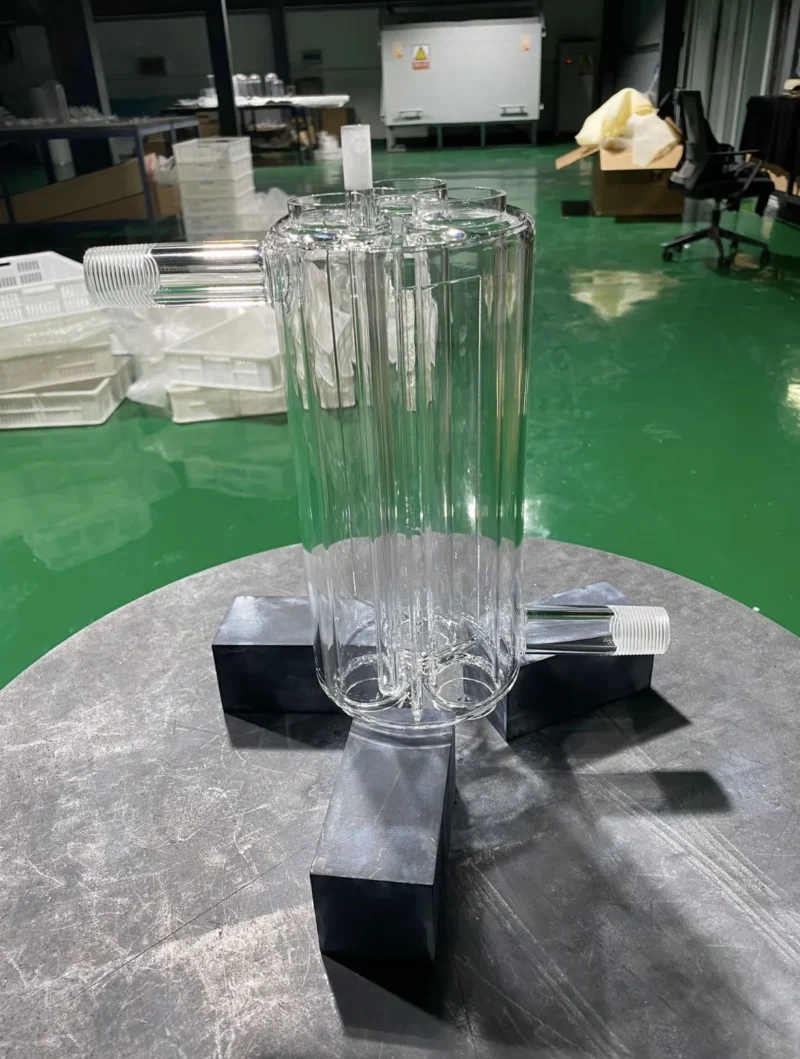
Threaded-connection heater chamber
Requirement. A heater chamber that connects to existing fittings without adapters.
How it is built. Quartz chamber with CNC-milled threaded ends matched to the customer drawing, fire-polished and annealed.
Checked against the drawing. Thread form, end dimensions, and chamber length.
Formed, welded, and annealed under one ISO 9001 system
Manufacturing and quality
FGQuartz operates a 15,000 m² facility in Lianyungang covering CNC diamond machining, oxy-hydrogen flame forming, welding, fire polishing, and annealing, so the quartz chamber is made and finished in one plant. Learn more about FGQuartz; tube stock is covered on the quartz glass tubes page.
Quartz inline heater applications
Applications
Quartz heater manufacturer: why specify FGQuartz
Manufacturer
Quartz inline heater FAQ
Procurement questions
What is a quartz inline heater?
A quartz inline heater, also called a quartz flow-through or circulation heater, is a heater whose wetted chamber is high-purity fused silica. Process fluid or gas passes through the quartz chamber and is heated as it flows, so it contacts only quartz and not a metal surface.
Do you supply the heating element and controls?
FGQuartz manufactures the fused silica chamber to your drawing. Heating elements, lamps, and control systems are typically supplied by your equipment integrator, and the chamber is designed to suit them.
What fluids can a quartz heater chamber handle?
Quartz suits DI water, HCl, HNO₃, H₂SO₄, aqua regia, organic solvents, and process gases. It is not suitable for HF, hot concentrated phosphoric acid, or hot strong alkalis such as concentrated KOH or NaOH.
What is the difference between a quartz inline heater and an immersion heater?
An inline heater heats the fluid in a separate chamber on a circulation loop, so no heater sits in the tank and the wetted material is fused silica only. An immersion heater places the element directly in a static bath, taking tank space and relying on convection or stirring. The inline option needs a pump and loop.
How does quartz compare with stainless steel or fluoropolymer for the wetted material?
Quartz releases no metal ions from the chamber, resists mineral acids, and allows visual inspection, but is rigid and brittle and is not suitable for HF. Stainless steel is a contamination risk in ultra-pure water and acids. Fluoropolymers (PFA / PTFE) suit HF but have a lower temperature limit than quartz.
What outlet temperature and pressure can a quartz heater chamber run at?
Fused silica itself is rated to 1200°C (2192°F) continuous, so the fluid and heat source define the working limit and the outlet temperature is set by your process. The pressure rating is calculated per drawing from chamber OD, wall, temperature, and end closures; it is not a catalog number.
What chamber shapes and connections are available?
Straight-through, coiled, multi-pass, or custom flow paths, with plain tube ends, side-arm ports, fused or CNC-machined flanges, or threaded ends. The interface to your fittings is confirmed in design-for-manufacture (DFM) review.
What are the minimum order quantity, lead time, and quote process?
There is no minimum order quantity; single prototypes are welcome. Custom builds typically take 3–6 weeks depending on size and drawing complexity, and the quote confirms the schedule. Send a drawing (DXF, STEP, IGES, or PDF), or the fluid, flow rate, and space envelope; replies typically arrive within 24 business hours.
Related pages
Keep reading
Quartz tanks
Welded fused silica baths with ports sized for heaters and circulation loops.
Quartz glass tubes
Custom fused silica tubes, OD 5–1000 mm, built to your drawing.
Semiconductor quartz glass
Quartzware for wet benches, diffusion, and CVD.
What is quartz glass?
How quartz glass, fused quartz, and fused silica relate.
Technical specifications
Thermal, mechanical, optical, and chemical tables for fused silica.
Custom quartz glass
Build-to-print quartz parts from a single prototype to production.