Why Custom Quartz Requires a Combination of Processes
High-purity fused silica (quartz glass) is fundamentally different from ordinary glass or metal. It is extremely hard and brittle, softens only at approximately 1680 °C, and must maintain exceptional purity and surface integrity in demanding applications. Because of these material characteristics, no single fabrication method can simultaneously deliver complex geometry, tight dimensional tolerances, and high surface quality.
Flame forming alone can create smooth bends, hermetic seals, multi-port joints, and complex three-dimensional shapes that would be difficult or impossible to machine from solid stock. However, flame forming has limited control over final dimensions. It is not well suited for achieving strict flatness, precise hole positions, or tight slot-pitch tolerances.
CNC cold machining, on the other hand, excels at producing accurate dimensions, flat surfaces, slots, holes, and complex profiles with high repeatability. The limitation is that diamond tooling inevitably leaves microscopic cracks and residual stress just beneath the surface. In high-temperature, vacuum, or cyclic thermal environments, these micro-defects can become initiation points for fracture or particle generation, reducing both service life and process cleanliness.
The practical solution is a hybrid process that combines the strengths of each method:
- Flame forming is used to create the overall shape, joints, and seals.
- CNC machining is used to achieve the required dimensional accuracy and critical features.
- Fire polishing is then applied to heal the micro-cracks left by machining and restore a smooth, continuous surface.
Only by integrating thermal processing and cold machining in a controlled sequence, followed by fire polishing, can manufacturers meet the combined requirements of geometry, purity, and long-term reliability demanded by semiconductor, optical, and laboratory applications. This is why FGQuartz relies on the combination of flame forming, CNC machining, and fire polishing rather than any single technique.
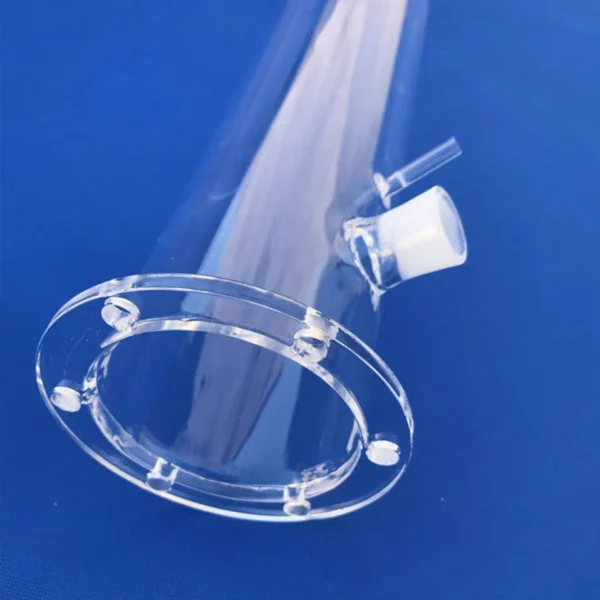
Flame Forming / Thermal Processing
Flame forming, also known as oxy-hydrogen thermal processing or quartz glassblowing, is the primary method used to create complex shapes, hermetic joints, and three-dimensional geometries in high-purity fused silica.
The process uses a clean-burning hydrogen-oxygen flame to heat selected zones of the quartz until the material reaches its softening point (approximately 1680 °C). At this temperature the glass becomes plastic and can be bent, stretched, joined, sealed, or reshaped while retaining its amorphous structure and high purity. Because the only combustion product is water vapor, contamination risk remains extremely low — a critical requirement for semiconductor and optical-grade components.
What Flame Forming Can Do
- Tube bending, necking, and controlled diameter changes
- Domed or flat end sealing
- Side-port and multi-port welding
- Flange and manifold assembly
- Creation of complex free-form shapes and multi-chamber structures
- High-integrity hermetic joints that are particle-free
Typical Parts Produced by Flame Forming
- Custom process tubes and furnace components
- Gas manifolds and injectors
- Multi-port reactors and laboratory apparatus
- Sealed vessels and complex welded assemblies
Advantages
- Ability to form geometries that cannot be machined economically from solid stock
- True fused (hermetic) joints with excellent strength and cleanliness
- Minimal material waste compared with subtractive machining
- Excellent surface quality when followed by fire polishing
Limitations
- Limited control over final dimensional tolerances
- Not ideal for tight flatness, precise hole positions, or fine slot features
- Requires skilled technicians and careful stress-relief annealing
For these reasons, flame forming is almost always combined with CNC machining when a part must meet both complex geometry and strict dimensional requirements.
CNC Cold Machining
CNC cold machining is the primary method used to achieve precise dimensions, complex geometric features, and high repeatability in fused silica components. Unlike flame forming, which relies on heat to reshape the material, cold machining removes material at room temperature using diamond-impregnated tooling.
Because fused silica is extremely hard and brittle, conventional metal-cutting tools cannot be used. Instead, specialized diamond tools and carefully controlled process parameters are required to minimize subsurface damage while achieving the required accuracy.
What CNC Machining Delivers
- Tight dimensional tolerances on critical features
- Precise flatness and parallelism
- Accurate slots, grooves, and wafer boat pitch
- Complex external and internal profiles
- Precision holes (through holes and blind holes)
- Threaded features and mounting interfaces
- High repeatability across production batches
Key Capabilities
- Multi-axis CNC milling of complex shapes and pockets
- Precision turning and centerless grinding
- Diamond core drilling
- Edge preparation and chamfering
- Fine feature machining for semiconductor and optical components
Tolerance and Feature Control
CNC machining is essential when a part must meet strict geometric requirements that flame forming cannot reliably achieve. Typical applications include wafer boat slot pitch, optical mounting surfaces, flange faces, and precision locating features. With proper tooling and process control, high dimensional accuracy and surface consistency can be maintained from prototype to volume production.
Limitations of CNC Alone
Even with optimized parameters, CNC machining of fused silica leaves a thin layer of subsurface micro-cracks and residual stress. These defects are not always visible but can significantly reduce mechanical reliability under high temperature, vacuum, or thermal cycling conditions. For this reason, CNC-machined surfaces that will see demanding service are almost always followed by fire polishing.
CNC cold machining therefore provides the dimensional foundation of a custom quartz component, while subsequent thermal processes restore surface integrity and complete the final geometry.
Fire Polishing – Healing Micro-Cracks
Fire polishing is a critical finishing step in the fabrication of high-performance quartz components. After CNC machining or mechanical grinding, the surface of fused silica contains microscopic cracks and residual stress just beneath the surface. These defects, often invisible to the naked eye, can become initiation points for fracture, particle generation, or reduced optical performance in high-temperature, vacuum, or cyclic service environments.
Fire polishing addresses this problem by applying a controlled oxy-hydrogen flame to the surface. The flame briefly melts a very thin outer layer of the silica. Surface tension causes the molten material to flow, closing micro-cracks and producing a smooth, continuous, glass-like finish.
What Fire Polishing Achieves
- Heals or significantly reduces subsurface micro-cracks
- Removes tool marks and machining-induced surface damage
- Restores a smooth, clean surface with improved optical quality
- Enhances cleanability and reduces particle generation risk
- Improves mechanical reliability under thermal cycling
Why Fire Polishing Is Important
In semiconductor process equipment, optical systems, and high-temperature laboratory applications, surface integrity is as important as dimensional accuracy. A part that meets all geometric tolerances can still fail prematurely if residual micro-cracks are left untreated. Fire polishing provides a practical and effective way to restore surface continuity without the need for extensive mechanical polishing in many industrial applications.
The process is particularly valuable for:
- Semiconductor process tubes, boats, and injectors
- Optical windows and precision cells
- Components exposed to repeated high-temperature cycles
- Parts that must remain particle-free in clean environments
Process Considerations
Fire polishing must be carefully controlled. Excessive heat can distort critical dimensions or create new residual stress. When performed correctly after CNC machining, it complements the dimensional accuracy of cold processing with the surface quality benefits of thermal finishing. In many cases, fire polishing is followed by controlled annealing to further stabilize the component.
By combining CNC machining with fire polishing, manufacturers can deliver quartz parts that meet both strict geometric requirements and the demanding surface integrity standards of advanced industries.
Integrated Process Flow
A reliable custom quartz component is the result of a controlled sequence of processes rather than any single technique. At FGQuartz, thermal processing and cold machining are performed in the same facility, allowing a seamless workflow from raw material to finished part. The typical process flow is as follows:
1. Engineering Review and DFM
Every project begins with a detailed review of the customer drawing (DXF, STEP, IGES, or PDF). Our engineers evaluate manufacturability, identify the optimal combination of flame forming and CNC operations, and confirm critical tolerances, material grade, and surface requirements.
2. Material Selection
The appropriate high-purity fused silica grade is selected based on the application — standard, low-OH, UV-grade, or other specified material. Material purity and consistency are verified before processing begins.
3. CNC Preparation (When Required)
Critical dimensional features, mating surfaces, precision slots, holes, and locating interfaces are often machined first. This establishes the geometric foundation of the part and ensures that subsequent thermal operations can be performed with accurate reference surfaces.
4. Flame Forming and Welding
Complex shapes, bends, end seals, side ports, flanges, and multi-section assemblies are created using oxy-hydrogen flame forming. This stage produces the overall geometry and hermetic joints that cannot be achieved by machining alone.
5. Fire Polishing
After machining and forming, fire polishing is applied to heal micro-cracks, remove tool marks, and restore a smooth, continuous surface. This step is essential for parts that will operate under high temperature, vacuum, or clean-room conditions.
6. Annealing
Controlled annealing is performed to relieve residual stress and stabilize the final dimensions of the component, ensuring long-term reliability under thermal cycling.
7. Final Inspection and Cleaning
The finished part undergoes dimensional inspection, visual examination, and high-purity cleaning before packaging. Critical features are verified against the approved drawing.
Because both thermal and cold processes are carried out under one roof, we maintain full control over alignment, cleanliness, and schedule — from prototype through volume production.
What We Can Make
By combining flame forming, CNC machining, and fire polishing in a single controlled workflow, FGQuartz produces a wide range of high-purity fused silica components that go far beyond standard tubes, rods, and plates. The hybrid process allows us to manufacture both relatively simple custom parts and highly complex assemblies that must meet strict geometric, purity, and reliability requirements.
Complex Tube and Furnace Components
We regularly produce custom process tubes, furnace liners, and high-temperature reaction tubes with non-standard diameters, wall thicknesses, end configurations, and port arrangements. Flame forming enables precise bending, necking, and sealing, while CNC machining ensures accurate flange faces, mounting features, and critical internal dimensions. Fire polishing is applied to critical surfaces to minimize particle generation and improve long-term thermal performance.
Flanged Assemblies and Multi-Port Structures
Many semiconductor and laboratory systems require quartz components with integrated flanges, side ports, and multi-port connections. These parts demand both hermetic joints and precise interface dimensions. Our process sequence typically involves CNC preparation of mating surfaces, followed by oxy-hydrogen welding of ports and flanges, and final fire polishing of exposed surfaces. The result is a strong, clean, and dimensionally accurate assembly ready for vacuum or high-temperature service.
Gas Manifolds, Injectors, and Flow Components
Gas delivery components such as manifolds, injectors, and distribution tubes often combine complex internal flow paths with tight external tolerances. Flame forming is used to create the overall flow geometry and sealed joints, while CNC machining produces accurate mounting interfaces, connection features, and critical orifices. Fire polishing helps maintain clean internal surfaces that resist particle generation during process gas flow.
Wafer Boats and Precision Carriers
Semiconductor wafer boats require precise slot geometry, consistent pitch, and high thermal stability. CNC machining delivers the required dimensional accuracy for slot width, depth, and spacing. When additional features such as custom handles, end supports, or reinforced structures are needed, flame forming and welding are integrated into the process. Fire polishing is used on critical surfaces to reduce the risk of particle contamination and improve mechanical reliability under repeated thermal cycling.
Laboratory and Scientific Apparatus
We manufacture a wide range of custom laboratory quartzware, including reaction vessels, combustion tubes, specialized flasks, evaporating dishes with non-standard geometries, and multi-chamber assemblies. These parts often require a combination of free-form shaping by flame forming and precise features produced by CNC machining. Fire polishing is particularly valuable for improving surface quality and chemical cleanability in analytical and high-temperature laboratory applications.
Optical and High-Purity Components
For optical windows, cells, and precision mounts, dimensional accuracy and surface quality are equally important. CNC machining establishes the required geometry and flatness, while fire polishing or additional optical finishing is used to achieve the necessary surface condition. When complex housings or integrated structures are required, flame forming and welding are added to the process sequence.
Fully Custom Parts to Customer Drawings
In addition to the categories above, we regularly produce fully custom components based on customer drawings or samples. These may include irregular shapes, multi-section welded assemblies, hybrid geometries that combine machined and flame-formed features, and parts that must meet specific material grade, surface finish, and cleanliness requirements. Each project begins with an engineering review to determine the optimal process sequence and confirm feasibility.
Whether the requirement is a single prototype or a production series, the integrated use of flame forming, CNC machining, and fire polishing allows us to deliver components that meet both complex geometric demands and the high purity standards of advanced industries.
Quality & Capability Summary
Consistent quality in custom quartz fabrication depends on more than individual process steps. It requires controlled material selection, stable process parameters, dimensional verification, and surface integrity management throughout the entire workflow. At FGQuartz, these elements are managed under an ISO 9001-certified quality system within a single manufacturing facility.
Material Grades and Purity
We work primarily with high-purity fused silica (SiO₂ ≥ 99.99%). Depending on the application, different grades can be selected, including standard natural fused quartz, low-OH material, and synthetic fused silica for ultraviolet or optical requirements. Trace metal content is kept at very low levels to minimize contamination risk in semiconductor, optical, and analytical applications. Material selection is confirmed during the engineering review stage so that the chosen grade matches both the process environment and the fabrication method.
Dimensional Capability
CNC cold machining provides the primary means of achieving tight geometric control. Critical features such as diameters, lengths, flatness, slot pitch, hole positions, and interface dimensions are produced and verified according to the approved drawing. Flame-formed features are controlled through skilled process execution and subsequent dimensional checking. When a part combines both processes, the sequence is planned so that the most critical tolerances are established by machining and protected during later thermal operations.
Surface Quality and Micro-Crack Control
Surface condition is treated as a functional requirement, not only an aesthetic one. After CNC machining, fire polishing is used to heal subsurface micro-cracks and remove tool marks. This step is especially important for components that will operate under high temperature, vacuum, or clean-room conditions. For optical or ultra-high-purity applications, additional mechanical or chemical polishing can be applied when required. The goal is to deliver a surface that supports both mechanical reliability and process cleanliness.
Process Control and Traceability
Key process variables — including flame parameters, machining conditions, annealing cycles, and cleaning procedures — are controlled and documented. Each custom order is processed according to the approved drawing and the agreed process sequence. Dimensional inspection and visual examination are performed before final cleaning and packaging. This approach provides consistency from prototype through repeat production and supports traceability when required by the customer.
Inspection and Acceptance
Finished components are checked against the customer drawing for critical dimensions and features. Visual inspection is used to confirm surface condition, joint quality, and overall workmanship. High-purity cleaning is performed before packaging to reduce particle and contamination risk. When specific inspection reports, material certificates, or additional testing are required, these can be arranged as part of the order.
Practical Capability Range
The integrated process supports a wide range of part sizes and complexities, from small laboratory components to larger process tubes, manifolds, and multi-section assemblies. Minimum order quantity is one prototype. Standard lead time for custom work is typically three to six weeks after drawing approval, depending on complexity and current workload. Because thermal processing and CNC machining are performed in the same facility, schedule and quality control remain under one responsibility from start to finish.
This combination of material control, hybrid processing, surface finishing, and inspection forms the practical foundation of our custom quartz capability.
Request a Quote for Custom Quartz Fabrication
If your project requires more than standard quartz tubes, rods, or plates, we are ready to support you. FGQuartz combines flame forming, CNC machining, and fire polishing in one facility to produce complex, high-purity fused silica components for semiconductor, optical, solar, and laboratory applications.
To receive a quotation, please send us the following information:
- Drawing or sketch (DXF, STEP, IGES, or PDF preferred)
- Material grade requirement (if known)
- Quantity and target delivery schedule
- Any special surface, cleanliness, or inspection requirements
Our engineers will review manufacturability and provide a clear quotation, typically within 24 business hours. Minimum order quantity is one prototype. Standard lead time for custom work is usually 3–6 weeks after drawing approval, depending on complexity.
You can contact us by email or through our website:
- Email: [email protected]
- Custom fabrication page: https://fgquartz.com/products/custom-quartz-glass/
- Contact page: https://fgquartz.com/contact/
We look forward to reviewing your drawing and supporting your next quartz component project.