Quartz Wafer Boats for Semiconductor Diffusion & Solar Processing
Written by Fei X, Engineering Lead, FGQuartz · Reviewed by Fei X, Production/QA Manager, FGQuartz
Published: February 2022 · Last updated: September 2026
Quick Answer: A quartz wafer boat is a high-purity fused silica carrier that holds semiconductor or solar wafers upright in precisely spaced slots during high-temperature furnace processes such as diffusion, oxidation, and LPCVD. FGQuartz manufactures standard and fully custom quartz boats for 2″–12″ (50–300 mm) wafers, including M10/G12 solar formats, with custom slot counts, pitch, and horizontal or vertical configurations.
Key Takeaways
- Precision Slot Geometry: CNC-slotted pitch accuracy on the order of ±0.05 mm where specified, critical for uniform wafer spacing and process yield.
- Wide Format Range: 2″–12″ (50–300 mm) semiconductor wafers plus M10/G12 solar formats, in 25/50/100/150+ slot capacities.
- High-Temperature Stability: Continuous operation up to 1200°C with excellent sag resistance and thermal shock resistance.
- Low Particle Generation: Fire-polished slots and controlled surface finish reduce wafer scratching and contamination.
- No Minimum Order Quantity: Standard boats through fully custom carriers, single prototype to volume production.
- Integrated Fabrication: CNC slotting, thermal welding, fire polishing, and stress-relief annealing under one ISO 9001 facility.
FGQuartz manufactures high-precision wafer boats and carriers for semiconductor and solar diffusion furnaces, supplying customers in 40+ countries since 2005. Browse our full product portfolio.
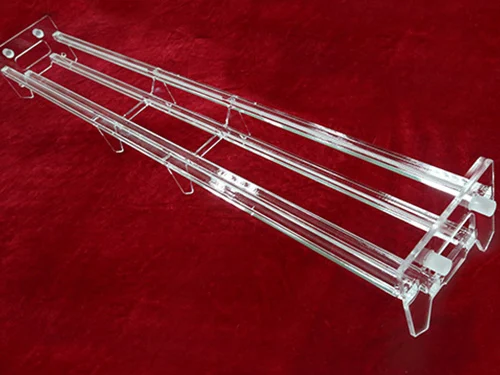
What Is a Quartz Wafer Boat?
A quartz wafer boat (also called a wafer carrier or wafer cassette) is a comb-like fused silica fixture with precisely machined slots that hold silicon or solar wafers upright and evenly spaced while they pass through a high-temperature furnace. The boat’s job is to survive repeated thermal cycling without warping, sagging, or shedding particles onto the wafers — which is why fused quartz, rather than metal or plastic, is the standard material: it combines near-zero thermal expansion, high-temperature stability to 1200°C+, and chemical inertness that keeps wafers free of metallic contamination.
FGQuartz quartz wafer boats securely hold wafers through extreme thermal cycling, from standard horizontal boats to precision vertical carriers, matching furnace geometry, slot pitch, and payload to your process. We supply standard semiconductor and solar quartz boats, fully custom boats to CAD drawings, horizontal/vertical/half-shell designs, and integrated boat sleds and push paddles.
Quartz Wafer Boat Types & Profiles
Primary quartz boat architectures manufactured by FGQuartz. The table below is a quick reference; full detail on each type follows.
| Boat Type | Best For | Key Feature |
|---|---|---|
| Diffusion Boats | Atmospheric diffusion / doping | Fire-polished slots for uniform gas flow and low scratching |
| Oxidation Boats | Wet/dry oxide growth | Strong sag resistance at 1000°C+, open design for uniform oxide thickness |
| LPCVD Boats | Low-pressure CVD environments | Tight-tolerance slots for vacuum stability, caged/sled assemblies |
| Annealing Boats | Thermal cycling / anneal steps | High resistance to thermal stress, heavy-duty rod construction |
| Solar High-Capacity Boats | M10/G12 solar wafer lines | High-density, back-to-back loading, reinforced for robotic handling |
| Custom Carriers | Non-standard furnace geometry, OEM tooling | Custom pitch, angle, groove profile, half-shell designs |
Diffusion Quartz Boats
Engineered for uniform gas flow during atmospheric diffusion.
• Precise wafer pitch for consistent doping
• Fire-polished slots to reduce scratching and particles
• Horizontal and vertical configurations
Used in semiconductor front-end processes. See also wafer boats for diffusion furnaces.
Oxidation Quartz Boats
Thermally robust carriers for wet and dry oxide growth.
• Strong sag resistance at 1000°C+
• Open design for uniform oxide thickness
• Compatible with opaque heat baffles
LPCVD Quartz Boats
Carriers for low-pressure CVD environments.
• Geometry aimed at reducing film flaking issues
• Tight-tolerance slots for vacuum stability
• Caged and sled assemblies available
Annealing Quartz Boats
Structures for thermal cycling and anneal steps.
• High resistance to thermal stress
• Maintains wafer spacing under load
• Heavy-duty rod construction when required
Solar High-Capacity Boats
High-throughput carriers for modern PV lines.
• Optimized for M10/G12 formats
• High-density and back-to-back loading
• Reinforced for robotic handling
Custom Quartz Carriers
Fully custom wafer holders machined to your drawings.
• Custom pitch, angle and groove profiles
• Half-shell and integrated end-plate designs
• Reverse engineering of legacy parts
Explore custom fabrication.
Typical Specifications of Quartz Boats
Baseline specifications of FGQuartz high-purity quartz boats. Dimensions and slot profiles are fully customizable. Full material data: Technical Specifications.
1. Dimensional & Design Range
| Parameter | Typical Range | Notes |
|---|---|---|
| Wafer Size Compatibility | 2″ – 12″ (50–300 mm) | Supports M10 / G12 solar formats |
| Slot Pitch & Width | Custom (typical 2.0 – 6.0 mm) | High-precision CNC; pitch critical for yield |
| Payload Capacity | 25 / 50 / 100 / 150+ slots | High-density and back-to-back designs |
| Surface Finish | Flame-polished / fine CNC milled | Optimized for low particle generation |
2. Material Purity
| Property | Typical Value |
|---|---|
| SiO₂ Purity | ≥ 99.99% |
| Trace Metallic Impurities | Ultra-low |
| Material Type | High-purity fused silica |
3. Thermal & Physical Performance
| Property | Typical Value |
|---|---|
| Continuous Operating Temp. | Up to 1200°C |
| High-Temperature Sag Resistance | Excellent |
| Coefficient of Thermal Expansion | ≈ 5.5 × 10⁻⁷ /°C |
| Thermal Shock Resistance | Outstanding |
How Quartz Wafer Boats Are Made
Semiconductor-grade quartz boats require precise CNC cold machining combined with stress-controlled thermal processing.
Multi-Axis CNC Slotting — Diamond milling cuts V-grooves and U-grooves into the quartz body with tight pitch accuracy (typically on the order of ±0.05 mm where specified) — this pitch precision is what keeps wafers evenly spaced and directly affects process yield.
Thermal Welding & Assembly — Oxy-hydrogen flame joints attach support rods, end plates, and sleds, allowing boats to be built from multiple sections for larger payloads or non-standard geometries.
Fire Polishing — A final flame pass reduces micro-cracks and particle shedding from the machined slots, which is critical since even sub-micron particles can cause device defects on the wafer surface.
Stress-Relief Annealing — Controlled cool-down limits warping under repeated high-temperature service, extending boat service life and keeping slot pitch stable over hundreds of thermal cycles.
Dimensional Metrology — Every boat is verified for slot pitch, parallelism, and bow before shipment.
More on our hybrid fabrication process.
Quartz Wafer Boats vs. Alternative Carrier Materials
Quartz is the standard wafer carrier material, but SiC-coated graphite and solid SiC boats are used in specific process windows — here’s how they compare.
| Material | Max Temp | Contamination Risk | Typical Use |
|---|---|---|---|
| Fused Quartz | ~1200°C | Very low (chemically inert, transparent for visual inspection) | Diffusion, oxidation, LPCVD, general front-end processes |
| SiC-Coated Graphite | ~1400°C+ | Low if coating intact; carbon risk if coating degrades | Epitaxy, higher-temperature CVD |
| Solid SiC | ~1600°C+ | Very low, but opaque (no visual monitoring) | Extreme high-temperature epitaxy |
Quartz remains the standard choice for diffusion, oxidation, and LPCVD because it combines chemical purity with full transparency, letting operators visually inspect wafer loading and process conditions — something opaque SiC and graphite boats cannot offer. For processes exceeding quartz’s practical service temperature, SiC-based carriers are typically specified instead.
Applications of Quartz Boats
Semiconductor Fabs
• Diffusion and oxidation processes
• LPCVD (Poly-Si, SiN, LTO)
• RTP and annealing
• Wet cleaning cassettes (where quartz is specified)
Full solutions: Semiconductor Quartz.
Solar PV Manufacturing
• High-density boats for POCl₃ diffusion
• ALD / PECVD protective carriers
• Robotic loading for M10 / G12 wafers
How to Choose the Right Wafer Boat for Your Process
Use this three-step framework to specify the right boat before requesting a quote:
- Identify your process step. Diffusion and LPCVD favor fire-polished, tight-pitch slotting; oxidation favors an open design for uniform oxide growth; annealing favors heavy-duty rod construction for repeated thermal cycling.
- Confirm wafer size and payload. Specify wafer diameter (2″–12″ or M10/G12 solar format) and required slot count (25/50/100/150+) to match your furnace tube length and throughput target.
- Decide standard vs. custom. If your furnace interface, slot pitch, or handling system doesn’t match a standard boat, plan for a custom carrier — FGQuartz accepts single-piece prototype orders with no MOQ.
Send CAD drawings or key dimensions (wafer size, slot count, pitch, horizontal/vertical, furnace interface) to our engineering team for a feasibility review.
Quartz Wafer Boat Pricing: What Drives the Cost?
Quartz wafer boat pricing depends on four main factors:
- Wafer size and slot count — a 25-slot boat for small-diameter wafers costs less than a 150+ slot high-capacity solar boat.
- Slot pitch precision — tighter pitch tolerances require more CNC time and inspection.
- Construction type — a simple single-piece slotted boat is more economical than a multi-section welded assembly with sleds or push paddles.
- Order volume — unit pricing improves at higher volumes, though FGQuartz accepts single-piece prototype orders with no MOQ.
For an accurate quote, send your wafer size, slot count, and any drawings to our engineering team — quotations are typically returned within 24 business hours.
Quality Assurance & Handling Guidance
Every FGQuartz wafer boat is verified for slot pitch, parallelism, and bow before shipment under our ISO 9001 quality system.
In-service handling tip: Clean boats regularly to remove particulate buildup in the slots, and inspect for surface devitrification (crystallization) if boats are cycled above ~1150°C for extended periods — early-stage devitrification increases particle generation before it becomes visible as surface clouding.
Why Choose FGQuartz for Wafer Boats
• Experience since 2005: Fused silica process components for semiconductor and solar customers.
• Precision CNC slotting: Aimed at stable pitch and low particle generation.
• Integrated manufacturing: Machining, welding and annealing under one ISO 9001 facility.
• Flexible volume: Single prototype to volume production, no mandatory high MOQ.
• Global reach: Export experience to 40+ countries with full compliance documentation.
• Matching range: Process tubes, rods and crucibles.
Company overview: About FGQuartz.
Frequently Asked Questions
Diffusion and oxidation boats emphasize stable slot pitch and gas flow along the load. LPCVD boats often need tighter slot control and shapes that limit film flaking. Solar boats often use higher slot counts for larger wafers such as M10 or G12. State the process on the RFQ so pitch and capacity can be matched.
A quartz wafer boat is a high-purity fused silica carrier that holds silicon wafers during high-temperature furnace steps. It is used in diffusion, oxidation, LPCVD, CVD and annealing processes in semiconductor and solar manufacturing so wafers stay spaced, aligned and chemically clean inside the process tube.
The minimum order quantity is one prototype. Typical lead time is about 3–6 weeks after drawing approval, depending on slot complexity and quantity.
Yes. A drawing (DXF, STEP or IGES), furnace model reference, or photos with critical dimensions of a worn boat are usually enough to produce a drop-in replacement. One prototype order is accepted.
Yes. FGQuartz manufactures horizontal diffusion-furnace boats and vertical wafer boats, as well as half-shell and custom carriers. Base rails, handles and end geometry are matched to the process tube and loadport when drawings or samples are provided.
Boats are made from high-purity fused silica (typically SiO₂ ≥ 99.99%) so the hot-zone carrier does not add metallic contamination. Slots are CNC milled and often fire-polished to limit particles and micro-cracks, then cleaned and packed for process use.
Yes. Slot pitch, slot width, groove profile and total slot count (for example 25, 50, 100 or 150+ slots) are customized by CNC machining. Pitch accuracy is critical for doping and film uniformity, so the qualified tool drawing or a measured sample should define the pitch.
FGQuartz quartz boats typically support wafer sizes from 2 inch to 12 inch (about 50 mm to 300 mm), including common solar formats such as M10 and G12. Slot count, pitch and orientation are matched to the furnace and load size.