JGS1, JGS2, and JGS3 fused silica optics
Optical Quartz Glass
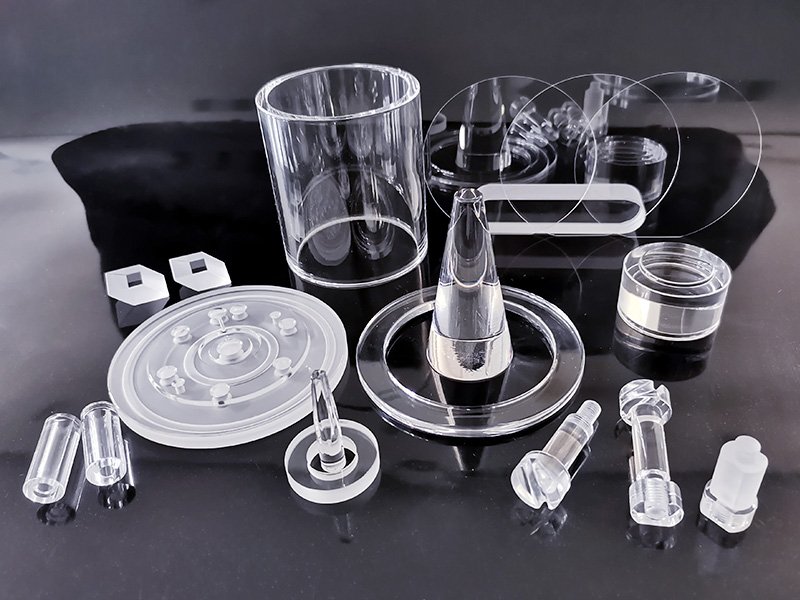
Optical fused silica (quartz glass) is specified when a system must transmit from the deep ultraviolet into the infrared, hold its figure through temperature change, or survive high-power light. FGQuartz makes windows, plates, optical flats, lens and prism blanks, cuvettes, viewports, and custom CNC optics in JGS1, JGS2, and JGS3 grades.
FGQuartz builds fused silica components to drawing in any geometry that can be formed or machined from fused silica, and confirms feasibility in DFM review. State the working wavelength and surface requirement, and the engineering team recommends the grade. Prototypes start from one piece, and quotes are typically returned within 24 business hours.
Quick answer
Which grade of optical quartz glass do I need?
Choose by wavelength: JGS1 for work below about 250 nm (deep UV), JGS2 for roughly 220 nm through the visible and near-infrared, and JGS3 for clean transmission beyond about 2.5 μm. The transmission bands are about 185–2500 nm for JGS1, 220–2500 nm for JGS2, and 260–3500 nm for JGS3.
Key takeaways
- Fused silica works across a very wide laser wavelength range, but CO₂ at 10.6 μm is outside its transmission window; use a mid-IR material for that line.
- Optical-grade plates reach flatness down to λ/10 with parallelism under 30 arc seconds, in formats up to 1200 mm × 1200 mm.
- Windows, lens and prism blanks, cuvettes, flow cells, and viewports are made to your drawing; AR and HR coatings can be arranged through partner coating houses.
- Plates and windows are typically polished on both sides; plates for thermal or structural use can be left as-cut or ground.
Written by the FGQuartz Engineering Team · Updated November 2026
On this page: Choose a grade · Why fused silica · Laser lines · Optical uses · Find components · Surface quality · Limits · Custom optics · FAQ · Quote
Lead time depends on size and drawing complexity; the quote confirms the schedule.
JGS1, JGS2, or JGS3: match the grade to the wavelength
Optical grades
Choose the grade for the working wavelength and do not specify purity you will not use. Typical values are on the technical specifications page.
| Grade | Material | Transmission band | Typical use |
|---|---|---|---|
| JGS1 | Synthetic fused silica | ≈ 185–2500 nm | Deep-UV windows and optics, work below about 250 nm |
| JGS2 | High-purity natural quartz | ≈ 220–2500 nm | UV–visible and near-IR windows, general optics, cost-sensitive work |
| JGS3 | Low-OH material | ≈ 260–3500 nm | Infrared windows, broadband UV–VIS–IR systems, IR sensing |
Rule of thumb: below about 250 nm choose JGS1; beyond about 2.5 μm or for high-power IR choose JGS3; mainly 220 nm to the near-IR and cost-sensitive, choose JGS2.
When does an optical system need fused silica?
Why fused silica
Optical properties (refractive index 1.4585 at 589 nm, UV transmission over 90% at 254 nm for 10 mm) are on the technical specifications page.
| Problem | Why ordinary optical glass struggles | How fused silica helps |
|---|---|---|
| Deep-UV transmission | Ordinary optical glass and borosilicate become opaque in the deep UV. | JGS1 transmits from about 185 nm. |
| Thermal stability of the figure | Higher-expansion glass distorts under heat and cycling. | Thermal expansion of 5.5 × 10⁻⁷ /°C keeps the figure stable. |
| High-power light | Many glasses darken or damage under intense UV or pulsed lasers. | Fused silica is a standard substrate for high-power laser optics; verify the damage threshold for your own pulse regime and surface. |
| Chemical durability | Some optical glasses weather or etch in process environments. | Fused silica resists acids and solvents, so it suits spectroscopy cells and process windows. |
Which grade for which laser line?
Laser lines
State the wavelength, pulse regime, and surface quality on the RFQ and the grade, blank size, and finish are recommended.
| Laser line | Grade |
|---|---|
| Excimer and deep-UV lasers (ArF 193 nm, KrF 248 nm) | JGS1 |
| Nd:YAG 4th harmonic (266 nm) and XeCl (308 nm) | JGS1 or JGS2, depending on the requirement |
| Nd:YAG 3rd and 2nd harmonics (355 nm, 532 nm) and fundamental (1064 nm) | JGS2 |
| Telecom wavelengths (1310 nm, 1550 nm) | JGS2 |
| Broadband UV–VIS–IR, thermal imaging, high-power IR | JGS3 |
| CO₂ laser (10.6 μm) | Outside the fused silica window; use a mid-IR material |
How is optical quartz used in practice?
Optical uses
Laser and photonic systems, deep-UV and semiconductor process monitoring, spectroscopy, scientific research, high-temperature viewing, and UV lighting and curing all rely on the same material; only the grade, finish, and geometry change.
Laser and photonic systems
Workflow
- Pick the grade from the wavelength
- Specify flatness, parallelism, and surface quality
- Fabricate and polish
- Coat if required
| Point | Detail |
|---|---|
| Where quartz is used | Windows, plates, and flats, lens and prism blanks, beam splitters, and laser cavity components. |
| Why quartz | Wide transmission, thermal stability, and use as a standard high-power laser substrate. |
| Watch-outs | Verify the damage threshold for your pulse regime. AR and HR coatings can be arranged through partner coating houses. |
Spectroscopy and analytical instruments
Workflow
- Choose the grade for the wavelength range
- Specify path length and cell geometry
- Fabricate the cell or window
- Clean and measure
| Point | Detail |
|---|---|
| Where quartz is used | Cuvettes, flow cells, and optical windows. See laboratory quartz. |
| Why quartz | UV transmission with chemical resistance for analytical and research work. |
| Watch-outs | Path length and surface quality are set on the drawing. |
Process monitoring and viewports
Workflow
- Identify the chamber or furnace opening
- Specify size, thickness, and seal interface
- Fabricate and fit
| Point | Detail |
|---|---|
| Where quartz is used | Observation windows and viewports for furnaces and chambers. See high-temperature quartz. |
| Why quartz | Optical access with thermal and mechanical reliability. |
| Watch-outs | Specify temperature, atmosphere, and the sealing method. |
UV lighting and curing
Workflow
- Choose the envelope or window grade
- Specify dimensions and ends
- Fabricate
| Point | Detail |
|---|---|
| Where quartz is used | UV lamp envelopes and windows, and optical elements for photochemical systems. |
| Why quartz | Transmits the UV that ordinary glass blocks. |
| Watch-outs | Grade follows the lamp wavelength. |
Find the right optical component
Find components
This table points to the pages that hold the specifications and sizes.
| Optical need | Where to look | What is available |
|---|---|---|
| Windows, flats, and discs | Quartz glass plates | Optical windows and substrates in JGS grades |
| Rods and light guides | Quartz glass rods | Optical rods and blanks |
| UV lamp and process tubes | Quartz glass tubes | Clear tubes and envelopes |
| Lenses, prisms, beam splitters, cells | Custom quartz glass | Optical elements and assemblies to drawing |
What surface quality and sizes are available?
Surface quality
| Item | Capability |
|---|---|
| Flatness | Down to λ/10 for optical-grade plates |
| Parallelism | Under 30 arc seconds for optical-grade plates |
| Formats | Standard formats up to 1200 mm × 1200 mm (about 47 × 47 in); larger formats by engineering review |
| Finish | As-cut, ground, or optically polished, including double-side polished (DSP) windows |
| Coatings | AR and HR coatings through partner coating houses |
Flatness, parallelism, and scratch-dig are set on the drawing. See the plates page for the full plate specification.
When quartz is not the right choice
Limits
Quartz is chosen for purity, thermal stability, and chemical inertness. It is not suited to every environment.
| If your process involves… | Quartz suitability | Consider |
|---|---|---|
| CO₂ laser at 10.6 μm | Outside the fused silica transmission window. | ZnSe, germanium, or another mid-IR material |
| Wavelengths below about 185 nm | Below the JGS1 band. | A vacuum-UV material |
| HF (hydrofluoric acid) | Not suitable. HF attacks fused silica. | An HF-compatible material, such as a fluoropolymer |
| Hot concentrated phosphoric acid | Not suitable. | A compatible material for the bath |
| Hot strong alkalis (for example hot KOH or NaOH) | Not suitable; quartz is attacked. | A compatible material for the bath |
| Continuous service above about 1200°C (2192°F) | Beyond the continuous working limit of fused silica. | A higher-temperature ceramic |
Can FGQuartz make my optical part if it is not on the list?
Custom parts
FGQuartz builds fused silica components to drawing in any geometry that can be formed or machined from fused silica, and confirms feasibility in DFM review. There are three paths:
- Use a standard item from the product pages.
- Modify a standard item: a different size, a port, a flange, a lid, or a changed slot or hole pattern.
- Build to your drawing, sketch, or sample: DXF, STEP, IGES, PDF, a dimensioned sketch, or a worn sample with key dimensions.
Commonly requested
- Windows and viewports with drilled holes, steps, or special outlines
- Lens and prism blanks for further polishing and coating
- Cuvettes and flow cells with a specified path length
- Stepped, drilled, or non-standard optics from a drawing or sample
Prototypes start from one piece. Simpler custom parts typically take 7–14 days and complex assemblies 3–6 weeks. See custom quartz glass fabrication.
Illustrative scenarios
Scenarios
These are typical requests, not customer case studies.
| Situation | What FGQuartz builds | What to send |
|---|---|---|
| A UV lab needs windows below 250 nm | JGS1 windows to a specified flatness | Wavelength, diameter, thickness, flatness, and parallelism |
| A furnace needs a new viewport | A clear fused silica viewport with the seal interface | Temperature, atmosphere, size, and sealing method |
| A research team needs a stepped window | A CNC-machined window with steps and holes | Drawing or sketch and the wavelength band |
| An IR system needs low-loss transmission beyond 2.5 μm | A JGS3 window or blank | Wavelength band, size, and surface requirement |
Optical quartz glass FAQ
FAQ
Which grade of optical quartz glass do I need?
Choose by wavelength: JGS1 for work below about 250 nm (deep UV), JGS2 for roughly 220 nm through the visible and near-infrared, and JGS3 for clean transmission beyond about 2.5 μm. The transmission bands are about 185–2500 nm for JGS1, 220–2500 nm for JGS2, and 260–3500 nm for JGS3.
Which grade suits which laser line?
Excimer and deep-UV lines such as ArF 193 nm and KrF 248 nm use JGS1; 266 nm and 308 nm use JGS1 or JGS2 depending on the requirement; 355 nm, 532 nm, 1064 nm, and telecom lines at 1310 and 1550 nm use JGS2; broadband UV–VIS–IR, thermal imaging, and high-power IR use JGS3. State the wavelength, pulse regime, and surface quality on the RFQ.
Can fused silica be used for CO₂ laser optics at 10.6 μm?
No. CO₂ at 10.6 μm is outside the fused silica transmission window; use a mid-IR material such as ZnSe or germanium. Fused silica is also below its band under about 185 nm.
Is fused silica suitable for high-power laser optics?
Fused silica is a standard substrate for high-power laser optics, but the damage threshold depends on your pulse regime and surface, so verify it for your own application.
What flatness, parallelism, and sizes are available?
Optical-grade plates reach flatness down to λ/10 with parallelism under 30 arc seconds, in standard formats up to 1200 mm × 1200 mm (about 47 × 47 in); larger formats are evaluated case by case. Finish can be as-cut, ground, or optically polished, including double-side polished (DSP) windows.
Can you supply coated optics?
AR and HR coatings can be arranged through partner coating houses. Flatness, parallelism, and scratch-dig are set on the drawing.
What optical parts can FGQuartz make?
Windows, plates, optical flats, lens and prism blanks, cuvettes, flow cells, viewports, UV lamp envelopes, and custom CNC optics in JGS1, JGS2, and JGS3 grades, built to your drawing, sketch, or sample.
What are the minimum order quantity, lead time, and quote process?
Prototypes start from one piece. Simpler custom parts typically take 7–14 days and complex assemblies 3–6 weeks, and the quote confirms the schedule. State the working wavelength and surface requirement and send a drawing or sketch; quotes are typically returned within 24 business hours.
Related pages
Keep reading
Quartz glass plate
Plates, discs, and windows up to 1200 × 1200 mm.
Quartz glass rods
Optical rods and blanks, 3–300 mm OD.
Quartz glass tubes
Clear tubes and UV lamp envelopes, OD 5–1000 mm.
Laboratory quartz glass
Cuvettes, flow cells, and apparatus for analysis.
Technical specifications
Thermal, mechanical, optical, and chemical tables for fused silica.
Custom quartz glass
Build-to-print quartz parts from a single prototype to production.