Quartz Inline Heaters | Flow-Through & Circulation Heating Chambers
Written by Fei X, Engineering Lead, FGQuartz · Reviewed by Fei X, Production/QA Manager, FGQuartz
Published: February 2022 · Last updated: September 2026
Quick Answer: A quartz inline heater (also called a flow-through heater or circulation heater) is a high-purity fused silica chamber that heats process fluid as it circulates through the chamber, rather than submerging a fixed heating element in a static bath. The all-quartz wetted path keeps the fluid free of metallic contamination, making it the standard choice for heating ultra-pure water, aggressive acids, and other chemistries that a metal or PTFE-jacketed heater would contaminate or corrode.
Key Takeaways
- Zero Metal Contact: The entire fluid-wetted path is fused silica, eliminating metallic ion contamination in the process stream.
- Flow-Through Design: Heats fluid in motion (circulation loop or single-pass line), rather than a static immersion bath.
- Chemically Compatible: Resists the same broad range of acids and solvents as other fused silica process equipment (excluding HF and hot concentrated phosphoric acid).
- Custom Chamber Geometry: Single-pass, multi-pass/serpentine, and manifold-integrated chambers built to your flow rate and heating element configuration.
- Integrates with Existing Equipment: Flanged, ported, and threaded connections engineered to match your wet bench or fluid delivery system.
- No Minimum Order Quantity: Single prototype through OEM production volumes, quotes typically within 24 business hours.
FGQuartz manufactures custom quartz inline heater chambers for semiconductor wet benches, ultra-pure water systems, and chemical process lines where the heating element or heat source must be isolated from the fluid by an all-quartz barrier. Every chamber is built to your flow path, connection style, and heating element type — there is no fixed catalogue geometry, because inline heaters are inherently an equipment-integration component.
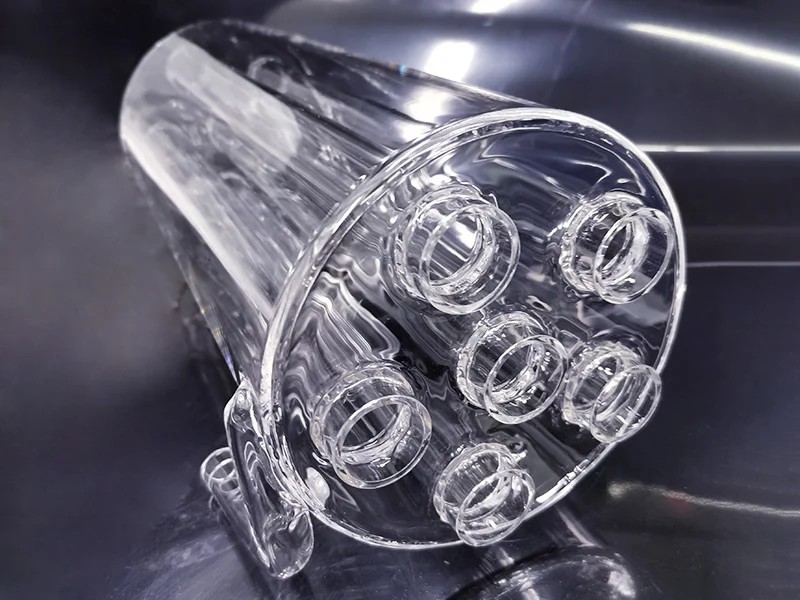
What Is a Quartz Inline Heater?
A quartz inline heater is a fused silica chamber engineered to heat a liquid as it flows through a process line, rather than heating a static volume of liquid in a tank. The heat source — typically a resistive heating element, an infrared lamp, or a hot-fluid jacket, depending on the system design — is separated from the process fluid by the quartz chamber wall, so the fluid never contacts anything but fused silica.
This design serves two purposes at once: it protects the process fluid from metallic contamination (critical for semiconductor wet processes and ultra-pure water systems), and it protects the heating element from direct chemical attack by the fluid. Because fused silica transmits infrared radiation efficiently and tolerates rapid, repeated thermal cycling, it also supports IR-lamp-heated configurations where the lamp sits outside the quartz chamber and the process fluid never touches an electrical component at all.
Quartz Inline Heater Types We Engineer
Primary inline heater chamber architectures FGQuartz fabricates. Because these components integrate directly into existing fluid systems, most orders are custom from the first quote — the table below is a starting reference, not a fixed catalogue.
| Chamber Type | Best For | Key Feature |
|---|---|---|
| Single-Pass Flow-Through | Simple in-line heating on a straight process line | Straight tube chamber, minimal pressure drop |
| Multi-Pass / Serpentine | Higher heat transfer within a compact footprint | Internal baffles or U-bends increase fluid residence time |
| Immersion-Element Chamber | Resistive heating elements isolated from process fluid | Quartz sheath/well separates the element from the fluid path |
| IR Lamp-Heated Chamber | Contactless heating, fastest response | Thin-wall quartz body maximizes IR transmission to the fluid |
| Manifold-Integrated Chamber | Direct retrofit into an existing wet bench or skid | Custom flanges, ports, and fittings matched to your equipment |
Typical Specifications
| Parameter | Placeholder Range | Notes |
|---|---|---|
| Chamber Diameter | [confirm] | Matched to flow rate and connection size |
| Chamber Length | [confirm] | Longer chambers increase residence time / heat transfer area |
| Wall Thickness | [confirm] | Selected for structural integrity and, for IR-heated designs, IR transmission |
| Connection Type | Flanged, threaded, or ported to match your line | Confirmed from your equipment drawing |
2. Material & Purity
| Property | Typical Value |
|---|---|
| SiO₂ Purity | ≥ 99.99% |
| Metallic Impurities | Ultra-low (suitable for ultra-pure water and semiconductor-grade fluids) |
| Material Type | High-purity fused silica |
3. Thermal & Chemical Performance
| Property | Typical Value |
|---|---|
| Continuous Operating Temperature (chamber material) | Up to approx. 1200°C |
| Thermal Shock Resistance | Excellent |
| Chemical Resistance | Excellent vs. common acids and solvents; attacked by HF and hot concentrated phosphoric acid |
Note: The chamber material rating (1200°C) describes the quartz itself, not the practical operating temperature of the fluid being heated, which is set by your process requirement and the heating element/lamp design.
How Quartz Inline Heaters Are Made
Inline heater chambers combine thermal forming and CNC machining, the same two core capabilities behind all FGQuartz custom fabrication.
Tube Forming & Sizing — The chamber body starts as fused silica tubing, sized to the required flow diameter and heating element or lamp geometry.
Flame Welding of Ports & Flanges — Inlet/outlet ports, mounting flanges, and any internal baffles for multi-pass designs are oxy-hydrogen flame-welded to the chamber body, maintaining a fully fused, leak-tight, all-quartz wetted path.
CNC Machining of Connection Features — Flange faces, bolt patterns, and threaded fittings are precision machined to mate with your existing equipment.
Fire Polishing — Internal surfaces are fire-polished to reduce particle generation, which matters for both semiconductor-grade fluid purity and long-term chamber cleanliness.
Thermal Annealing — Stress-relief annealing after welding and machining supports resistance to thermal cycling in continuous heating service.
Learn more about our thermal processing and cold processing capabilities.
Quartz Inline Heaters vs. Alternative Heater Materials
Quartz is the standard choice where fluid purity or chemical resistance rules out metal, but PTFE-jacketed and titanium heaters are common alternatives in less purity-critical service.
| Material | Contamination Risk | Chemical Resistance | Typical Use |
|---|---|---|---|
| Fused Quartz | Very low (chemically inert, no metal contact) | Excellent except HF and hot phosphoric acid | Semiconductor wet benches, ultra-pure water, most acid heating |
| PTFE-Jacketed Metal | Low if jacket intact; metallic risk if jacket fails | Good, jacket-dependent | General industrial chemical heating |
| Titanium | Low for many chemistries, but not purity-critical grade | Good general resistance, poor vs. HF and reducing acids | Plating lines, saltwater and general process heating |
Fused quartz is specified whenever the process cannot tolerate any risk of metallic ion contamination — semiconductor wet benches and ultra-pure water systems are the clearest examples. For less purity-sensitive industrial heating, PTFE-jacketed or titanium heaters are often more economical.
Applications of Quartz Inline Heaters
Semiconductor Wet Processing
• In-line heating of process chemistries feeding wet benches and tanks
• Recirculation loop heating for bath temperature control
• Ultra-pure water heating for rinse and cleaning steps
See Semiconductor Quartz and Quartz Tanks.
Ultra-Pure Water & Chemical Processing
• Point-of-use heating for high-purity water systems
• In-line heating of aggressive acids and solvents in chemical delivery lines
• Laboratory and pilot-scale process fluid heating
See Laboratory Quartz.
How to Choose the Right Quartz Inline Heater
Use this framework to specify your chamber before requesting a quote:
- Define the heat source. Resistive immersion element, IR lamp, or hot-fluid jacket — this determines whether the chamber needs an internal well/sheath or a thin IR-transmissive wall.
- Confirm flow rate and required temperature rise. These determine chamber length, diameter, and whether a single-pass or multi-pass design is needed.
- Specify the fluid chemistry. Confirm the process fluid is compatible with fused silica (excluding HF and hot concentrated phosphoric acid).
- Provide your connection interface. Send the flange, thread, or port specification from your existing equipment so the chamber mates directly into your system.
Send your flow rate, heat source type, fluid chemistry, and connection drawing to our engineering team for a feasibility review.
Pricing: What Drives the Cost?
Quartz inline heater pricing depends on four main factors:
- Chamber complexity — a simple single-pass chamber costs far less than a multi-pass or manifold-integrated design.
- Connection features — flanges, ports, and custom fittings add welding and machining steps beyond a plain tube.
- Dimensions — larger diameter or longer chambers require more raw material and processing time.
- Order volume — unit pricing improves at higher volumes, though FGQuartz accepts single-piece prototype orders with no MOQ.
For an accurate quote, send your chamber requirements and connection drawing to our engineering team — quotations are typically returned within 24 business hours.
Why Choose FGQuartz for Inline Heater Chambers
• Experience since 2005: Fused silica process component fabrication for semiconductor and chemical processing customers.
• Integrated manufacturing: Flame welding and CNC machining under one ISO 9001 facility, so ports, flanges, and the chamber body are built as one continuous process.
• Build-to-print: Chambers matched to your existing equipment interface rather than forcing a fixed catalogue geometry.
• Flexible volume: Single prototype through production, no minimum order quantity.
• Global reach: Export experience to 40+ countries with full compliance documentation.
More about the company: About FGQuartz. Explore related quartz tanks and quartz tubes.
Frequently Asked Questions
Yes. Flanges, ports, and thread connections are machined to match your equipment drawing, and there is no minimum order quantity for prototype or replacement chambers.
FGQuartz manufactures the quartz chamber — the fused silica component that contacts the process fluid. Heating elements, lamps, and control systems are typically supplied by your equipment integrator; we build the chamber to fit your specified heat source and connection interface.
No. Hydrofluoric acid attacks the SiO2 network and should not be run through a fused silica chamber. Discuss your specific chemistry with our engineering team if HF is part of your process.
A traditional immersion heater places a heating element directly in a static tank of fluid. An inline (flow-through) heater heats fluid as it circulates through a chamber, which suits continuous-process and recirculation-loop applications rather than a static bath.
A quartz inline heater heats process fluid as it flows through a fused silica chamber, keeping the fluid free of metallic contamination — used for semiconductor wet-bench chemistries, ultra-pure water, and other purity-critical or corrosive fluids.