What Are Quartz Tube Assemblies and Gas Components?
Quartz tube assemblies and gas components are high-purity fused silica parts that distribute, inject or connect process gases inside semiconductor furnaces, CVD/LPCVD tools, analytical instruments and laboratory apparatus. They are not the main process tube itself. The process tube is the reaction chamber; injectors, manifolds, side ports and flanged ends control where and how gas enters that chamber.
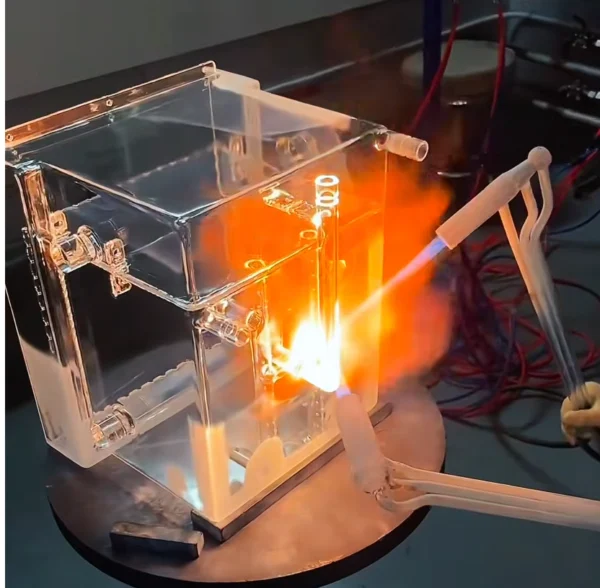
FGQuartz fabricates these parts from high-purity fused silica using oxy-hydrogen flame welding, CNC drilling and machining, fire polishing and annealing. Typical products include tee and multi-port manifolds, single-lance and multi-hole gas injectors, injector rings, flanged tube ends, side-arm welds and quartz ICP torch tubes. Geometry follows the customer drawing or a qualified sample — there is no single catalog SKU for every tool.
This guide covers the main component types, what must appear on the drawing, how parts interface with process tubes and boats, and how to request a quote. Related product pages: quartz glass tubes, custom fabrication, and the hybrid fabrication process guide.
Why Fused Silica for Gas Paths
After the final metal-to-quartz transition, process gas should contact only SiO₂ in the hot zone. Fused silica remains stable in the same temperature band as the process tube (typically continuous service near 1100–1200 °C depending on chemistry), resists common hydride, chloride and oxide precursors, and does not contribute metallic contamination the way a stainless path would. Low thermal expansion helps long lances and welded branches stay aligned through thermal cycling. Optical clarity allows inspection of hole condition and internal deposits.
Material grade should match the process tube it runs with. Semiconductor furnace injectors and manifolds use high-purity fused silica consistent with the tube specification (including OH and trace metals when those are controlled). Optical-grade callouts such as deep-UV transmission are usually unnecessary unless the part also has an optical function.
Quartz Manifolds and Multi-Port Assemblies
A quartz manifold distributes gas or fluid from one or more inlets to multiple outlets in a compact, chemically inert assembly. Tee, cross and multi-port layouts reduce long external piping runs and keep the wetted path in fused silica.
Tee assemblies
A tee joins three tube segments in a T geometry so one line can branch into two (or two lines can combine). Tees are used for sampling points, dual feeds and compact branching in laboratory and process setups. Flame-welded tees must be annealed as an assembly; residual weld stress is a common crack location if annealing is skipped.
Multi-port manifolds
Multi-port bodies integrate several ports in one piece so multiple gases or circuits can be managed without a large external metal manifold inside the hot zone. Ports may be independently used for injection, exhaust or sensing. In laboratory work they reduce contamination risk and simplify layout; in industrial tools they centralize gas management next to the chamber.
Selection notes
Specify flow intent (injection vs exhaust vs sampling), port count and sizes, tube OD/ID, and whether ports are plain, flanged or jointed. Chemical compatibility with the gas list must be confirmed — fused silica is not suitable for HF service. Space, budget and complexity trade off between a simple tee and a multi-port custom body.
Quartz Gas Injectors for Diffusion, LPCVD and CVD
A quartz gas injector delivers process gas into a diffusion, LPCVD or CVD furnace at a defined location and hole pattern. Film thickness and dopant uniformity along the wafer load depend heavily on hole diameter, pitch, clocking and insertion depth — not only on the process tube and wafer boat.
Main injector types
- Single-lance injector — Straight tube, open or flame-sealed distal end, one or a few orifices. Common for diffusion and oxidation when a single axial feed is enough.
- Multi-hole injector tube — Lance with a drilled or flame-opened hole pattern along its length. Default choice when LPCVD/CVD needs distribution along the load. Hole diameter is often in the 0.5–3 mm range; pitch and angular orientation are process-specific.
- Injector ring — Toroidal or segmented ring that releases gas around the circumference at a fixed axial station. Used when azimuthal uniformity matters. Ring-to-feed welds need careful annealing.
- Side-arm / multi-port injector — Branch welded through the process tube wall or onto a flange neck. Tees and Y-joints fall here. Replacement often means a tube-and-arm set, not a removable lance.
- Showerhead-style distributor — Plate or large drilled face for area distribution. More of a CNC plate job than a drawn tube; only build when hole count and pattern are defined.
Hole pattern belongs on the drawing
Hole diameter, axial pitch, clocking (e.g. 12 o’clock vs staggered), open vs closed distal end, and insertion depth from a flange face or tube end must be specified. Copying an eroded sample without measuring original hole size will reproduce wear, not the qualified tool. FGQuartz holds positions by CNC diamond drilling or controlled flame opening; we do not invent a pattern for an unproven recipe.
Interface to the process tube
- Slip-fit into tube or liner (give injector OD and tube ID)
- Ground joint or tapered neck (state joint size)
- Flanged end (OD, thickness, seal face)
- Welded side-arm (non-removable; plan spares as assemblies)
Inner bore that sees gas should be fire-polished. Ground ID sheds particles into the first runs.
Flanged Quartz Tube Joints
Flanged ends provide a mechanical interface between high-temperature quartz and metal or quartz end hardware — O-ring seals, clamps or bolted faces. Flanges may be flame-formed/fused or CNC-machined depending on flatness and seal requirements.
What to specify
- Flange outer diameter, thickness and face style
- Bolt circle or clamp style if any
- Seal surface finish and gasket compatibility (gasket material is usually customer-side)
- Tube OD/ID and overall length
- Operating temperature and whether vacuum service applies
Alignment and even clamp load matter at installation. Over-tightening can chip quartz faces. Regular inspection for cracks or seal-face damage extends service life. Flanged tubes are widely used on semiconductor process chambers, diffusion furnaces and laboratory vacuum setups. Product context: quartz glass tubes.
Quartz ICP Torch and Torch Tube Assemblies
Inductively coupled plasma (ICP) torches for optical emission and mass spectrometry use quartz tubes to contain and shape the plasma. High purity, thermal shock resistance and optical clarity support stable plasma and low background in elemental analysis.
FGQuartz supplies torch tubes and related quartz components compatible with major instrument platforms when dimensions are provided (including demountable and mini-torch styles where specified). Outer tube dimensions, injector geometry and intermediate tube sizes must match the torch body — send the instrument model or a sample drawing. Related laboratory context: laboratory quartz and the laboratory quartz glassware guide.
How These Parts Are Made
Most gas components combine thermal and cold processes:
- Flame forming and welding — Branches, tees, rings, flanges and sealed ends
- CNC drilling and milling — Hole patterns, threads, flat flange faces, precision ports
- Fire polishing — Inner surfaces and hole edges to reduce particles and crack starters
- Annealing — Stress relief after welding, especially at side-arms and ring feeds
Full process description: Quartz Custom Fabrication Process Guide. Cold and thermal capability pages: cold processing, thermal processing.
Common Failure Modes
- Cracks at side-arm or ring welds — residual stress; anneal as a complete assembly
- Hole enlargement from chemistry — wear, not a “wrong grade”; measure new parts, not scrap
- Particles from unpolished ID or sharp drilled edges — specify fire polish / chamfer
- Binding slip-fits after heat-up — leave designed clearance between injector OD and tube ID
- Flange chip or seal leak — alignment, gasket choice and clamp torque
What to Send for a Quote
To quote accurately, include as many of the following as possible:
- Component type (manifold, tee, injector lance/ring, flanged tube, side-arm tube, ICP torch tube)
- Drawing (DXF, STEP, IGES, PDF) or dimensioned sketch; photo of a sample if reverse-engineering
- OD/ID, length, port or hole pattern, insertion depth, flange dimensions
- Process context (diffusion, LPCVD, CVD, lab gas panel, ICP model)
- Material grade notes if the process tube already specifies OH or trace metals
- Quantity and any cleanliness or inspection requirements
Minimum order quantity is one prototype. Engineering review and quotation are typically returned within 24 business hours.
Request Quartz Tube Assemblies and Gas Components
FGQuartz manufactures high-purity fused silica manifolds, injectors, flanged tubes and related assemblies for semiconductor, solar, analytical and laboratory equipment. Send drawings or samples and we will confirm manufacturability and price.
- Email: [email protected]
- Contact: https://fgquartz.com/contact/
- Quartz tubes: https://fgquartz.com/products/quartz-glass-tubes/
- Custom fabrication: https://fgquartz.com/products/custom-quartz-glass/
- Process guide: https://fgquartz.com/quartz-custom-fabrication-process-guide/
- Semiconductor applications: https://fgquartz.com/applications/semiconductor-quartz-glass/
We look forward to supporting your next quartz gas-path or tube-assembly requirement.