What Is Laboratory Quartz Glassware?
Laboratory quartz glassware is high-purity fused silica equipment made for analytical chemistry, sample preparation, high-temperature reactions and contamination-sensitive work. Unlike ordinary borosilicate lab glass, fused silica can be used continuously around 1200 °C, resists most mineral acids, and contributes very little metallic contamination to the sample.
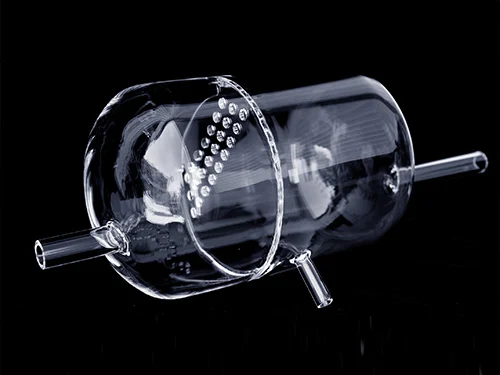
FGQuartz manufactures both standard laboratory forms and fully custom pieces: beakers, flasks, crucibles, evaporating dishes, test tubes, combustion tubes, reaction vessels and multi-neck apparatus. Material is selected for purity and thermal performance; fabrication uses oxy-hydrogen flame forming, annealing and, where needed, CNC finishing so that joints, necks and critical dimensions match the drawing.
This guide covers the main vessel types, when to choose quartz instead of borosilicate, how to specify an order, and how the pieces are used in real laboratory work.
Why Quartz Instead of Borosilicate
Most routine laboratory glassware is borosilicate. Quartz is used when temperature, purity or thermal shock exceed what borosilicate can handle.
- Temperature — Fused silica supports continuous service near 1200 °C and short excursions higher. Borosilicate is typically limited to about 500 °C continuous use.
- Purity — High-purity fused silica minimizes alkali and boron leaching. That matters for trace-metal analysis, ultra-pure acid handling and semiconductor-related wet chemistry.
- Thermal shock — Very low thermal expansion allows rapid temperature changes that would crack borosilicate of similar geometry, provided the part is properly annealed.
- Chemistry — Quartz resists hydrochloric, nitric and sulfuric acids and most organic solvents, including at elevated temperature. It is attacked by hydrofluoric acid, hot concentrated phosphoric acid and strong alkalis at high temperature. Do not specify quartz for HF service.
Below about 500 °C, with no strict blank requirement, borosilicate is often adequate and lower cost. Above that temperature, or when blank and cleanliness dominate, quartz is the practical glass-based choice.
Quartz Beakers
A quartz beaker is an open vessel with a wide mouth and usually a pouring spout. It is intended for open heating, mixing, pouring and short-term holding — not for reflux or vacuum work that needs a neck and joint.
Common forms
- Low-form — Wider and shorter; convenient for evaporation, hotplate work and easy access with a spatula.
- Tall-form — Narrower and taller; reduces solvent loss during longer heating.
- Graduated — Approximate volume marks for routine batching (not a substitute for a volumetric flask).
- Custom — Lids, side arms, reinforced rims or non-standard dimensions made to drawing.
When to order a beaker
Use a beaker when the process is open-top: acid digestion with free evaporation, reagent preparation, pouring into another vessel, or visual monitoring on a hotplate. If the process needs a stopper, condenser or inert-gas line, order a flask instead.
Selection notes
Specify nominal volume, low-form or tall-form, whether a spout is required, and material grade if purity is critical. Avoid impact and over-tight clamping; inspect for chips before high-temperature use. Clean with dilute nitric acid and high-purity water for trace work; never use HF or abrasive scouring.
Quartz Flasks
A quartz flask has a reduced opening (neck) so that stoppers, ground joints, condensers or gas lines can be attached. It is the vessel for closed or semi-closed work: digestion under reflux, distillation, inert blanketing and multi-connection synthesis.
Main types
- Erlenmeyer (conical) — Wide base, sloping walls, narrow neck. Good for swirling and digestion; can sit on a hotplate if the base is specified flat enough. Not the first choice for even boiling in distillation.
- Round-bottom — Spherical body for uniform heating in a mantle. Standard choice for distillation and reflux. Needs a cork ring, clamp or mantle; it will not stand alone on a flat plate.
- Multi-neck — Two, three or four necks on a round body for condenser, temperature probe and addition funnel at once. Each joint size and neck angle should be on the drawing. Welds must be annealed as an assembly.
- Volumetric and other custom — Calibrated marks or special neck layouts made when the print requires them.
Joints and what must be on the drawing
Ground joint size (for example 14/20, 19/22, 24/40, 29/42), inner vs outer, neck length and wall thickness belong on the specification. “Standard neck” is not enough to quote or manufacture reliably. Quartz joints of the same taper standard will mate with matching borosilicate apparatus.
Flask vs beaker
Order a beaker for open heating and pouring. Order a flask when vapor must be returned, removed or excluded, or when a joint must seal during a hold at temperature. Ordering the wrong form is a common first RFQ mistake.
Quartz Crucibles and Evaporating Dishes
Crucibles and evaporating dishes are open cups for ashing, ignition, fusion and high-temperature sample preparation. They have no neck. Choose them when the sample is a solid or residue that must be heated in air or a controlled atmosphere, not when you need a closed joint.
Evaporating dishes
Shallow dishes used to evaporate solvents, ash organic matter and prepare residues for gravimetric or spectroscopic analysis. High thermal stability and chemical inertness keep the inorganic residue free from vessel-derived contamination. Quartz dishes withstand muffle-furnace temperatures that would soften borosilicate and often outperform porcelain on purity and thermal shock.
Laboratory crucibles
Low-form or tall-form cups, with or without lids, for ashing, fusion and melt work. Sizes typically range from small analytical volumes up to larger laboratory capacities. For silicon crystal growth and large industrial CZ crucibles, see the dedicated product page; this guide focuses on laboratory-scale ware.
Use and care
Allow the dish or crucible to cool before cleaning. Use mild detergent or dilute acid as appropriate; rinse thoroughly. Avoid HF and abrasive pads. Store so pieces do not chip against each other. Residual carbon from ashing can often be removed by a brief empty heat in the furnace.
Quartz Test Tubes and Combustion Tubes
Closed-end or open tubes in fused silica are used for small-scale high-temperature reactions, sample containment in tube furnaces and controlled combustion or gas-flow experiments.
Test tubes
Clear fused silica tubes, closed at one end, for heating small samples, sealed-tube reactions and work that needs visual monitoring. They tolerate temperatures far above ordinary glass test tubes and introduce minimal contamination. Available in various diameters and lengths; custom lengths and wall thicknesses are routine.
Combustion tubes
Longer tubes designed for combustion, gas flow and thermal analysis. Open ends allow controlled gas passage and avoid pressure build-up. Material and surface quality must remain stable under prolonged heat so that reaction products are not contaminated by the tube itself.
Both forms benefit from clean handling, gradual thermal ramps for thick walls, and annealing after any flame work or welding of side arms.
Other Laboratory Quartz Items
- Reaction vessels and multi-chamber apparatus — Built to drawing for research and pilot work.
- Optical cells and cuvettes — When UV transmission and path length are specified (often finished beyond simple fire polish).
- Watch glasses, covers and plates — For covering dishes or optical / high-temperature viewing.
- ICP-related tubes and torch components — Compatible geometries for common instrument platforms when dimensions are provided.
Standard catalog sizes can be supplied for common beakers, dishes and tubes. Non-standard geometry is produced under the same custom fabrication process used for industrial quartz parts: flame forming, CNC where needed, fire polishing and annealing.
How Laboratory Quartzware Is Made
Most laboratory vessels are hot-worked. Tube or blank stock is shaped on an oxy-hydrogen flame; necks and joints are formed or welded; ground joints are finished to taper; the piece is annealed to relieve stress. Critical flats or interfaces may be CNC-machined. Fire polishing improves inner surface cleanliness and reduces particle generation in high-purity use.
A full description of the hybrid process (flame forming, CNC and fire polishing) is available on our process guide: https://fgquartz.com/quartz-custom-fabrication-process-guide/.
Cleaning, Compatibility and Common Failures
- Cleaning — Dilute nitric acid soak and high-purity water rinse is standard for trace work. Ultrasonic cleaning helps for narrow tubes. Do not use HF, strong hot alkali or abrasive scouring.
- HF and fluorides — Quartz is not suitable. Use PTFE or other HF-compatible materials for those digests.
- Cracks at necks — Often residual weld stress; replacements should be annealed as a complete assembly.
- Thermal shock — Prefer controlled ramps for large or thick pieces; discard chipped ware before furnace use.
- Clouding or thinning — Often chemistry (fluoride or hot caustic), not “bad quartz.” Change material or process conditions.
What to Send for a Quote
To quote laboratory quartzware accurately, include:
- Vessel type (beaker, Erlenmeyer, round-bottom, multi-neck, dish, crucible, test tube, combustion tube, or custom)
- Volume or key dimensions
- Joint sizes and neck layout if applicable
- Material grade if known (standard, low-OH, optical, etc.)
- Quantity and any surface or cleanliness requirements
- Drawing, sketch or photo of a sample (DXF, STEP, IGES or PDF preferred for custom work)
Minimum order quantity is one prototype. Engineering review and quotation are typically returned within 24 business hours.
Request Laboratory Quartz Glassware
FGQuartz supplies standard and custom laboratory fused silica ware for analytical, research and high-temperature work. Whether you need a set of beakers and dishes or a multi-neck flask built to print, send the details above and we will confirm feasibility and price.
- Email: [email protected]
- Laboratory application page: https://fgquartz.com/applications/laboratory-quartz/
- Custom fabrication: https://fgquartz.com/products/custom-quartz-glass/
- Contact: https://fgquartz.com/contact/
- Crucibles product page: https://fgquartz.com/products/quartz-crucible/
- Tubes product page: https://fgquartz.com/products/quartz-glass-tubes/
We look forward to supporting your laboratory quartz requirements.