Home / Products / Quartz Glass Rod
Custom fused silica solid rods · Ø 3–300 mm · Drawn, ground, and machined
Quartz Glass Rod
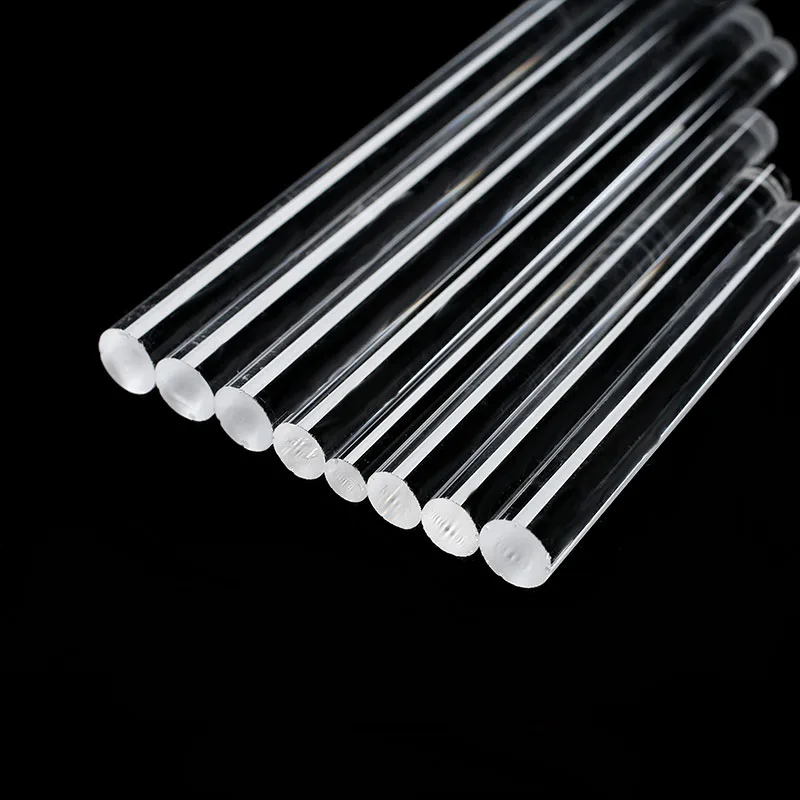
Quartz glass rods — also called fused silica rods or fused quartz rods — are solid fused silica cylinders used as structural supports, boat and rack rails, chemically inert stirring rods, optical fiber preform target (starting) rods, and fixtures in high-temperature furnaces.
FGQuartz manufactures drawn rods from 3 mm to 300 mm outer diameter, with standard lengths up to 3000 mm and larger solid ingots on request, from fused silica with SiO₂ ≥ 99.99%. Rods are supplied as drawn or centerless-ground for tighter diameter and straightness control, and are finished into custom parts — ground, tapered, stepped, threaded, drilled, bent, and welded — to the customer drawing. Custom manufacturing is available from a single prototype, with no minimum order quantity.
Quick answer
What is a quartz glass rod used for? Quartz glass rods are used as structural supports, chemically inert stirring rods, optical fiber preform target and starting rods, and support elements in semiconductor wafer boats and high-temperature furnace fixtures.
Key takeaways
- FGQuartz supplies rods from 3 mm to 300 mm OD, in standard lengths up to 3000 mm, with larger solid ingots on request.
- Centerless-ground rods typically reach straightness and concentricity better than 0.1 mm/m, verified in inspection; as-drawn rods are less dimensionally precise.
- External and internal threads, through and blind holes, slots, and custom end profiles are machined to drawing.
- Ultra-high-purity centerless-ground target and starting rods are made for VAD and MCVD preform processes.
Written by the FGQuartz Engineering Team · Updated October 2026
On this page: Specifications · Grade and finish · Drawn vs ground · Rod types · Project examples · Applications · FAQ and quote
Lead time depends on size and drawing complexity; the quote confirms the schedule.
What quartz glass rods are specified for
Product features
Quartz glass rod specifications
Technical specifications
Values below describe the standard build for fused silica rods. Critical dimensions and tolerances are set from the drawing and confirmed in design-for-manufacture (DFM) review.
| Parameter | Specification |
|---|---|
| Material | High-purity fused silica / fused quartz (SiO₂ ≥ 99.99%). Optical grades (JGS1 / JGS2 / JGS3) and opaque fused silica when specified. See JGS1 vs JGS2 vs JGS3. |
| Outer diameter | 3 mm – 300 mm, made to drawing. |
| Length | Standard lengths up to 3000 mm; larger solid ingots on request. Longer parts by welded sections when required. |
| Dimensional tolerance | Drawn tolerance as standard. Tighter diameter control via centerless grinding, per drawing. |
| Straightness and concentricity | Centerless-ground rods typically better than 0.1 mm/m, verified during quality inspection. Other classes set from the drawing and confirmed in DFM review. |
| Purity | SiO₂ ≥ 99.99%. Trace metals and OH vary by grade. |
| Surface finish | As-drawn, centerless-ground, or fire-polished to the requirement on the drawing. |
| End type | Plain cut, chamfered, fire-polished, flat, domed, ball-ended, or hooked. |
| Features | Steps, tapers, external and internal threads, through and blind holes, cross-holes, slots, and flats, CNC-machined to drawing. |
| Working temperature | Continuous to 1200°C, short-term to 1300°C. |
| Processing | Diamond cutting, centerless grinding, core drilling, CNC machining, oxy-hydrogen flame forming and welding, fire polishing, annealing. |
| Customization | Build-to-print from DXF, STEP, IGES, or PDF. Single prototypes through production. No MOQ. |
Full thermal, mechanical, optical, and chemical tables: Technical Specifications. Load capacity depends on diameter, span, and support, and is set per drawing — it is not a catalog number.
Choosing the rod grade and finish
Rod selection
Most structural rods, such as boat rails, supports, and stirring rods, use clear process-grade fused quartz. JGS1, JGS2, and JGS3 are chosen by wavelength when the rod is an optical element, light guide, or blank. Opaque fused silica suits thermal insulation and heat-shield uses.
Finish decides fit. Drawn rods are fine for loose supports. When a rod slots into a machined hole, fits a fitting, or must run straight through a preform process, centerless grinding brings the diameter and straightness within a tighter band. Send the diameter, tolerance, length, load, and temperature so grade and finish can be matched. For a fuller explanation of the material, see What is quartz glass?
Typical properties of fused silica
Typical values for high-purity fused silica. Optical transmission and OH content vary by grade.
| Continuous service | 1200°C |
| Short-term maximum | 1300°C |
| Softening point | ≈ 1680°C |
| Annealing point | ≈ 1215°C |
| Strain point | ≈ 1120°C |
| Thermal expansion (20–300°C) | 5.5 × 10⁻⁷ /°C |
| Thermal conductivity (20°C) | ≈ 1.4 W/(m·K) |
| Density | ≈ 2.2 g/cm³ |
Chemical note: excellent resistance to HCl, HNO₃, H₂SO₄, aqua regia, and organic solvents. Attacked by HF, hot concentrated phosphoric acid, and hot strong alkalis.
As-drawn rod vs centerless-ground rod
Comparison
The two finishes suit different jobs. The choice turns on how tightly the diameter and straightness must be held.
| Point | As-drawn rod | Centerless-ground rod |
|---|---|---|
| Surface | Naturally smooth from the forming process. | Precision-ground surface. |
| Diameter control | Less dimensionally precise. | Ground to tight OD tolerances. |
| Straightness | Set by the drawing process. | Typically better than 0.1 mm/m, with tight concentricity. |
| Typical use | Loose supports, spacers, stock for machining. | Fitted interfaces and optical fiber preform target and starting rods. |
| Cost | Lower; no grinding step. | Higher; grinding adds a processing step. |
Pricing for any rod depends on diameter, length, finish, and machined features such as drilling, slotting, or threading.
Rod types we fabricate
Customization
Straight drawn stock is only the starting geometry. FGQuartz cuts, grinds, machines, flame-forms, and welds rods into finished parts, from a single prototype to production, with no minimum order quantity. Non-rod custom parts are on the custom quartz glass page.
| Rod type | Typical use | What is fabricated |
|---|---|---|
| Standard drawn rods | Supports, spacers, and stock for further machining | Clear or opaque rods cut to length with chamfered or fire-polished ends. |
| Ground rods | Fitted and sealing interfaces | Centerless-ground rods with tightened diameter control per drawing. |
| Boat and rack rails | Wafer boats, racks, and carriers | Rods cut and CNC-slotted, then welded to end plates or frames. |
| Stirring and handling rods | Laboratory stirring, hooks, and sample handling | Rods with ball, paddle, or hooked ends, flame-formed and fire-polished. |
| Machined rods | Mounting pins, fixtures, and mating parts | Steps, tapers, threads, holes, slots, and flats machined to drawing. |
| Preform target and starting rods | VAD and MCVD optical fiber preform processes | Ultra-high-purity centerless-ground rods engineered for straightness and dimensional consistency. |
| Welded rod assemblies | Frames, racks, and multi-part supports | Rod-to-rod and rod-to-plate joints, annealed after welding. |
Representative rod builds
Project examples
Three typical custom rod projects, described by the requirement, the build route, and what is checked against the drawing. Customer names and confidential drawing data are withheld.
01 · Semiconductor
Boat rail set
Requirement. Matched rails that hold wafers in a diffusion boat.
How it is built. Rods cut to length, CNC-slotted at the specified pitch, welded to end plates, fire-polished and annealed.
Checked against the drawing. Rod length, slot pitch and depth, and overall boat geometry.
02 · Fiber optic
Preform target and starting rod
Requirement. A straight, high-purity rod for a VAD or MCVD preform process.
How it is built. Centerless-ground to a tight diameter, cut to length, ends finished to the drawing.
Checked against the drawing. Diameter, straightness, concentricity, and length.
03 · Furnace fixtures
Threaded and drilled support rod
Requirement. A metal-free mechanical joint in a high-temperature zone.
How it is built. Rod with CNC-milled external thread, cross-holes, and chamfered ends, annealed after machining.
Checked against the drawing. Thread form, hole position and size, and overall length.
Drawn, ground, and machined under one ISO 9001 system
Manufacturing and quality
FGQuartz operates a 15,000 m² facility in Lianyungang covering melting, CNC diamond machining, centerless grinding, oxy-hydrogen flame forming, welding, fire polishing, and annealing, so rod parts are made and finished in one plant. Learn more about FGQuartz.
Handling: clean with an acid bath or alcohol wipe before high-temperature use. Alkali salts and fingerprints catalyze devitrification above roughly 1150°C. Support long or slender rods along their length and avoid point loads and impact on the ends.
Quartz glass rod applications
Applications
Why specify FGQuartz
Manufacturer
Procurement questions
FAQ
Yes. FGQuartz manufactures ultra-high-purity centerless-ground target and starting rods for VAD and MCVD optical fiber preform processes, engineered for straightness and dimensional consistency.
Pricing depends on diameter, length, surface finish (as-drawn vs. centerless-ground), and any machined features such as drilling, slotting, or threading.
Centerless-ground quartz rods typically achieve straightness and concentricity tolerances better than 0.1 mm/m, verified during quality inspection.
Yes. FGQuartz machines external and internal threads, through and blind holes, and custom end profiles using diamond drilling and CNC milling, enabling metal-free mechanical assemblies in high-temperature zones.
FGQuartz supplies quartz rods from 3 mm to 300 mm outer diameter, with standard lengths up to 3000 mm and larger solid ingots available on request.
An as-drawn rod comes directly from the forming process with a naturally smooth but less dimensionally precise surface. A centerless-ground rod is precision-ground to tight OD tolerances and exceptional straightness, required for applications like optical fiber preform drawing.
Quartz glass rods are used as structural supports, chemically inert stirring rods, optical fiber preform target/starting rods, and support elements in semiconductor wafer boats and high-temperature furnace fixtures.