Introduction to Quartz Manifolds
Quartz manifolds serve as essential components in numerous industrial applications, primarily due to their remarkable properties and functional versatility. At their core, quartz manifolds are specialized assemblies designed for the seamless distribution of gases and fluids. These manifolds are typically constructed from high-purity quartz, a material prized for its exceptional chemical inertness, thermal stability, and mechanical strength.
The composition of quartz contributes significantly to its suitability in manifold applications. Unlike traditional materials, quartz can withstand extreme temperatures and pressures without deforming or degrading. This characteristic makes quartz manifolds ideal for use in environments where other materials may fail, such as in chemical processing, semiconductor manufacturing, and various research laboratories.
Additionally, the optical clarity of quartz enhances its functionality in applications that require monitoring or manipulation of light, as seen in certain analytical instruments and optical devices. The transparency allows for visual inspection and adjustment of internal gas or fluid flows, which is not possible with opaque materials. Furthermore, quartz displays excellent resistance to corrosive substances, making quartz manifolds a preferred choice in sectors where exposure to aggressive chemicals is routine.
In terms of practical applications, quartz manifolds are extensively used in industries such as pharmaceuticals, biotechnology, and environmental testing. Their durable nature ensures reliable performance under demanding conditions, while their design can adapt to various configurations including tee and multi-port arrangements. This flexibility allows operators to customize setups according to specific operational requirements, ensuring optimal performance of gas and fluid transport systems. High-purity quartz tubes form the foundation of many of these manifold designs.
Overall, quartz manifolds represent a critical technology that underpins advanced industrial processes, offering both reliability and efficiency in the handling of gases and fluids across a spectrum of applications.
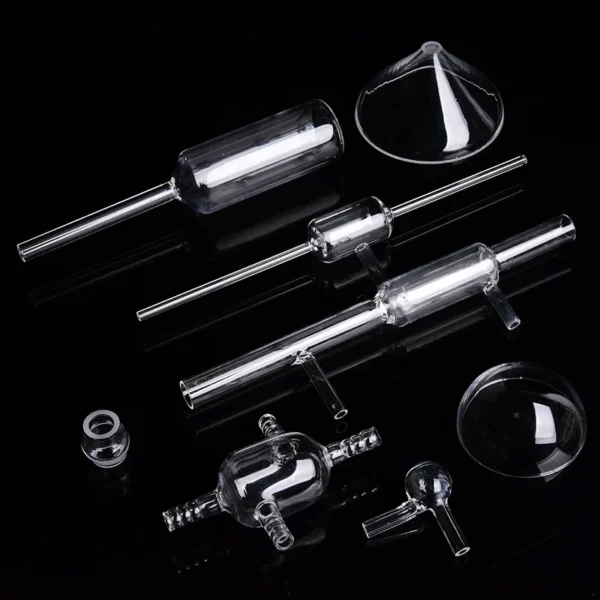
Custom shaped quartz fittings and lab apparatus produced by quartz flame forming fabrication
The Functionality of Tee Assemblies
Tee assemblies serve a crucial role in various gas distribution systems, functioning as integral components designed to facilitate the branching of gas flow. Their structure, resembling the letter “T,” allows for the connection of three segments of piping, enabling the distribution of gases from a single source to multiple outlets. This design is particularly advantageous in applications where efficient gas flow management is paramount.
One of the primary benefits of tee assemblies is their ability to optimize space and enhance the efficiency of gas distribution systems. By allowing for multiple connections, these assemblies minimize the need for lengthy piping runs and reduction fittings, leading to a more compact and streamlined setup. This can result in significant savings in both installation costs and material usage, which are essential considerations in industrial settings where budget constraints are common.
Applications of tee assemblies are widespread, ranging across various industries. For instance, in the chemical manufacturing sector, tee assemblies are utilized to distribute gases such as nitrogen and oxygen to multiple reaction vessels. Similarly, in the oil and gas industry, tee assemblies provide a reliable method for sampling and transporting gases for analysis and processing. Research facilities also benefit from this configuration, where precise gas delivery is critical for experiments and testing.
Moreover, the adaptability of tee assemblies allows them to be implemented in varying pressure and temperature conditions, making them suitable for diverse operational environments. Their design can accommodate different materials and sizes, ensuring compatibility with existing systems, thus simplifying upgrades and expansions in gas distribution setups.
Overall, tee assemblies play a vital role in enhancing the functionality and efficiency of gas distribution systems across numerous applications. Their versatility, coupled with the potential for cost reduction, underscores their importance in designing effective gas delivery networks.
Multi-Port Assemblies: Versatility and Applications
Multi-port gas assemblies represent a significant advancement in the design and functionality of gas distribution systems. These assemblies differ fundamentally from traditional manifold configurations by allowing for the connection of multiple gas inputs or outputs within a single unit. This greatly enhances their flexibility and efficiency in various applications, spanning laboratory environments to large-scale industrial processes.
The construction of multi-port assemblies typically involves several ports integrated into a single manifold. Each port is designed to accommodate a different gas line, which can either deliver or receive gases as necessary. This configuration enables users to manage several gas types simultaneously, thus facilitating complex experiments or manufacturing processes. The robust design ensures that each port can be activated or deactivated independently, allowing for customized gas flow management tailored to specific needs.
In laboratory settings, the versatility of multi-port gas assemblies allows researchers to conduct experiments requiring multiple gases without the need for extensive piping systems. This compact solution minimizes the risk of gas contamination and simplifies workflow. In industrial processes, such as chemical manufacturing or pharmaceutical production, multi-port assemblies contribute to enhancing safety and efficiency by centralizing gas management and reducing the amount of equipment needed for operation.
Additionally, the adaptability of multi-port assemblies means they can be easily modified or expanded to accommodate new gases as requirements evolve, making them an invaluable asset in rapidly changing research and production environments. Their ability to streamline operations and reduce costs makes them a preferred choice across various sectors looking to optimize their gas handling capabilities. For specialized configurations, custom products can be fabricated to exact requirements.
Selecting the Right Assembly for Your Needs
When it comes to choosing between quartz manifolds, tee assemblies, and multi-port assemblies, several factors should be carefully considered to ensure that the selected configuration meets specific operational requirements. An essential criterion is the desired flow rate, as different assemblies facilitate different capacities of gas transport. Understanding the flow rate needed for your application can guide the decision between a simpler tee assembly or a more complex multi-port assembly.
Another critical aspect to evaluate is the compatibility with the gases being used. Certain materials present within quartz manifolds and gas assemblies may react unfavorably with specific gases. It is crucial to examine the chemical compatibility of the materials with your intended gases to avoid any potential hazards or inefficiencies in gas handling.
Alongside these technical specifications, budgetary considerations and overall project costs cannot be overlooked. Multi-port assemblies, while versatile, tend to be more expensive than their simpler counterparts. Therefore, it’s advisable to conduct a cost-benefit analysis that examines both immediate and long-term costs associated with each assembly type to ensure a financially sound decision.
Space constraints also play a significant role in the selection process. In applications with limited installation space, a tee assembly might be preferable due to its compact design. In contrast, if the setup allows for more extensive arrangements, a multi-port assembly may provide greater flexibility and functionality, accommodating multiple gas lines efficiently.
Ultimately, a well-rounded assessment of these factors—flow rates, gas compatibility, budget, and space restrictions—will assist in selecting the most suitable quartz manifold or gas assembly. By aligning these components with project requirements, one can optimize both performance and safety in gas handling applications. High-quality quartz tubes and related assemblies ensure reliable long-term performance.