Introduction
Thermal expansion is one of the most important properties when selecting materials for high-temperature applications.
When a material is heated, it expands. When it cools, it contracts. If this dimensional change creates excessive stress, components may deform, crack, or fail during operation.
Quartz glass is widely used in demanding applications because it has an extremely low coefficient of thermal expansion compared with most glass materials.
This unique characteristic allows quartz components to maintain dimensional stability during repeated heating and cooling cycles.
Applications that benefit from this property include:
- Semiconductor furnace systems
- Solar manufacturing equipment
- Laboratory heating systems
- Optical instruments
- High-temperature processing equipment
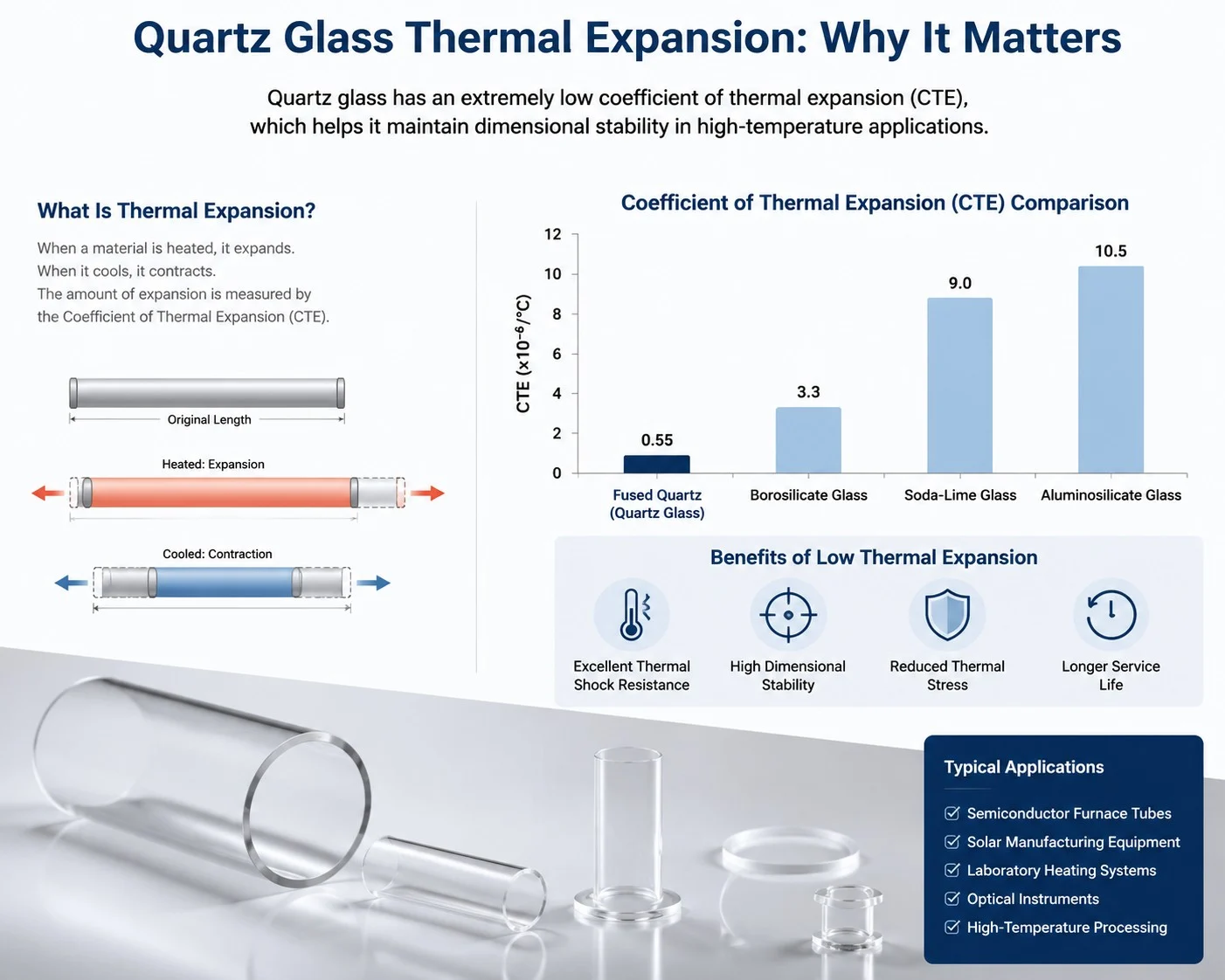
1. What Is Thermal Expansion?
Thermal expansion describes how much a material changes size when its temperature changes.
The amount of expansion is usually expressed through the coefficient of thermal expansion (CTE).
A lower CTE means:
- Less dimensional change during heating
- Lower thermal stress
- Better stability in temperature variations
For precision components, thermal expansion is a critical design factor.
2. Why Does Quartz Glass Have Low Thermal Expansion?
The low thermal expansion of quartz glass comes from its unique silicon dioxide (SiO₂) structure.
The strong Si-O bonds create a stable network that changes very little when temperature varies.
Compared with many conventional glass materials, quartz glass experiences significantly smaller dimensional changes.
This provides advantages in:
- High-temperature equipment
- Precision manufacturing
- Repeated thermal cycling environments
3. Thermal Expansion and Thermal Shock Resistance
Low thermal expansion is directly related to thermal shock resistance.
When a component is heated or cooled rapidly, different areas of the material may experience different temperatures.
This creates internal stress.
Materials with higher expansion rates are more likely to experience:
- Cracking
- Warping
- Mechanical failure
Because quartz glass expands very little, it can better withstand sudden temperature changes.
This is why quartz is commonly selected for:
- Furnace tubes
- Reaction chambers
- Heating system components
4. Why Thermal Expansion Matters in Semiconductor Manufacturing
Semiconductor processes often involve repeated high-temperature cycles.
Quartz components used in these systems must maintain:
- Stable dimensions
- Clean surfaces
- Reliable performance
Examples include:
- Quartz furnace tubes
- Quartz boats
- Quartz process chambers
- Quartz liners
If thermal expansion is too high, component dimensions may change during processing, affecting equipment performance and process consistency.
5. Thermal Expansion in Quartz Tube Applications
Quartz tubes are one of the most common industrial applications where low thermal expansion is important.
During operation, furnace tubes may experience:
- Continuous high temperature
- Rapid heating
- Cooling cycles
- Long operating periods
Low expansion helps quartz tubes:
- Maintain their shape
- Reduce thermal stress
- Extend service life
For customized quartz tubes, engineers need to consider:
- Tube diameter
- Wall thickness
- Length
- Heating profile
- Installation method
6. Quartz Glass vs Other Glass Materials
Quartz glass has significantly lower thermal expansion compared with ordinary glass and many specialty glasses.
Quartz Glass
Advantages:
- Extremely low expansion
- Excellent thermal stability
- Suitable for extreme temperatures
Borosilicate Glass
Advantages:
- Lower expansion than common glass
- Suitable for laboratory heating applications
However, for high-temperature industrial processing, quartz glass provides a wider operating margin.
7. Factors Affecting Thermal Performance
Although quartz glass itself has excellent thermal properties, component performance also depends on design and manufacturing.
Important factors include:
Component Geometry
Sharp corners, uneven thickness, and complex structures may increase stress concentration.
Surface Quality
Scratches or defects can become stress points during thermal cycling.
Manufacturing Process
Processes such as:
- Forming
- Welding
- Machining
- Annealing
can influence residual stress and reliability.
8. How FGQuartz Controls Quartz Component Reliability
For custom quartz components, performance depends on more than material selection.
Manufacturing control includes:
- Precision forming
- CNC machining
- Surface finishing
- Stress relief through annealing
- Dimensional inspection
These processes help ensure quartz components perform reliably in demanding applications.
FAQ
Why does quartz glass have low thermal expansion?
Quartz glass has a stable silicon dioxide network structure that changes very little with temperature variations.
Is quartz glass resistant to thermal shock?
Yes. Its low thermal expansion allows quartz glass to withstand rapid temperature changes better than many glass materials.
Why is thermal expansion important for furnace tubes?
Furnace tubes experience repeated heating and cooling. Low expansion reduces stress and helps maintain dimensional stability.
Does quartz glass expand when heated?
Yes. All materials expand when heated, but quartz glass expands much less compared with most glass materials.
Conclusion
Quartz glass thermal expansion is one of the key reasons this material is used in semiconductor, solar, laboratory, and high-temperature applications.
Its extremely low expansion coefficient helps reduce thermal stress, maintain dimensional accuracy, and improve reliability during repeated temperature cycles.
When designing quartz components, thermal expansion should be considered together with geometry, surface finish, manufacturing process, and operating conditions.
FGQuartz provides customized quartz glass components, including quartz tubes, plates, windows, boats, and precision-machined parts for high-temperature applications.