Introduction
Chemical resistance is one of the key reasons quartz glass is selected for demanding industrial applications.
When materials are exposed to chemicals, they may experience corrosion, surface damage, contamination, or loss of performance. For industries such as semiconductor manufacturing, laboratory research, and chemical processing, material stability is critical.
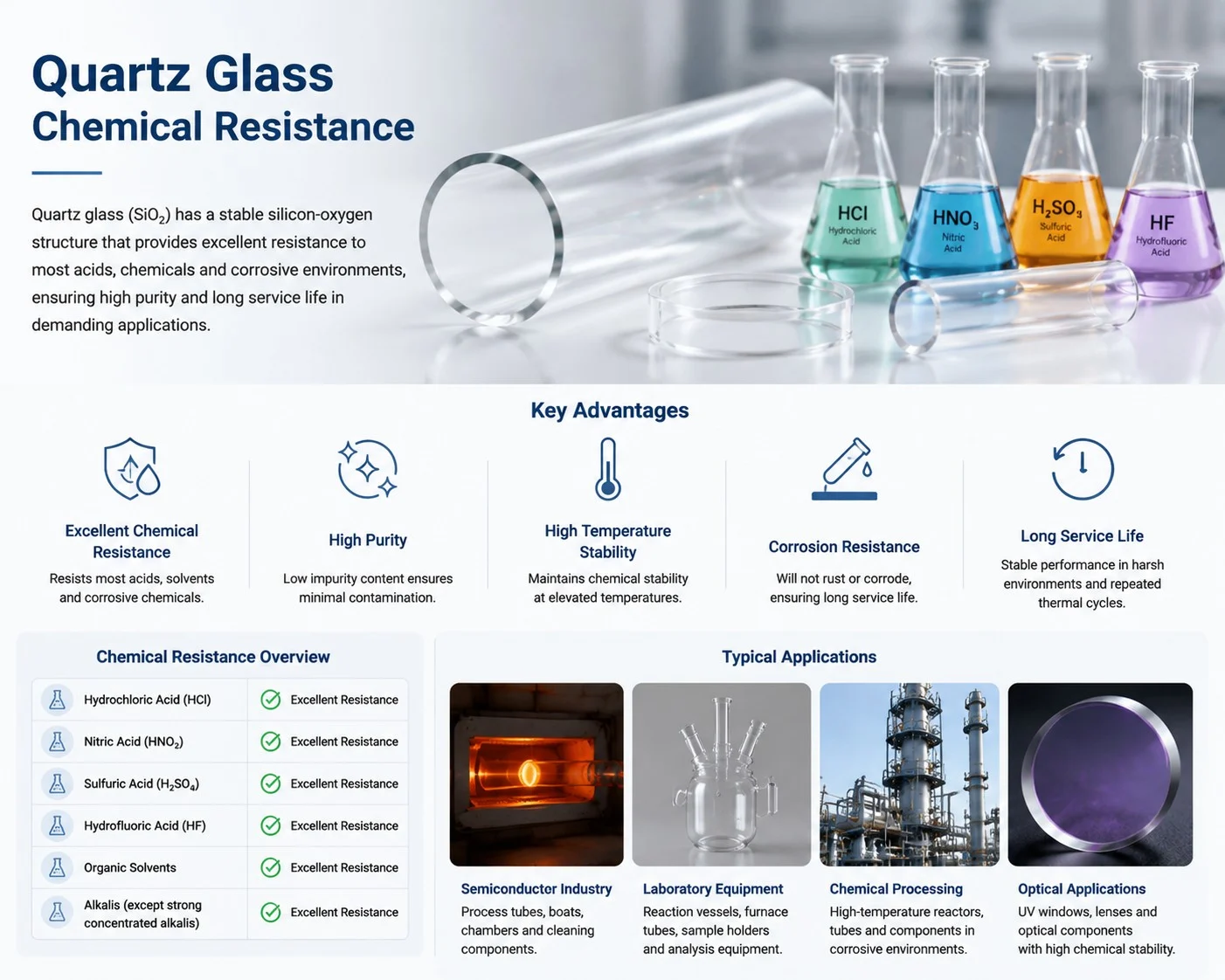
Quartz glass provides excellent chemical durability because of its stable silicon dioxide (SiO₂) structure. This allows quartz components to maintain performance in many aggressive environments where ordinary glass or other materials may not be suitable.
Common applications include:
- Semiconductor processing equipment
- Laboratory reaction systems
- High-temperature chemical processing
- Quartz tubes and chambers
- Precision industrial components
1. Why Does Quartz Glass Have Excellent Chemical Resistance?
The chemical stability of quartz glass comes from its strong silicon-oxygen network.
The Si-O bonds create a highly stable structure that provides resistance against many chemical substances.
Compared with conventional glass materials, quartz glass contains fewer modifying elements, which reduces chemical reactions with external environments.
This results in:
- Low contamination risk
- Stable surface performance
- Long service life
- Reliable operation under demanding conditions
2. Quartz Glass Resistance to Acids
Quartz glass shows excellent resistance to many acids.
It is commonly used in environments involving:
- Hydrochloric acid
- Nitric acid
- Sulfuric acid
- Other laboratory chemicals
However, chemical resistance depends on:
- Temperature
- Concentration
- Exposure time
- Component design
For high-temperature chemical processes, engineers should evaluate actual operating conditions before selecting materials.
3. Quartz Glass and Semiconductor Chemical Processes
Semiconductor manufacturing requires extremely strict contamination control.
Quartz glass is widely used because it provides:
- High chemical stability
- Low contamination risk
- Excellent high-temperature performance
Typical applications include:
- Quartz process tubes
- Quartz boats
- Quartz chambers
- Quartz cleaning equipment
During semiconductor processing, quartz components may be exposed to aggressive chemicals and repeated thermal cycles.
Material stability directly affects process reliability and component lifetime.
4. Quartz Glass Compared with Other Materials
Quartz Glass vs Ordinary Glass
Ordinary glass contains additional components that can affect chemical stability.
Quartz glass provides:
- Better chemical durability
- Higher temperature capability
- Better purity performance
Quartz Glass vs Borosilicate Glass
Borosilicate glass has good chemical resistance and is widely used in laboratories.
However, quartz glass provides advantages in:
- Higher temperature environments
- UV applications
- High-purity processing
The correct material depends on the application requirements.
5. Chemical Resistance in Laboratory Applications
Laboratories often require materials that can withstand chemical exposure while maintaining cleanliness.
Quartz glass is used for:
- Reaction vessels
- Furnace tubes
- Sample holders
- Optical observation windows
Advantages include:
- Easy cleaning
- Low contamination
- Good long-term stability
6. Limitations of Quartz Glass Chemical Resistance
Although quartz glass has excellent chemical resistance, it is not completely unaffected by every chemical.
Certain conditions may affect quartz glass performance, including:
- Strong alkaline solutions
- High-temperature chemical exposure
- Long-term aggressive environments
Material selection should consider the complete operating environment rather than only one property.
7. How Manufacturing Quality Affects Chemical Performance
Chemical resistance depends not only on material composition but also on manufacturing quality.
Important factors include:
Surface Finish
A smoother surface can improve:
- Cleanability
- Resistance to contamination
- Process stability
Processing Quality
Manufacturing processes such as:
- CNC machining
- Flame polishing
- Welding
- Annealing
can influence component reliability.
Cleaning and Handling
Proper cleaning and handling are important for high-purity applications.
Especially in semiconductor environments, surface contamination control is essential.
8. Applications of Chemically Resistant Quartz Components
Quartz glass is widely used in:
Semiconductor Industry
- Process tubes
- Wafer boats
- Chambers
- Cleaning components
Laboratory Industry
- Reaction equipment
- Heating systems
- Sample containers
Chemical Industry
- High-temperature processing equipment
- Corrosive environment components
Optical Industry
- Chemical-resistant optical windows
FAQ
Is quartz glass resistant to acids?
Yes. Quartz glass has excellent resistance to many acids and is widely used in chemical and laboratory applications.
Can quartz glass be used with chemicals?
Yes, but the chemical type, concentration, temperature, and exposure time should be considered.
Is quartz glass better than borosilicate glass for chemical resistance?
Both materials have good chemical resistance. Quartz glass is preferred when higher temperature stability and purity are required.
Why is quartz used in semiconductor equipment?
Quartz provides chemical stability, high-temperature resistance, and low contamination characteristics required in semiconductor processing.
Conclusion
Quartz glass chemical resistance is one of the main reasons it is used in semiconductor, laboratory, and industrial applications.
Its stable silicon dioxide structure provides excellent resistance to many chemicals while maintaining performance under high-temperature conditions.
For applications requiring cleanliness, reliability, and long-term stability, quartz glass remains one of the preferred engineering materials.
FGQuartz provides custom quartz glass components, including quartz tubes, plates, windows, boats, crucibles, and precision-machined quartz parts for demanding industrial applications.