Introduction
Quartz glass manufacturing is a specialized process that requires precise control of temperature, material handling, forming methods, and finishing processes.
Unlike ordinary glass production, quartz glass processing requires extremely high temperatures because silicon dioxide has a very stable molecular structure.
The final performance of a quartz component depends not only on the material itself, but also on how it is formed, machined, polished, and inspected.
For industrial applications such as semiconductor equipment, solar manufacturing, laboratory furnaces, and optical systems, manufacturing quality directly affects component lifetime and reliability.
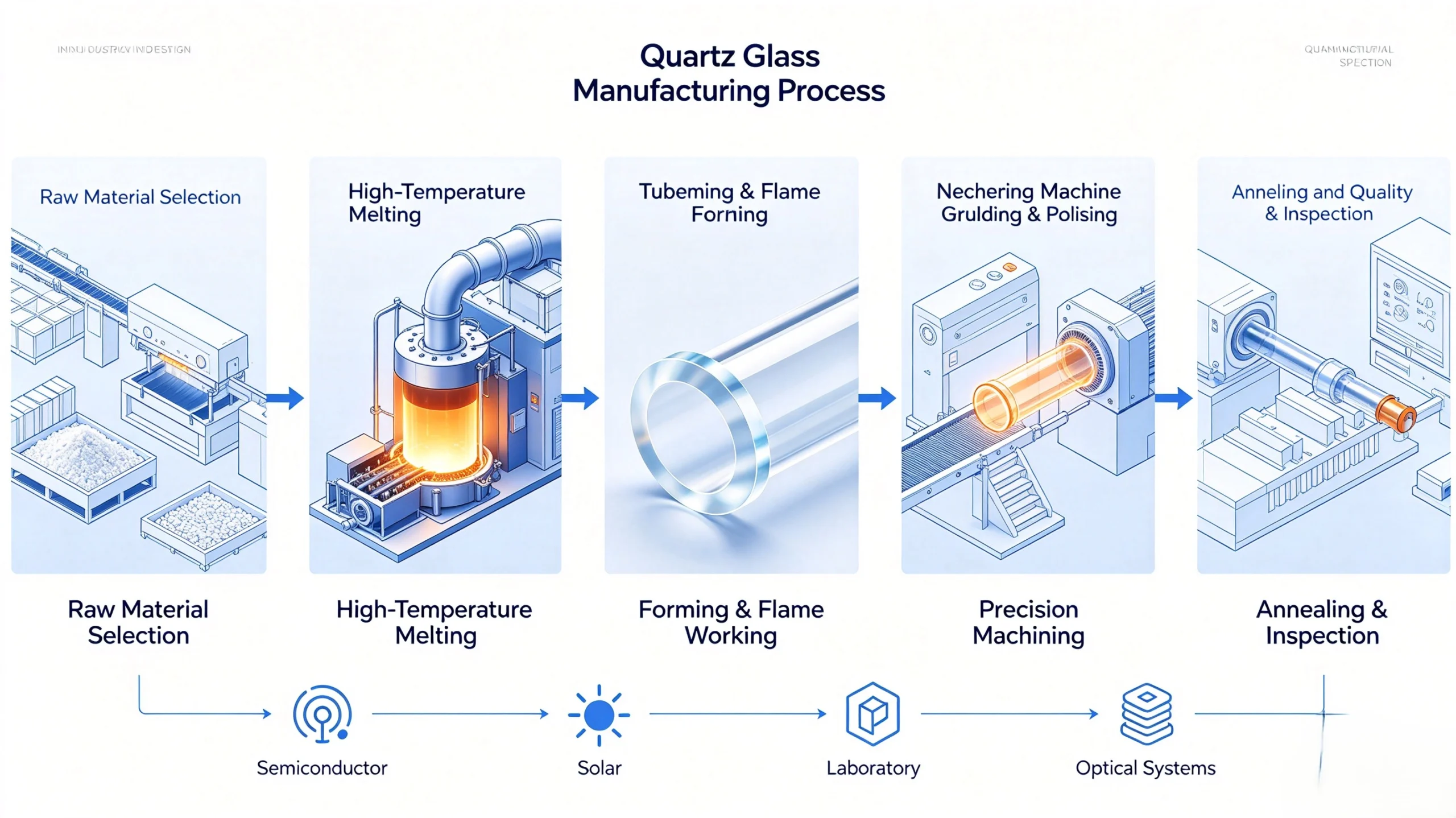
1. Selection and Preparation of Raw Materials
The manufacturing process begins with selecting suitable silica raw materials.
The raw material quality affects:
- Optical performance
- Chemical stability
- Contamination control
- High-temperature performance
Before production, materials typically go through preparation processes including:
- Cleaning
- Sorting
- Removing unwanted impurities
- Preparing suitable particle size
For high-performance applications, material selection must match the customer’s requirements.
2. Quartz Glass Melting Process
The core step of quartz glass manufacturing is melting silicon dioxide at extremely high temperatures.
During melting:
- Silica particles are heated until they become molten
- Gas bubbles and impurities are controlled
- The molten material forms a homogeneous glass structure
Because quartz glass requires very high processing temperatures, specialized equipment and precise temperature control are necessary.
The melting process influences:
- Transparency
- Internal quality
- Homogeneity
- Thermal performance
3. Forming Quartz Glass Components
After melting, quartz glass can be formed into different shapes depending on the application.
Common forming methods include:
Tube Forming
Used for:
- Furnace tubes
- Reactor tubes
- Process chambers
Tube dimensions such as:
- Outer diameter
- Inner diameter
- Wall thickness
- Length
must be carefully controlled.
Flame Forming
Oxyhydrogen flame processing is widely used for quartz fabrication because it provides a clean high-temperature heat source.
Applications include:
- Tube sealing
- Welding
- Custom shapes
- Complex quartz structures
The process allows manufacturers to create components that cannot be produced using standard machining alone.
4. Precision Machining of Quartz Glass
Many industrial quartz components require additional machining after forming.
Quartz glass can be processed through:
CNC Machining
Used for:
- Holes
- Slots
- Threads
- Complex geometries
- Precision dimensions
Because quartz glass is hard and brittle, machining requires appropriate tools and processing parameters.
Grinding and Polishing
Grinding controls:
- Dimensions
- Flatness
- Surface geometry
Polishing improves:
- Surface quality
- Optical performance
- Cleanability
Different applications require different surface finishes.
5. Quartz Glass Welding and Assembly
Some quartz components require multiple parts to be joined together.
Quartz welding is commonly used for:
- Side ports
- Special connections
- Complex assemblies
The welding process requires careful temperature control to minimize stress.
After welding, components may require additional finishing and inspection.
6. Annealing and Stress Relief
Annealing is an important step in quartz glass manufacturing.
During heating and forming, internal stress can develop inside the material.
Controlled annealing helps:
- Reduce residual stress
- Improve thermal stability
- Increase service reliability
For components used in repeated heating cycles, proper stress control is especially important.
7. Surface Finishing
The final surface treatment depends on the application.
Common finishing methods include:
Flame Polishing
Advantages:
- Smooth surface
- Improved transparency
- Reduced surface roughness
Mechanical Polishing
Advantages:
- Higher dimensional control
- Suitable for precision components
Grinding Finish
Used when specific surface textures or dimensions are required.
8. Quality Inspection
Before shipment, quartz components require inspection to ensure they meet customer requirements.
Typical inspection items include:
- Dimensions
- Surface condition
- Appearance
- Processing accuracy
- Cleanliness
For custom quartz parts, inspection is based on customer drawings and application requirements.
9. Custom Quartz Glass Manufacturing
Standard quartz products can meet many applications, but industrial customers often require customized solutions.
Custom quartz manufacturing may include:
- Special dimensions
- Complex structures
- Machined features
- Custom openings
- Special surface finishes
Examples:
- Quartz furnace components
- Quartz windows
- Quartz boats
- Quartz reactors
- Custom quartz assemblies
FAQ
Can quartz glass be machined?
Yes. Quartz glass can be machined using specialized CNC equipment, grinding, drilling, and polishing processes.
Can quartz glass be welded?
Yes. Quartz glass can be joined using high-temperature flame processing for specialized components.
Why is quartz glass difficult to manufacture?
Quartz glass requires extremely high processing temperatures and careful control because it is hard, brittle, and sensitive to manufacturing conditions.
What affects quartz glass quality?
Material selection, forming process, machining accuracy, surface treatment, and inspection all influence final quality.
Conclusion
Quartz glass manufacturing is a combination of material science, high-temperature processing, precision machining, and quality control.
From raw material preparation and melting to CNC machining, polishing, annealing, and inspection, every manufacturing step affects the performance of the final component.
For demanding industries such as semiconductor, solar, laboratory, and optical applications, choosing an experienced quartz glass manufacturer is essential.
FGQuartz specializes in custom quartz glass fabrication, providing quartz tubes, plates, rods, windows, boats, crucibles, and precision quartz components according to customer requirements.