Introduction
Quartz glass is one of the most widely used advanced glass materials in high-temperature, optical, semiconductor, and laboratory applications.
Unlike ordinary glass, quartz glass is mainly composed of silicon dioxide (SiO₂), giving it unique properties such as extremely low thermal expansion, excellent temperature resistance, high optical transmission, and outstanding chemical stability.
These characteristics make quartz glass suitable for demanding applications where conventional glass materials cannot provide sufficient performance.
Common quartz glass applications include:
- Semiconductor processing equipment
- Solar manufacturing systems
- High-temperature furnaces
- UV sterilization equipment
- Optical instruments
- Laboratory components
- Custom industrial parts
This article explains the key properties of quartz glass and why it is selected for advanced industrial applications.
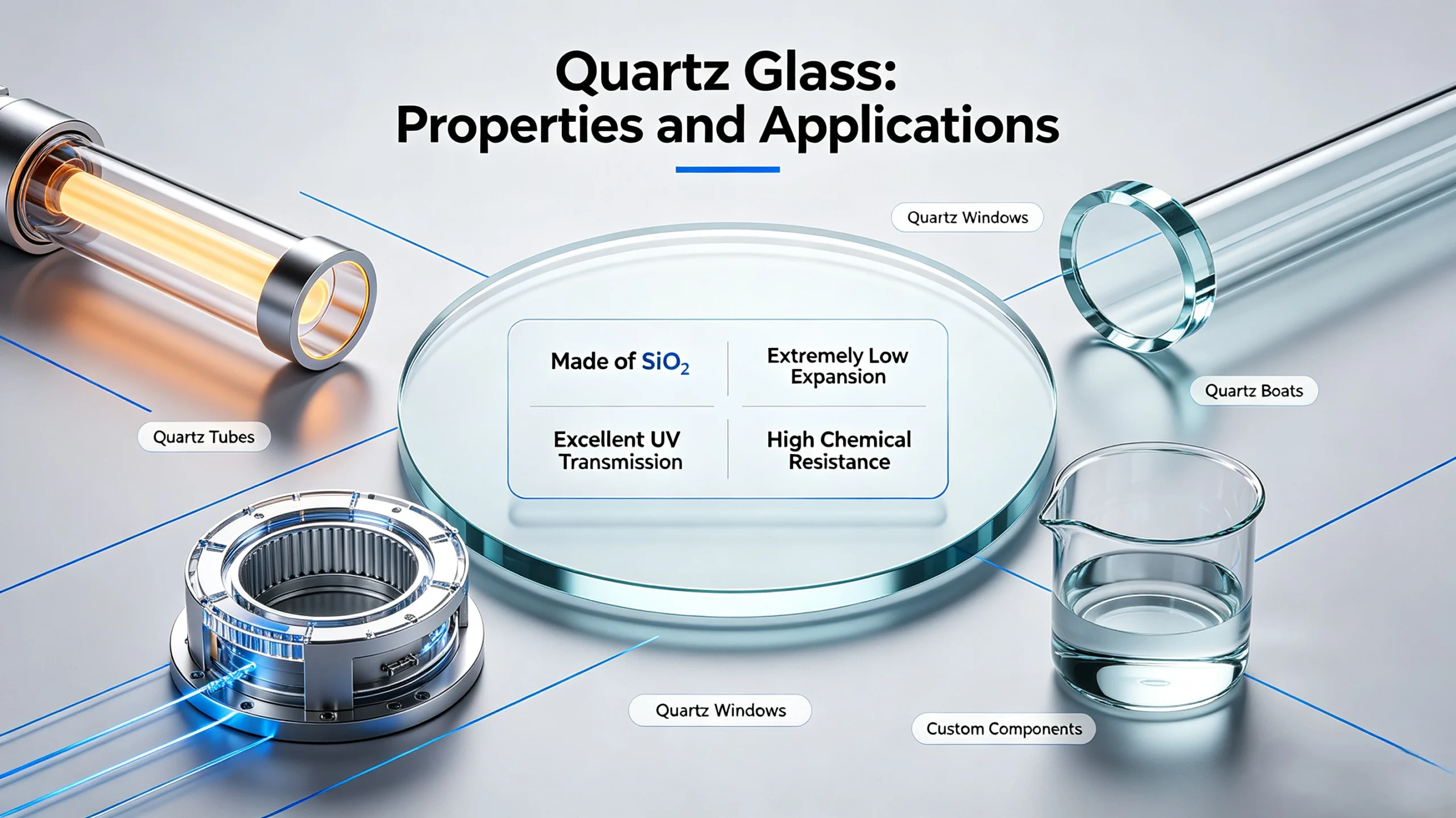
1. Composition and Structure of Quartz Glass
Quartz glass is an amorphous glass material mainly consisting of silicon dioxide (SiO₂).
Unlike crystalline quartz, quartz glass does not have a regular crystal structure. Instead, its silicon and oxygen atoms form a stable three-dimensional network.
This unique structure provides:
- Low thermal expansion
- Excellent thermal shock resistance
- High chemical stability
- Good optical performance
- Long-term temperature stability
The absence of many modifying elements found in conventional glass allows quartz glass to maintain its properties under extreme conditions.
2. Thermal Properties of Quartz Glass
Thermal performance is one of the most important reasons quartz glass is selected for industrial applications.
Low Thermal Expansion
Quartz glass has an extremely low coefficient of thermal expansion compared with most glass materials.
This means it expands and contracts very little when temperature changes.
Advantages include:
- Reduced thermal stress
- Improved dimensional accuracy
- Better resistance to temperature cycling
This makes quartz glass suitable for:
- Furnace tubes
- Semiconductor process chambers
- Laboratory heating equipment
High Temperature Resistance
Quartz glass can operate in high-temperature environments while maintaining excellent stability.
It is commonly used in:
- Diffusion furnaces
- Annealing systems
- High-temperature reactors
- Solar processing equipment
Compared with ordinary glass and many engineering plastics, quartz glass provides significantly higher temperature capability.
Thermal Shock Resistance
Because quartz glass expands very little when heated, it can withstand rapid temperature changes better than many other glass materials.
This property is important for equipment that experiences:
- Frequent heating and cooling cycles
- Rapid temperature changes
- High-temperature processing
3. Optical Properties of Quartz Glass
Quartz glass is widely used in optical applications because of its excellent light transmission characteristics.
UV Transmission
One of the major advantages of quartz glass is its ability to transmit ultraviolet wavelengths.
This makes it suitable for:
- UV lamps
- UV sterilization systems
- Optical windows
- Photochemical equipment
Many common glass materials absorb UV radiation, while quartz glass maintains excellent transparency in this range.
Infrared Transmission
Quartz glass also provides good infrared transmission performance.
Applications include:
- Infrared heating systems
- Optical sensors
- Thermal measurement equipment
Optical Clarity
High-quality quartz glass provides excellent transparency and low optical distortion.
This is important for:
- Observation windows
- Optical instruments
- Scientific equipment
4. Chemical Resistance of Quartz Glass
Quartz glass has excellent chemical stability because of its strong silicon-oxygen structure.
It provides good resistance against many:
- Acids
- Solvents
- High-temperature chemical environments
This makes quartz glass suitable for applications requiring:
- Low contamination
- Material stability
- Long service life
Typical industries include:
- Semiconductor manufacturing
- Chemical processing
- Laboratory research
5. Electrical Properties of Quartz Glass
Quartz glass is also valued for its electrical insulation properties.
Important characteristics include:
- High electrical resistivity
- Low dielectric loss
- Stable performance at elevated temperatures
Because of these properties, quartz glass is used in:
- Semiconductor equipment
- Electrical insulation components
- High-frequency applications
6. Mechanical Properties of Quartz Glass
Quartz glass provides good mechanical stability, although its behavior differs from metals and ceramics.
Important characteristics include:
- High hardness
- Good dimensional stability
- Excellent surface quality after polishing
However, quartz glass is a brittle material, which means proper design and machining methods are important.
Manufacturing processes such as:
- CNC machining
- Grinding
- Flame polishing
- Annealing
help improve the reliability of custom quartz components.
7. Quartz Glass Specifications Overview
Typical quartz glass specifications include:
| Property | Description |
|---|---|
| Material | Silicon dioxide (SiO₂) |
| Structure | Amorphous glass |
| Thermal Expansion | Extremely low |
| Temperature Stability | Excellent |
| UV Transmission | Excellent |
| Chemical Resistance | Excellent |
| Electrical Insulation | Excellent |
| Optical Performance | High |
For detailed technical values, refer to the FGQuartz Quartz Glass Specifications page.
8. Why Quartz Glass Is Used in Semiconductor Manufacturing
Semiconductor manufacturing requires materials that can withstand high temperatures while minimizing contamination.
Quartz glass is widely used because it provides:
- High thermal stability
- Excellent chemical resistance
- Low contamination risk
- Good dimensional stability
Typical semiconductor quartz components include:
- Quartz tubes
- Quartz boats
- Quartz chambers
- Quartz windows
9. Why Quartz Glass Is Used for Custom Components
Quartz glass can be processed into complex components through:
- CNC machining
- Grinding
- Polishing
- Flame forming
- Welding
Custom quartz components are commonly used when standard materials cannot meet:
- Temperature requirements
- Optical requirements
- Dimensional requirements
FAQ
What are the main properties of quartz glass?
The main properties include high temperature resistance, low thermal expansion, excellent UV transmission, chemical resistance, and electrical insulation.
Why is quartz glass better than ordinary glass?
Quartz glass provides higher temperature resistance, better thermal shock performance, and superior optical properties compared with ordinary glass.
Can quartz glass withstand high temperatures?
Yes. Quartz glass is designed for high-temperature applications and maintains excellent stability under demanding conditions.
Is quartz glass chemically resistant?
Yes. Quartz glass has excellent resistance to many chemicals and is widely used in semiconductor and laboratory applications.
Conclusion
Quartz glass combines excellent thermal, optical, chemical, and electrical properties, making it one of the most important materials for advanced industrial applications.
Its low thermal expansion, high temperature stability, UV transparency, and chemical resistance allow it to perform in environments where ordinary glass cannot.
From semiconductor equipment and solar manufacturing to laboratory and optical systems, quartz glass provides reliable performance for demanding applications.
FGQuartz specializes in custom quartz glass manufacturing, including quartz tubes, quartz plates, quartz rods, quartz windows, quartz boats, crucibles, and precision-machined quartz components.