Introduction
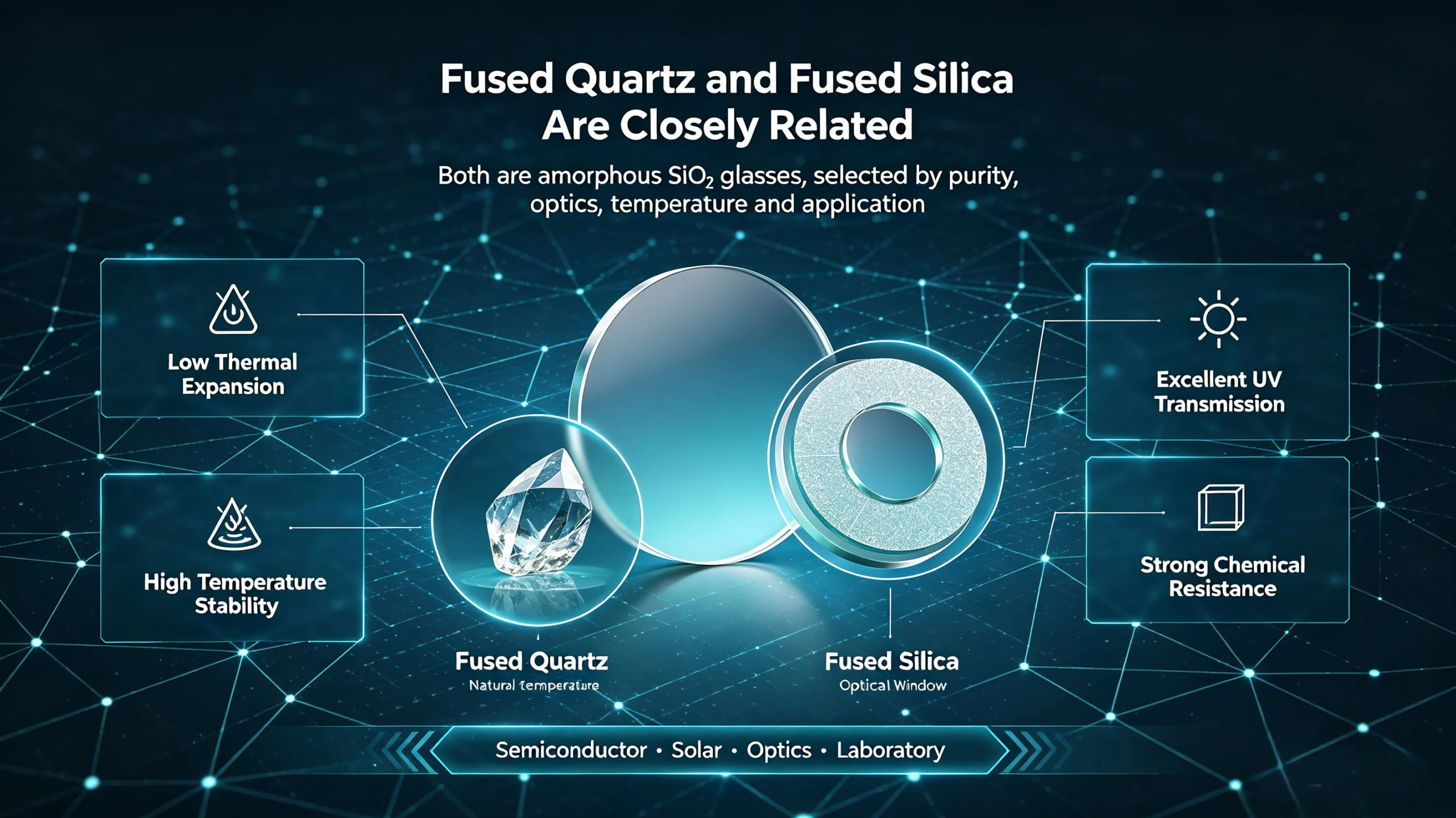
Fused quartz and fused silica are two terms that are often used interchangeably in the quartz glass industry. Because both materials are mainly composed of silicon dioxide (SiO₂), many engineers and buyers assume they are exactly the same material.
In most industrial applications, the difference is not the chemical composition but the manufacturing method, raw material source, and industry terminology.
Both materials offer excellent thermal stability, chemical resistance, and optical performance. However, understanding their differences helps engineers select the correct material for semiconductor equipment, optical components, laboratory applications, and high-temperature systems.
1. What Is Fused Silica?
Fused silica is a high-purity glass material made by melting silicon dioxide.
Unlike traditional glass, fused silica does not contain significant amounts of modifying elements such as sodium, calcium, or boron. This gives it a stable silica network structure with excellent performance characteristics.
Key properties include:
- Extremely low thermal expansion
- Excellent thermal shock resistance
- High temperature stability
- Excellent UV transmission
- High chemical resistance
- Superior dimensional stability
Fused silica is commonly used in:
- Semiconductor manufacturing equipment
- Optical components
- UV systems
- Precision laboratory equipment
- Aerospace applications
2. What Is Fused Quartz?
Fused quartz is another form of synthetic quartz glass produced by melting natural quartz crystal or quartz sand.
In industrial applications, the term “fused quartz” is often used to describe quartz glass produced through a fusion process.
Depending on the industry and region, “fused quartz” and “fused silica” may refer to similar materials.
The differences usually relate to:
- Raw material source
- Manufacturing process
- Industry terminology
- Specific application requirements
3. Fused Quartz vs Fused Silica Comparison
| Property | Fused Quartz | Fused Silica |
|---|---|---|
| Main Component | Silicon dioxide (SiO₂) | Silicon dioxide (SiO₂) |
| Structure | Amorphous silica | Amorphous silica |
| Thermal Expansion | Very low | Very low |
| Temperature Resistance | Excellent | Excellent |
| UV Transmission | Excellent | Excellent |
| Chemical Resistance | Excellent | Excellent |
| Thermal Shock Resistance | Excellent | Excellent |
| Optical Performance | Excellent | Excellent |
| Typical Use | Industrial quartz components | Optical and precision applications |
4. Are Fused Quartz and Fused Silica the Same?
In many cases, yes.
Both materials are forms of amorphous silicon dioxide glass. The difference is mainly related to terminology used by different industries.
For example:
- Semiconductor manufacturers may commonly use “fused quartz” or “quartz glass”.
- Optical industries often use “fused silica”.
- Scientific suppliers may use both terms depending on the product category.
When selecting material, engineers should focus less on the name and more on:
- Purity requirements
- Optical requirements
- Temperature conditions
- Dimensional accuracy
- Application environment
5. Manufacturing Differences
Although the final material composition is similar, manufacturing routes can vary.
Fused Quartz Manufacturing
Fused quartz is typically produced by melting natural quartz materials at high temperatures.
The process involves:
- Quartz raw material preparation
- High-temperature melting
- Forming
- Annealing
- Precision processing
Fused Silica Manufacturing
Fused silica is often associated with synthetic silica production methods where high-purity silicon compounds are converted into silica glass.
This process can provide extremely high purity and excellent optical performance for specialized applications.
6. Thermal Performance
One of the most important advantages of both fused quartz and fused silica is their extremely low thermal expansion.
Compared with ordinary glass materials, quartz glass experiences minimal dimensional changes during temperature variations.
This makes it suitable for:
- High-temperature furnace tubes
- Semiconductor processing equipment
- Precision optical systems
- Laboratory heating equipment
Low thermal expansion also improves resistance to thermal shock, allowing quartz components to withstand rapid temperature changes.
7. Optical Properties
Fused silica is especially well known in optical applications because of its excellent transmission characteristics.
It can transmit a broad wavelength range from ultraviolet to infrared.
Common applications include:
- UV optical windows
- Laser components
- Photolithography systems
- Optical instruments
Fused quartz also provides excellent optical performance and is widely used in industrial quartz components.
For detailed technical data, refer to FGQuartz quartz glass specifications.
8. Chemical Resistance
Both fused quartz and fused silica have excellent chemical stability.
They resist many:
- Acids
- Solvents
- High-temperature chemical environments
This makes quartz glass suitable for applications requiring contamination control and long-term reliability.
Industries using quartz components include:
- Semiconductor manufacturing
- Solar production
- Chemical processing
- Laboratory research
9. Which Material Should You Choose?
For most industrial applications, fused quartz and fused silica can provide similar performance.
The selection should be based on application requirements.
Choose Quartz Glass / Fused Quartz For:
- Quartz tubes
- Quartz boats
- Quartz crucibles
- Furnace components
- Industrial equipment parts
- Custom quartz machining
Choose Fused Silica For:
- Optical components
- Laser systems
- Precision scientific equipment
- Advanced UV applications
The best choice depends on design requirements, operating conditions, and manufacturing capability.
10. Fused Quartz and Fused Silica Applications
Semiconductor Industry
Quartz glass components are widely used in semiconductor processing because they provide:
- High temperature resistance
- Low contamination
- Excellent dimensional stability
Typical components include:
- Quartz furnace tubes
- Wafer boats
- Process chambers
- Quartz liners
Solar Industry
Quartz components are used in photovoltaic manufacturing equipment where thermal stability and cleanliness are essential.
Applications include:
- Diffusion furnace components
- Quartz carriers
- Process tubes
Optical Industry
Fused silica is widely used in optical systems requiring:
- UV transmission
- High precision
- Low optical distortion
FAQ
Is fused silica stronger than fused quartz?
Both materials have similar mechanical properties because they are primarily composed of silicon dioxide. Performance depends on manufacturing process and product design.
Is quartz glass the same as fused silica?
Quartz glass, fused quartz, and fused silica are often used to describe silica-based glass materials. The exact meaning depends on industry usage.
Which is better for high temperature?
Both fused quartz and fused silica provide excellent high-temperature performance. The correct choice depends on application requirements.
Why is fused silica used for optics?
Fused silica provides excellent UV transmission, low thermal expansion, and high dimensional stability, making it suitable for precision optical systems.
Conclusion
Fused quartz and fused silica are closely related silica glass materials with many similar properties, including excellent thermal stability, chemical resistance, and optical performance.
The main differences come from manufacturing methods, terminology, and application requirements rather than basic material composition.
For industrial quartz components, semiconductor equipment, solar manufacturing, and custom quartz fabrication, selecting the correct quartz glass material is essential.
FGQuartz provides customized quartz glass solutions, including quartz tubes, rods, plates, windows, boats, crucibles, and precision-machined quartz components.