Introduction
In high-purity manufacturing environments—particularly semiconductor wet processing, pharmaceutical production, and specialty chemical handling—contamination control is non-negotiable. Even trace levels of metallic ions leaching into process chemistry can compromise product quality or cause costly production failures. The quartz heater chamber is the critical wetted component that makes contamination-free fluid heating possible.
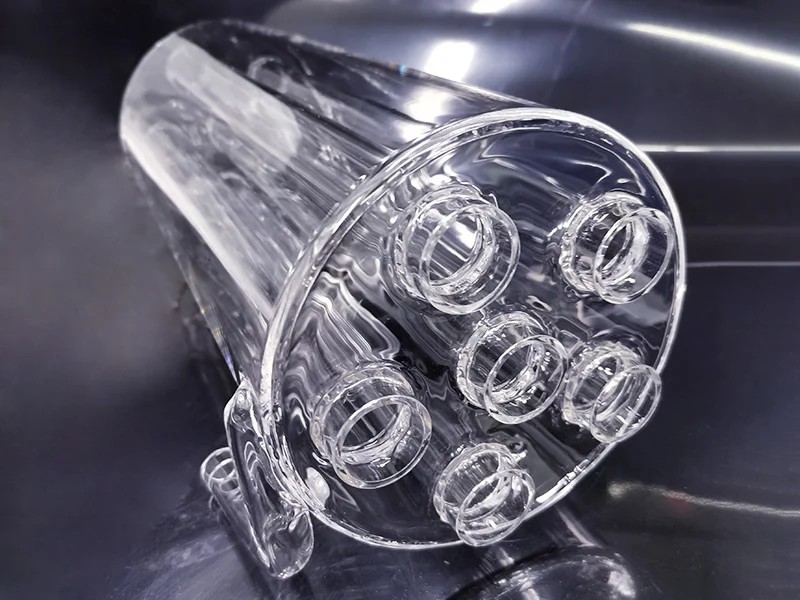
A quartz inline heater chamber is a high-purity flow-through fused quartz component that forms the core wetted path of inline heating systems. Heat transfers through the quartz wall from external heating elements without allowing the heating source to contact the process fluid. It is widely used in semiconductor manufacturing, ultrapure water systems, pharmaceutical production, and specialty chemical processing where contamination control is critical.
As a specialized quartz glass manufacturer, we produce the high-purity quartz chambers and flow tubes that serve as the heart of inline heating systems. This guide explains how quartz heater chambers work, compares design configurations, discusses engineering specifications, and helps OEMs and system integrators select the right quartz components for their heating applications.
Quick Answer
A quartz inline heater chamber is the high-purity fused quartz flow-through component that forms the wetted path of inline heating systems. Because the process fluid only contacts the quartz surface—never the heating element or other materials—quartz chambers deliver zero metal contamination, excellent chemical resistance, and precise thermal performance. They are the core component used by heater OEMs and system integrators for semiconductor wet processing, ultrapure water systems, pharmaceutical manufacturing, and corrosive chemical applications.
Key Takeaways
- All-quartz wetted path — 100% fused quartz contact surface for maximum purity
- Excellent chemical resistance — Inert to acids, bases, solvents, and oxidizing mixtures
- High temperature stability — Consistent thermal performance across wide temperature ranges
- Low thermal expansion — Exceptional thermal shock resistance for reliable operation
- Low particle generation — Minimal particulate release for cleanroom compatibility
- Customizable configurations — Tailored dimensions, connections, and geometries for OEM applications
How Quartz Inline Heater Chambers Work
Core Operating Principle
Quartz inline heater chambers operate on a simple but elegant principle: the process fluid flows through a high-purity quartz chamber while energy is transferred through the quartz wall from an external heating source. This design completely isolates the process fluid from the heating element and all non-quartz components, eliminating any risk of contamination from materials outside the quartz wetted path.
As a quartz component manufacturer, we produce the chamber itself—the precision fused quartz flow path that system integrators and heater OEMs pair with their chosen heating technology, control systems, and connection hardware.

Heating Technology Compatibility
Our quartz chambers are designed to work with all common inline heating technologies. The choice of heating method is determined by the system integrator based on application requirements:
1. Halogen Lamp Systems
Halogen-based systems use infrared lamps positioned around the quartz chamber. The lamps emit infrared radiation that passes through the transparent quartz wall and is absorbed by the fluid inside. Our quartz chambers are manufactured with tight dimensional tolerances to ensure optimal alignment with halogen lamp arrays and reflector systems.
Advantages of this configuration:
- Extremely fast response time for rapid temperature changes
- No direct electrical contact with the quartz wall
- Easy lamp replacement without draining process fluids
- Excellent for intermittent duty cycles and batch processes
2. Thin-Film Resistive Systems
Thin-film systems feature a conductive resistive layer deposited directly onto the outer surface of the quartz tube. Electrical current passes through this thin film, generating heat that conducts through the quartz wall to the fluid. We provide the high-purity quartz substrate with the surface finish and dimensional precision required for reliable thin-film deposition.
Advantages of this configuration:
- Higher energy efficiency with minimal heat loss
- More uniform heat distribution across the fluid path
- Longer service life with no consumable parts
- Compact footprint for space-constrained installations
Flow Path Design Options
We offer multiple flow path configurations to suit different performance requirements. The most advanced design is a tube-in-tube quartz configuration where fluid travels through a narrow annular gap between two concentric quartz tubes. This design:
- Maximizes surface area-to-volume ratio for efficient heat transfer
- Ensures close proximity of all fluid molecules to the heated wall
- Minimizes temperature stratification within the fluid stream
- Reduces holdup volume for faster process changeovers
We also manufacture single-tube designs, multi-pass configurations, and custom geometries tailored to specific application requirements.
Why Quartz Is the Material of Choice
Fused quartz is universally preferred for high-purity process heating chambers for three fundamental reasons:
Exceptional Purity
High-purity fused quartz contains extremely low levels of metallic impurities, preventing contamination of sensitive processes. Unlike metal or polymer materials that can leach ions into process fluids, quartz maintains its purity even at elevated temperatures and with aggressive chemistries.
Superior Chemical Resistance
Quartz is inert to virtually all common process chemistries including strong acids, bases, solvents, and oxidizing mixtures. This broad chemical compatibility means a single quartz chamber design can serve multiple applications across different industries.
Outstanding Thermal Properties
Fused quartz has an exceptionally low coefficient of thermal expansion—far lower than ordinary glass or metal. This provides outstanding thermal shock resistance, allowing quartz chambers to handle rapid temperature changes that would cause catastrophic failure in other materials. Quartz also offers good thermal conductivity for efficient heat transfer.
Engineering Insight: The thermal shock resistance of fused quartz is why quartz heater chambers can handle the rapid temperature ramps required in semiconductor wet processing. Other glass materials would crack under the same thermal stress conditions.
Application Analysis
Semiconductor Wet Processing (Primary Application)
Quartz heater chambers are the standard wetted component for semiconductor wet bench heating systems, supporting critical cleaning and processing steps:
Wafer Cleaning Processes
- Sulfuric-peroxide mixtures: High-temperature organic residue removal
- Ammonia-peroxide solutions: Particle removal from wafer surfaces
- Hydrochloric acid mixtures: Metal ion contamination removal
- Hydrofluoric acid dips: Oxide layer etching (typically unheated)
Process Criticality: Even minor temperature variation in cleaning chemistry can significantly impact particle removal efficiency and etch rates. The dimensional precision and thermal uniformity of our quartz chambers help system integrators achieve the high temperature accuracy required for consistent process results.
Photoresist Stripping
Heated chemical mixtures provide aggressive organic material removal. Quartz chambers handle these high-temperature acid mixtures without degradation or contamination.
Heated Rinsing Systems
Temperature-controlled deionized water rinses accelerate particle removal and reduce water consumption compared to room-temperature rinsing.
Ultra-Pure Water (UPW) Systems
Point-of-use UPW heaters deliver temperature-controlled ultra-pure water to process tools. The all-quartz wetted path ensures no ionic contamination is introduced into the water stream at the point of use.
LED and Flat Panel Display Manufacturing
Similar to semiconductor processing but with larger substrate sizes, LED and display manufacturing rely on quartz heater chambers for wet chemical processing of sapphire and glass substrates.
Solar Photovoltaic Manufacturing
Silicon wafer texturing and cleaning processes use heated chemical baths. While purity requirements are less stringent than semiconductors, quartz chambers offer superior chemical resistance and longevity compared to polymer alternatives.
Pharmaceutical and Biotech
High-purity water for injection (WFI), buffer solutions, and process water heating benefit from quartz’s inert, non-leaching properties and cleanability.
Specialty Chemical Processing
Fine chemical manufacturing, electronic-grade chemical production, and high-purity reagent handling all require contamination-free heating that quartz chambers provide.
Quality Standards and Manufacturing Specifications
Material Quality Standards
Our quartz heater chambers are manufactured from high-purity fused quartz with rigorous quality control:
- Quartz glass purity: High-purity fused quartz with controlled impurity levels
- Material traceability: Full material traceability from raw material through finished product
- Dimensional tolerances: Precision manufacturing tolerances for proper fit and function
- Surface finish: Controlled surface roughness optimized for each application
Performance Testing
Each quartz chamber undergoes comprehensive testing before delivery:
- Pressure testing: Hydrostatic pressure testing to verify structural integrity
- Leak testing: Helium or pressure decay leak testing to ensure fluid integrity
- Dimensional inspection: Precision measurement of all critical dimensions
- Visual inspection: Examination for surface defects and internal inclusions
Industry Compliance
Our manufacturing processes adhere to internationally recognized quality standards. Our quartz components are used in systems that must meet various regional and industry-specific requirements, from semiconductor fab specifications to pharmaceutical manufacturing standards.
Purchasing Note: Always verify that quartz component suppliers provide proper material documentation and quality certification. A heater chamber that claims high performance without supporting test data or material traceability is a risk factor for process reliability and safety.
Common Quartz Chamber Issues and Considerations
1. Thermal Shock and Cracking
Symptoms: Visible cracks in quartz material; fluid leakage; sudden loss of heating efficiency.
Root Causes:
- Thermal shock from excessively rapid temperature changes
- Mechanical stress from improper mounting or piping strain
- Material fatigue from repeated thermal cycling over time
- Manufacturing defects (internal bubbles or inclusions acting as stress concentrators)
Prevention and Solutions:
- Design systems with controlled temperature ramp rates during startup and shutdown
- Use flexible tubing connections to eliminate piping strain on the quartz chamber
- Follow recommended guidelines for maximum thermal cycling frequency
- Source chambers from reputable manufacturers with quality-controlled production
Engineering Insight: Fused quartz has an extremely low coefficient of thermal expansion—far lower than ordinary glass or metal. This exceptional thermal shock resistance is why quartz can handle rapid temperature changes that would cause catastrophic failure in other materials. Proper system design that respects quartz’s thermal limits ensures long service life.
2. Reduced Heat Transfer Over Time
Symptoms: Heating system takes progressively longer to reach set temperature; cannot maintain target temperature at higher flow rates.
Quartz-Related Causes:
- Internal scaling or mineral deposits on quartz walls reducing heat transfer
- Surface degradation from prolonged exposure to certain chemistries
Prevention and Solutions:
- Implement periodic chemical cleaning cycles to remove mineral deposits
- Select appropriate quartz material grades for specific chemical applications
- Follow recommended cleaning procedures to avoid surface damage
3. Contamination Concerns
Symptoms: Unexpected impurity levels in process fluid; product quality issues; increased particle counts.
Root Causes (often non-quartz):
- Non-quartz wetted components (connectors, seals) releasing contaminants
- Improper cleaning procedures introducing contamination
- Seal failures allowing ambient contamination ingress
- Quartz surface degradation releasing particulate material (rare with proper operation)
Prevention and Solutions:
- Verify all wetted components—not just the quartz chamber—are specified for high-purity service
- Use only properly cleaned and packaged replacement components
- Follow standardized cleaning procedures for high-purity systems
- Monitor process fluid quality with regular analytical testing
Important Note: In high-purity applications, non-quartz components are often the primary source of contamination. The quartz chamber itself, when properly manufactured and maintained, contributes negligible contamination.
Selection Guide: Specifying Quartz Heater Chambers
Step 1: Define Your Process Requirements
Start by documenting these critical parameters for your quartz chamber specification:
| Parameter | Why It Matters |
|---|---|
| Fluid type and chemistry | Determines quartz material selection and surface finish requirements |
| Flow rate range | Sizes the chamber bore and determines flow path geometry |
| Operating temperature range | Affects wall thickness and structural design considerations |
| Operating pressure | Determines wall thickness requirements and connection type |
| Temperature uniformity required | Influences flow path design and chamber length |
| Connection type | Determines end fitting configuration and sealing surfaces |
Step 2: Select Flow Path Configuration
Choose the flow path design that best matches your heat transfer and pressure drop requirements:
- Single tube: Simple design, lowest pressure drop, suitable for many basic applications
- Tube-in-tube (annular): Maximizes heat transfer surface area, best for high power density requirements
- Multi-pass: Extended flow path for applications requiring maximum temperature rise
- Custom geometry: Tailored configurations for unique integration requirements
Step 3: Specify Connection and Mounting Requirements
We offer various end configurations to match your system design:
- Connection type: Flared ends, ground joints, threaded adapters, or custom fittings
- Mounting orientation: Horizontal vs. vertical installation considerations
- Overall length and dimensions: Fit within available equipment space
- Integration features: Custom bosses, ports, or mounting features as needed
Step 4: Consider Material and Finish Options
Different applications may require specific quartz characteristics:
- Quartz material grade: Selected based on purity requirements and operating temperature
- Surface finish: Polished, ground, or as-fired surfaces depending on application
- Wall thickness: Balanced for pressure rating, thermal transfer, and cost
- Optical properties: Transparent, frosted, or opaque as required by heating technology
Step 5: Evaluate Customization Needs
Most OEM and specialty applications require some level of customization. Common customizations include:
- Custom dimensions and geometries for specific system integration
- Special end connections and sealing interfaces
- Integrated sensor wells or temperature measurement ports
- Multiple inlet/outlet configurations
- Special surface treatments or coatings
- Branding or part number marking
Critical Insight: For high-volume OEM applications, investing in a custom quartz chamber design optimized for your specific system can significantly improve performance, reduce assembly cost, and enhance product differentiation. The engineering cost of custom design is quickly recovered in production savings and improved product performance.
Frequently Asked Questions (FAQ)
Q1: What is a quartz inline heater chamber?
A quartz inline heater chamber is the high-purity fused quartz flow-through component that forms the wetted path of inline heating systems. Process fluid passes through the quartz chamber while heat transfers through the quartz wall from external heating elements. The all-quartz wetted path eliminates metal contamination, making these chambers the core component of heaters used in semiconductor wet processing, ultra-pure water systems, and corrosive chemical handling. Heater OEMs and system integrators pair our quartz chambers with their chosen heating technology and control systems.
Q2: What temperature can a quartz heater chamber handle?
Fused quartz chambers can operate across a wide temperature range, from ambient to relatively high temperatures. The practical temperature limit for a specific application depends on several factors: the boiling point of the process fluid at operating pressure, the pressure rating of the chamber design, and the temperature limits of associated seals and connection hardware. For gas-phase applications, quartz chambers can achieve significantly higher temperatures than liquid applications. Our engineering team can help determine the appropriate design for your temperature requirements.
Q3: Why is quartz used for heater chambers instead of other materials?
Quartz is preferred for high-purity heater chambers for three fundamental reasons: (1) Purity—high-purity fused quartz contains extremely low levels of impurities, preventing contamination of sensitive processes; (2) Chemical resistance—quartz is inert to virtually all common process chemistries including strong acids, bases, and solvents; (3) Thermal properties—exceptionally low thermal expansion provides outstanding thermal shock resistance, and good thermal conductivity enables efficient heat transfer. No other material combines all three properties as effectively as fused quartz.
Q4: How does a quartz chamber compare to other wetted materials?
Quartz chambers offer superior performance in several key areas compared to alternatives: much higher purity than metal or polymer materials, better thermal shock resistance than other glasses, broader chemical compatibility than most metals, and better temperature accuracy than polymer alternatives. The main tradeoff is cost—quartz has a higher material cost and requires specialized manufacturing—but typically offers lower total cost of ownership due to longer service life and reduced contamination risk in critical applications.
Q5: How long does a quartz heater chamber last?
With proper operation and maintenance, a fused quartz heater chamber can last for many years—often a decade or more. The quartz material itself is extremely durable and chemically stable. The main factors that shorten service life are excessive thermal cycling beyond recommended limits, mechanical stress from improper mounting or handling, and operation outside specified pressure or temperature parameters. We provide application guidelines to help customers maximize chamber service life in their specific systems.
Q6: What industries use quartz heater chambers?
Quartz heater chambers are used across multiple industries where high-purity heating is required. The largest application is semiconductor manufacturing for wet processing and wafer cleaning. Other major industries include: pharmaceutical and biotech manufacturing, LED and flat panel display production, solar photovoltaic manufacturing, specialty and fine chemical production, and any application requiring contamination-free fluid heating. We supply quartz chambers to heater OEMs and system integrators serving all these markets.
Q7: How do you specify the right size quartz heater chamber?
Specifying the right quartz chamber involves matching the internal dimensions and flow path geometry to your flow rate, required temperature rise, and pressure drop constraints. It’s important to consider flow velocity through the chamber to ensure proper heat transfer and avoid excessive pressure drop. Our engineering team works with customers to analyze their system requirements and recommend the optimal chamber configuration. We can also provide design assistance for custom geometries to meet specific performance targets.
Q8: What are common issues with quartz heater chambers?
The most common issues include: cracking from thermal shock or mechanical stress (rare with proper system design and handling), and reduced heat transfer from mineral buildup or scaling over time. Proper system design—including controlled temperature ramp rates, flexible piping connections, and appropriate maintenance procedures—can prevent most issues and extend chamber service life significantly. We provide application guidelines and technical support to help customers optimize their system design for maximum reliability.
Q9: Can quartz heater chambers handle corrosive chemicals?
Yes—this is one of their primary advantages. High-purity quartz is chemically inert to virtually all common process chemistries including strong acids, bases, solvents, and oxidizing mixtures. The key consideration for system designers is ensuring that all wetted components—not just the quartz chamber itself—are compatible with the specific chemistry. This includes fittings, seals, gaskets, and any other components that come into contact with the process fluid. We can advise on quartz material selection for specific chemical applications.
Q10: What dimensional tolerances can you achieve?
We manufacture quartz heater chambers with precision dimensional tolerances appropriate for each application. Critical dimensions such as bore diameter, wall thickness, length, and sealing surfaces are held to tight tolerances to ensure proper fit and performance in customer systems. Our quality control process includes precision measurement of all critical dimensions before shipment. For applications requiring special tolerances or specific alignment features, we can develop custom manufacturing processes to meet your requirements.
Q11: What maintenance do quartz heater chambers require?
Quartz chambers have minimal maintenance requirements when properly operated. Routine considerations include: periodic inspection for signs of damage or wear, cleaning to remove mineral deposits or process residue as needed, and regular leak testing as part of overall system maintenance. The specific maintenance schedule depends on the application chemistry, operating conditions, and system design. We can provide recommendations for cleaning procedures and inspection intervals based on your specific application.
Q12: Can you produce custom quartz heater chamber designs?
Yes—custom design and manufacturing is a core part of our business. We work closely with heater OEMs and system integrators to develop quartz chambers optimized for their specific system requirements. Common customizations include: custom dimensions and flow path geometries, special end connections and sealing interfaces, integrated features such as sensor wells or mounting bosses, multiple inlet/outlet configurations, and special surface finishes or treatments. We offer full engineering support from concept through production, with lead times varying by complexity and volume.
Conclusion
Quartz heater chambers are the critical wetted component that enables contamination-free fluid heating technology, offering an unmatched combination of purity, chemical resistance, and thermal performance. For precision manufacturing processes where contamination control matters, high-quality fused quartz chambers are not just a component—they’re an engineering necessity.
Selecting the right quartz heater chamber involves more than choosing a standard size. Fluid chemistry, flow requirements, pressure ratings, connection types, and integration considerations all influence chamber design and long-term performance. Working with an experienced quartz manufacturer that understands both the material properties and the application requirements helps ensure reliable performance and optimal system integration.
The key to success is partnering with a quartz manufacturer that can deliver precision-engineered chambers with consistent quality, reliable lead times, and responsive engineering support. Whether you need a standard configuration or a fully custom design, the right quartz component will deliver years of reliable service while protecting your process from the contamination risks that plague alternative materials.
Expert Tip: When designing a heating system, verify the compatibility of every wetted component—including fittings, seals, and sensors—not just the quartz chamber itself. In high-purity applications, non-quartz components are often the primary source of contamination. Choose your quartz supplier based on their ability to support your full system design requirements.
CTA
Need custom quartz heater chambers for your heating system?
Our engineering team can assist with:
- Quartz chamber design and optimization
- Flow path geometry analysis
- Material selection guidance
- Custom quartz fabrication and prototyping
- OEM and volume production
- Semiconductor-grade quartz manufacturing
Contact us for a free engineering consultation and quote.