Home / Products / Custom Quartz Glass / Cold Processing
Cold processing of fused silica: CNC diamond machining, grinding, lapping, and polishing
Quartz CNC Machining
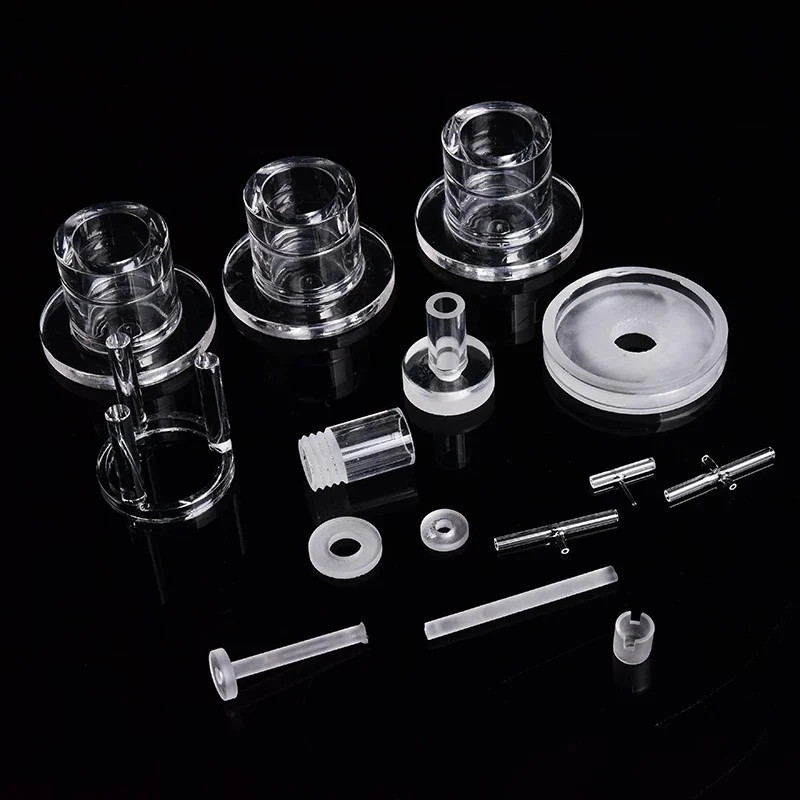
Quartz cold processing, also called quartz CNC machining or diamond machining, is the subtractive route for fused silica. Diamond-impregnated CNC tooling cuts, mills, drills, grinds, and polishes quartz at room temperature, so precise geometry is made without thermal distortion.
FGQuartz uses it for accurate holes, threads, wafer-boat slots, flat optical surfaces, and tight OD / ID features, and combines it with thermal processing when a part also needs welded or flame-formed geometry. It is one half of custom quartz glass fabrication, from a single prototype to production, with no minimum order quantity.
Quick answer
What is quartz cold processing? A subtractive manufacturing method that uses diamond-impregnated CNC tooling to mechanically cut, mill, and grind fused silica at room temperature, achieving precise geometries without thermal distortion.
Key takeaways
- Six core capabilities: CNC turning and centerless grinding, multi-axis milling, diamond core drilling, slicing and edge finishing, surface grinding, lapping, and optical polishing, and stress-relief annealing.
- Diamond tooling is required: fused silica is about Mohs 5.5–6.5 and brittle, and standard metal cutters would shatter or dull against it.
- Typical capability: wafer-boat slot pitch commonly held to around ±0.05 mm, and optical surfaces ground and polished to flatness of λ/10.
- Natural fused quartz, synthetic fused silica, and JGS1 / JGS2 / JGS3 grades are machined on the same CNC platforms.
Written by the FGQuartz Engineering Team · Updated October 2026
On this page: What it is · At a glance · Capabilities · Design guidance · Tolerances · Materials · Workflow · Cost drivers · FAQ and quote
Lead time depends on size and drawing complexity; the quote confirms the schedule.
What is quartz cold processing?
Overview
Cold processing removes material from hard, brittle fused silica at room temperature with precision diamond tooling. Because fused silica would shatter or dull conventional metal cutters, material is removed by controlled abrasive grinding and milling.
Unlike thermal processing, which softens and reshapes quartz in an oxy-hydrogen flame, cold processing excels at exact dimensional profiles, sharp angles, and flat surfaces without thermal warping. It is the preferred method for O-ring grooves, threads, stepped diameters, and internal pockets. After machining, parts can be lapped, optically polished, and annealed for dimensional stability in service.
Cold processing vs thermal processing: which do you need?
Comparison
| Need | Route |
|---|---|
| A flat, optically polished surface | Cold processing — grinding, lapping, polishing |
| A precise hole, thread, or O-ring groove | Cold processing — CNC drilling and milling |
| A bend, curve, or branch with no straight-line path | Thermal processing — flame forming |
| A sealed, leak-tight joint between two pieces | Thermal processing — flame welding |
| A tube with a flange, a machined slot, and a welded side port | Both, combined — the typical case for complex custom parts |
FGQuartz houses CNC machining and oxy-hydrogen flame work under one ISO 9001 system, so machined flanges can be fused onto flame-worked assemblies with aligned tolerances.
Core cold processing capabilities
Capabilities
Each operation runs on multi-axis CNC platforms with diamond tooling and controlled coolant, set up to minimize micro-cracking and hold the drawing dimensions.
Cold processes at a glance
At a glance
Six cold operations cover almost every machined part. Most parts combine several.
| Process | What it does | Typical parts |
|---|---|---|
| Turning and cylindrical grinding | Sets OD, ID, steps, tapers, and concentricity. | Furnace tubes, preform target rods, fixtures. |
| Multi-axis milling | Cuts slots, pockets, grooves, and threads. | Wafer boats, O-ring grooves, reactor lids. |
| Diamond core drilling | Makes clean through and blind holes. | Side-port tubes, showerheads, base plates. |
| Slicing and edge finishing | Cuts blanks to size and finishes edges. | Plate blanks, cut-to-length tubes. |
| Grinding, lapping, and polishing | Sets thickness, flatness, parallelism, and optical finish. | Windows, cuvettes, substrates. |
| Annealing | Relieves sub-surface stress left by machining. | Heavily milled or thick parts. |
CNC turning and cylindrical grinding
Centerless grinding and CNC turning give exact inner and outer diameters, concentricity, and stepped profiles on tubes and rods.
Capabilities
- OD and ID precision grinding
- Stepped diameters, mounting shoulders, and flanges
- Tapers and conical geometries
- Length cutting and end facing
- Chamfering and radius edge finishing
How it works
- The quartz is rigidly mounted on a CNC lathe or cylindrical grinder.
- Diamond wheels remove material at controlled feed rates under coolant.
- Fine passes bring the diameter to size while limiting sub-surface damage.
- Finished parts are inspected for OD, ID, and concentricity.
Typical applications
LPCVD furnace tubes, optical fiber preform target rods, wafer handling parts, and cylindrical vacuum fixtures. See the quartz tubes and quartz rods pages.
Multi-axis CNC milling
Multi-axis milling makes non-rotational features such as wafer slots, O-ring grooves, pockets, and freeform profiles.
Capabilities
- Wafer slotting and keyway milling
- Recessed pockets and interlocking features
- 3D contoured surface profiling
- Vacuum O-ring grooves and gas flow channels
- Internal and external thread milling
Process advantages
- Wide geometric flexibility for bespoke OEM designs
- Repeatability across production batches
- Works on plates, solid blocks, and curved tube surfaces
- Lower mechanical stress than impact machining
Typical applications
Semiconductor wafer boats with pitch slotting, reactor lids, optical mounts, and gas injection manifolds.
Diamond core drilling
Diamond core drilling gives clean, chip-controlled through-holes and blind holes with controlled diameter, depth, and edge condition.
Capabilities
- Standard and micro-diameter through-holes
- Depth-controlled blind holes
- Countersinks and counterbores
- Multi-hole showerhead arrays
Process
- The tube or plate is fixtured to prevent vibration.
- A diamond core drill advances under controlled feed with continuous coolant.
- Diameter, pitch, and depth are held to the drawing.
- Exit edges are chamfered or fire-polished to limit particle shedding.
Typical applications
Process tubes with side-injection ports, drilled base plates, windows with mounting holes, and gas distribution showerheads. For parts that combine drilling with flame forming, see custom quartz fabrication.
Precision slicing and edge finishing
Precision cutting turns raw silica blocks and ingots into sized plates, rods, and tubes. Edge finishing removes micro-fissures to protect parts during handling and thermal cycling.
Capabilities
- Diamond wire and saw cutting to length
- Angle cuts and mitering
- Edge chamfering, beveling, and corner rounding
- Slotting and notching
Process advantages
- Coolant flushing and tuned blade speeds reduce thermal shock during cutting
- Clean edges prepared for flame sealing or optical polishing
Typical applications
Cut-to-length diffusion tubes, plate blanks for optics, and substrate slicing. Related: quartz plates.
Surface grinding, lapping, and optical polishing
Surface grinding and double-side polishing (DSP) deliver the flatness, parallelism, and transmission that viewports and sensor interfaces require.
Capabilities
- Surface grinding to exact thickness
- Double-sided planetary lapping for parallelism
- Optical-grade polishing
- Flatness control to optical levels
- Removal of CNC tooling marks
Process advantages
- High transparency from UV to IR with low scatter
- Fewer particles in ultra-clean semiconductor service
- Reliable O-ring seating for UHV sealing
Typical applications
Laser windows, vacuum viewports, spectrophotometer cuvettes, and wafer inspection substrates. See optical quartz glass.
Stress-relief annealing
CNC machining does not distort quartz the way flame work does, but aggressive milling can leave sub-surface stress. Critical parts are annealed for long-term stability.
- The machined quartz is heated uniformly into the annealing range (around 1200°C).
- It is held there so internal stress relaxes.
- It is cooled slowly through the strain point so thermal shock is not reintroduced.
Benefits: lower sub-surface stress from diamond tooling, better resistance to cracking in the customer thermal cycle, and stable dimensions through the part life.
Typical parts: heavily milled wafer boats, deeply pocketed flanges, thick optical plates, and any cold-processed part bound for high-heat service.
Design guidance for machined quartz parts
Design guidance
General rules that reduce cost and chipping risk on machined fused silica. Final geometry is confirmed in DFM review.
| Design point | Why it matters |
|---|---|
| Use radii in internal corners | Sharp internal corners concentrate stress in a brittle material. A radius is easier to machine and stronger in service. |
| Keep features away from edges | Holes and slots very close to an edge or another feature leave thin sections that chip. |
| Avoid unsupported thin sections | Thin walls and fins are fragile during machining and handling. |
| Tolerance only what is functional | Tight flatness, parallelism, or pitch adds time and metrology. Mark sealing faces and mating interfaces, and leave the rest at commercial tolerance. |
| Specify finish by face | Optical polish on every surface adds cost. Polish only the faces that need it. |
| Say which features are critical and which are not | This lets the machining order and fixturing protect the dimensions that matter. |
Common machining issues and how they are controlled
Quality control
| Issue | Cause | How it is controlled |
|---|---|---|
| Chipping at hole exits and edges | Unsupported material as the tool breaks through. | Rigid fixturing, controlled feed, and chamfering or fire-polishing exit edges. |
| Sub-surface damage | Aggressive material removal with diamond tooling. | Finer finishing passes, coolant, and annealing for critical parts. |
| Tool marks on optical faces | Machining leaves a ground surface. | Lapping and optical polishing to the required finish. |
| Dimensional drift | Stress release or setup error. | Annealing where needed and CMM dimensional checks against the drawing. |
Typical tolerances and achievable finish
Tolerances
General reference values across the CNC platforms. Not every feature needs the tightest tolerance; DFM review identifies which dimensions are functionally critical so precision is paid for only where it matters.
| Feature | Typical achievable range |
|---|---|
| OD / ID grinding tolerance | Commercial to precision, geometry-dependent |
| Wafer boat slot pitch accuracy | Commonly around ±0.05 mm where specified |
| Surface flatness (optical polish) | Down to λ/10 for demanding optical requirements |
| Surface finish (DSP optical) | Scratch-dig to 20/10 on optical-grade windows where specified |
| Drilled hole diameter | Standard and micro-diameter, depth-controlled |
Final tolerances depend on part geometry, material grade, and feature location, and are confirmed in DFM review against your drawing.
Materials we machine
Materials
The CNC platforms and diamond tooling handle natural and synthetic material alike. The difference is which grade suits the application.
| Grade | Use in machined parts |
|---|---|
| Natural fused quartz | Economical choice for structural and process components such as tubes, boats, and general plates. |
| Synthetic fused silica | Semiconductor process parts and optical applications needing maximum purity and low bubble content. |
| JGS1 / JGS2 / JGS3 | Machined and polished for deep-UV, UV–visible, or infrared optics. See the JGS1 / JGS2 / JGS3 guide. |
FGQuartz sources and verifies the fused silica grade as part of the order.
Our precision machining workflow
Process
The same workflow supports a single R&D prototype or a volume OEM order.
What drives quartz machining cost?
Pricing
CNC quartz machining pricing depends on four main factors:
- Number and type of features. A simple OD grind costs far less than a part with several holes, threads, and optical polish.
- Tolerance requirements. Tight flatness, parallelism, or slot-pitch accuracy adds machining and metrology time.
- Surface finish. As-ground surfaces cost less than double-side optical polish.
- Order volume. Unit price improves at volume, though single-piece prototypes are accepted with no MOQ.
For an accurate quote, send the drawing with critical dimensions and tolerances marked. Quotations are typically returned within 24 business hours.
Procurement questions
FAQ
Both. FGQuartz sources and verifies the appropriate fused silica grade as part of the order.
Wafer boat slot pitch is commonly held to around ±0.05 mm; optical surfaces can be ground and polished to flatness of λ/10.
Yes. FGQuartz routinely accepts 2D/3D CAD files and provides DFM feedback prior to quoting.
Fused silica sits at roughly Mohs 5.5–6.5 hardness — standard metal cutters would shatter or dull instantly against it.
Cold processing mechanically removes material and is ideal for threads, slots, and flat surfaces. Thermal processing uses oxy-hydrogen flames to soften, bend, and weld quartz.
Yes. Specialized CNC centers and planetary lapping machines can achieve exact dimensions, strong parallelism, and optical-grade flatness.
It is used to produce accurate holes, wafer slots, internal/external threads, stepped diameters, and strictly flat surfaces.
Cold processing is a subtractive manufacturing method that uses diamond-impregnated CNC tooling to mechanically cut, mill, and grind fused silica at room temperature, achieving precise geometries without thermal distortion.