Introduction
UV transmission is one of the most important optical properties of quartz glass.
Many common glass materials absorb ultraviolet light, limiting their use in UV-based systems. Quartz glass, however, provides excellent ultraviolet transmission because of its highly stable silica structure and low absorption characteristics.
This makes quartz glass widely used in:
- UV sterilization systems
- UV lamps
- Optical instruments
- Photochemical equipment
- Semiconductor manufacturing systems
When selecting a material for UV applications, optical transmission performance is often a critical factor.
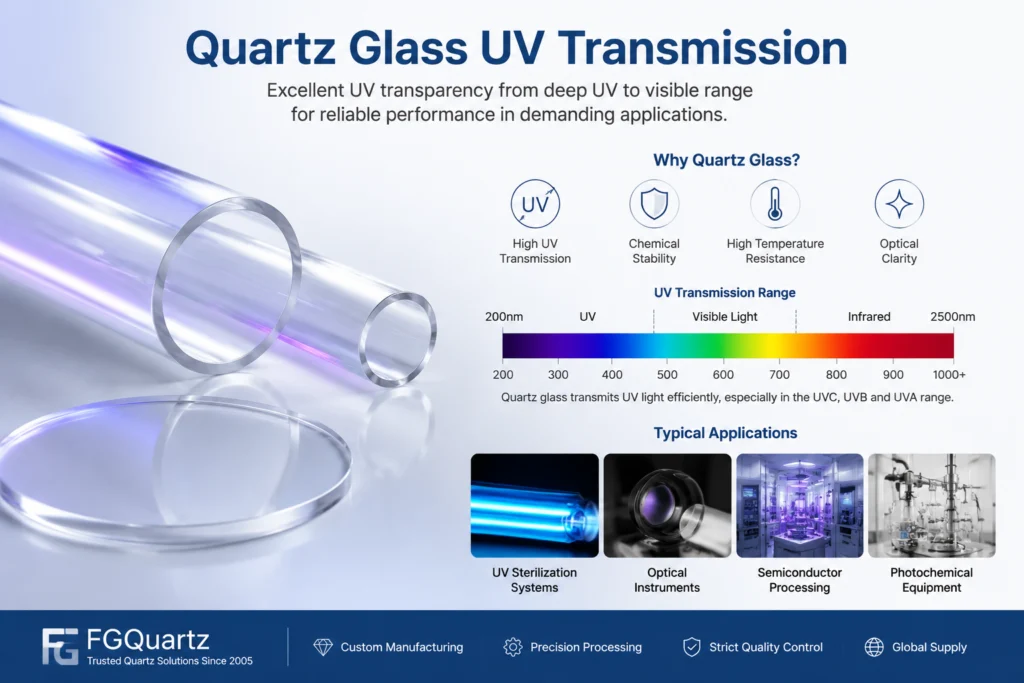
Quartz glass provides excellent ultraviolet transmission, making it suitable for UV lamps, sterilization systems, optical windows, and semiconductor applications.
1. Why Can Quartz Glass Transmit UV Light?
The ability of quartz glass to transmit ultraviolet light comes from its chemical structure.
Quartz glass is mainly composed of silicon dioxide (SiO₂), which has excellent optical stability across a wide wavelength range.
Compared with ordinary glass, quartz glass contains fewer components that absorb ultraviolet radiation.
As a result, quartz glass provides:
- High UV transparency
- Low optical absorption
- Stable optical performance
- Reliable long-term use
2. Quartz Glass vs Ordinary Glass for UV Applications
The biggest difference between quartz glass and ordinary glass is UV transmission capability.
Ordinary glass often blocks a significant amount of ultraviolet radiation, especially shorter wavelengths.
Quartz glass is preferred when UV light needs to pass through the material efficiently.
Comparison:
| Property | Quartz Glass | Ordinary Glass |
|---|---|---|
| UV Transmission | Excellent | Limited |
| UV Absorption | Low | Higher |
| Temperature Resistance | Higher | Lower |
| Chemical Stability | Excellent | Moderate |
| Typical Use | UV systems, optical equipment | General windows and containers |
3. Quartz Glass in UV Sterilization Systems
UV sterilization equipment relies on ultraviolet radiation to reduce microorganisms.
Quartz glass is commonly used for:
- UV lamp sleeves
- Protective tubes
- Reactor windows
The material needs to provide:
- High UV transmission
- Chemical resistance
- Long-term stability
- Easy cleaning
Poor UV transmission can reduce system efficiency, which is why quartz is widely selected for these applications.
4. Quartz Windows for Optical Systems
Quartz glass windows are used when optical observation or UV light transmission is required.
Applications include:
- Scientific instruments
- Optical testing equipment
- Industrial inspection systems
- Laser-related equipment
Important design considerations include:
- Thickness
- Surface finish
- Flatness
- Optical requirements
Custom quartz windows can be manufactured according to specific drawings and application requirements.
5. Quartz Glass in Semiconductor Manufacturing
Semiconductor manufacturing often involves UV-related processes and high-temperature environments.
Quartz components are used because they combine:
- UV transparency
- High temperature resistance
- Chemical stability
- Low contamination characteristics
Typical components include:
- Quartz windows
- Quartz tubes
- Process chambers
- Custom quartz parts
6. Factors Affecting UV Transmission
Although quartz glass has excellent UV performance, actual transmission depends on several factors.
Material Quality
Material composition and manufacturing quality affect optical performance.
Thickness
As thickness increases, light transmission characteristics may change.
Engineers must consider the relationship between:
- Required strength
- Optical performance
- Component dimensions
Surface Quality
Surface defects can affect light transmission.
Processes such as:
- Polishing
- Flame polishing
can improve surface quality for optical applications.
7. Quartz Glass for Different UV Applications
UV Sterilization
Requirements:
- High UV transmission
- Chemical stability
- Long service life
Products:
- Quartz tubes
- Quartz sleeves
UV Optical Systems
Requirements:
- Optical clarity
- Dimensional accuracy
- Surface quality
Products:
- Quartz windows
- Quartz plates
Industrial UV Processing
Requirements:
- Temperature resistance
- Stable performance
- Custom geometry
Products:
- Custom quartz components
8. Manufacturing Quartz Components for UV Applications
UV quartz components often require additional processing to meet application requirements.
Manufacturing processes may include:
- Cutting
- Grinding
- Polishing
- CNC machining
- Flame processing
- Inspection
For precision UV applications, manufacturing consistency is as important as material selection.
FAQ
Why is quartz glass used for UV lamps?
Quartz glass provides excellent UV transmission and can withstand the heat generated by UV lamps.
Does normal glass transmit UV light?
Most ordinary glass blocks a significant portion of UV radiation, making it unsuitable for many UV applications.
Is fused silica the same as UV quartz glass?
Both are silica-based materials with excellent UV performance. The exact terminology depends on the industry and application.
Can quartz glass be used for UV sterilization?
Yes. Quartz tubes and sleeves are widely used in UV sterilization equipment because of their UV transmission and chemical stability.
Conclusion
Quartz glass UV transmission is one of the key properties that makes it valuable for optical, sterilization, semiconductor, and industrial applications.
Its excellent ultraviolet transparency, combined with thermal stability and chemical resistance, allows quartz components to perform reliably in demanding environments.
FGQuartz manufactures custom quartz glass components, including quartz tubes, quartz windows, quartz plates, and precision-machined quartz parts for UV and industrial applications.