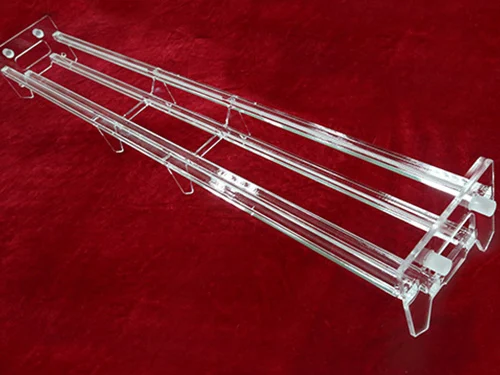
Most people in the industry treat the semiconductor quartz boat as a standard consumable — interchangeable, low-tech, and easy to procure. They are wrong. This guide explains exactly how every quartz product works inside a semiconductor fab, why the design details of a quartz boat matter far more than most engineers realize, and what happens to yield when any part of the thermal process system is mismatched.
There is a moment that most process engineers encounter at least once: you have spent weeks chasing a mysterious yield loss across your thermal oxidation line. You have checked the gas purity, verified the temperature controller, and swapped the thermocouple. Nothing works. Then someone suggests checking the quartz boat — and you discover it has thermally deformed by less than a millimeter. That was the entire root cause.
Semiconductor quartz products — boats, furnace tubes, gas nozzles, flow baffles and thermocouple sleeves — form the physical infrastructure inside every high-temperature furnace. Their geometry, purity, surface finish and mutual fit directly shape the thermal field, gas-flow distribution and mechanical precision that decide whether a process hits its target or drifts into the reject zone.
This complete guide covers what each quartz product does, how they work as a coordinated system through every thermal process step, why advanced nodes demand far more from these components, and the practical rules for qualification, maintenance and lifecycle management of semiconductor quartz boats and related parts.
This guide covers high-temperature thermal process applications only — thermal oxidation, diffusion doping, LPCVD, post-implant annealing and 3D stacking anneal. It does not cover PECVD, PVD, wet clean or CMP.
What Is a Semiconductor Quartz Boat and Why Does It Matter?
A semiconductor quartz boat is a wafer-carrying fixture made from electronic-grade high-purity fused silica. It holds wafers vertically or at a slight tilt inside a furnace tube during high-temperature processing, keeping them evenly spaced, stable and correctly oriented relative to the gas flow and heat source.
That description sounds simple. The design engineering that goes into a production-grade quartz boat — especially for advanced nodes — is anything but. Every geometric feature participates in shaping the environment each wafer experiences.
Why fused silica is used for semiconductor quartz boats
Fused silica (amorphous SiO₂) has a unique combination of properties that make it ideal for semiconductor thermal processing:
| Property | Why It Matters in the Furnace | Consequence of Inadequate Quality |
|---|---|---|
| Ultra-low thermal expansion | The boat keeps its geometry from room temperature to process temperature, holding every wafer slot in position relative to the robot and gas nozzles | Thermal deformation causes slot displacement, wafer tilt, pick-and-place errors and potential wafer-to-wafer contact |
| Extreme high-temperature stability | The structure does not soften, creep or lose mechanical integrity at process temperatures | Creep deformation leads to asymmetric loading, uneven heat exposure and wafer bowing |
| Excellent chemical inertness | Does not react with oxidizing, reducing or halide process gases and contributes no metallic or organic impurities | Any reaction or outgassing introduces contamination that degrades leakage, threshold voltage and reliability |
| High infrared transmittance | Radiant heat passes through the boat walls and supports, reaching wafer surfaces directly | Opaque or poorly transmissive material creates thermal shadowing and wafer-to-wafer temperature variation |
| Ultra-high purity (electronic grade) | Metallic impurities are controlled to trace levels that will not affect device-level electrical performance | Trace metallic contamination can introduce deep-level traps, degrading reliability and threshold stability |
The four functional modules of a quartz boat
Every semiconductor quartz boat is built from the same four functional modules. The engineering of each one drives the process outcome:
- Slot teeth (wafer contact points) — curved features that support each wafer by its edge. Tooth width, radius, contact angle, surface finish and pitch determine stability, contact area, thermal conduction and particle generation.
- Support rods — three or four longitudinal rods that carry all mechanical load. Straightness, diameter and high-temperature creep resistance decide whether the boat stays aligned after hundreds of thermal cycles.
- End plates — discs that anchor the support rods. Flatness sets vertical alignment; the weld joint between end plate and rod is the highest-stress location and the most common failure point.
- Flow guide structures — slots, chamfers or deflector fins that direct gas flow across each wafer slot. These are matched to the nozzle hole pattern and differ by process type.
An oxidation boat is designed for near-atmospheric oxidizing atmosphere. An LPCVD boat operates at low pressure with reactive precursors. A diffusion boat handles dopant carrier gases. A quartz boat is never a generic, interchangeable component — it is always process-specific.
The Complete Semiconductor Quartz Product Ecosystem
The quartz boat is one component in an interconnected system. Understanding how these products relate is essential for troubleshooting and for qualifying new hardware.
| Category | Product | Primary Function | Coupling with the Quartz Boat |
|---|---|---|---|
| Wafer Bearing | Quartz Boat | Holds wafers at defined positions inside the furnace tube | Primary reference component |
| Wafer Bearing | Quartz Boat Stand | Interface between the boat and the furnace drive mechanism | Tolerance must match the boat’s thermal expansion |
| Wafer Bearing | Quartz Wafer Transfer Fork | Robotic end effector for loading wafers into boat slots | Geometry must match slot pitch precisely |
| Wafer Bearing | Quartz Cleaning Basket | Protects the boat during wet cleaning | Must avoid pressure on support rods or end plates |
| Wafer Bearing | SiC Composite Boat | Higher creep resistance and lower particle generation | Upgrade when standard quartz boats reach their limits |
| Chamber Body | Quartz Furnace Tube | The reaction chamber itself | Inner diameter must provide uniform annular gas-flow gap |
| Chamber Body | Quartz Bell Jar / Insulation Cylinder | Radiant heat enclosure and temperature-field stability | IR transmittance and thermal uniformity affect every wafer |
| Gas Distribution | Quartz Gas Inlet Nozzle & Flow Baffle | Uniform gas distribution across the boat length | Hole pattern co-designed with boat slot pitch and flow guides |
| Process Auxiliary | Quartz TC Sleeve & Calibration Block | Accurate temperature measurement and dimensional reference | Measurement accuracy and go/no-go inspection reference |
The quartz boat, furnace tube, gas nozzle and flow baffle should be co-designed and co-qualified as a matched set. Replacing any one component from a different supplier can disturb gas flow or temperature uniformity. FGQuartz can supply complete matched sets. See our custom quartz glass fabrication capabilities.
How Quartz Products Work Across Every Thermal Process Step
Step 1 · Thermal Oxidation
Purpose: Grow a controlled-thickness silicon dioxide layer. Thickness uniformity directly affects transistor threshold-voltage consistency.
Key quartz parts: oxidation boat (slot geometry tuned for atmospheric oxidant flow), furnace tube, gas nozzle, flow baffle, boat stand, transfer fork and cleaning basket. Any mismatch in slot pitch or thermal expansion between boat and stand generates particles or loading errors.
Step 2 · Thermal Diffusion Doping
Purpose: Drive dopants (B, P, As…) into the silicon lattice. Uniformity of concentration is a major driver of parametric yield.
The diffusion boat is process-dedicated. It must never be shared with oxidation or LPCVD lines because residual dopants survive standard cleaning and cause cross-contamination. Multi-zone nozzles compensate for natural depletion along the boat length.
Diffusion quartz boats must never be used in other process lines. Residual dopants (especially arsenic) can survive cleaning and contaminate the next batch, causing leakage and junction-depth variation that are very hard to diagnose.
Step 3 · LPCVD
LPCVD operates at low pressure, so gas distribution depends heavily on geometry. CVD by-products deposit on the boat and tube and will flake if not managed. LPCVD boats need high-polish surfaces and wider inter-slot gaps. Multi-zone nozzles and in-situ cleaning are critical to prevent particle excursions.
Step 4 · Post-Ion-Implant Annealing
The challenge is purely thermal. Anneal boats prioritize minimal thermal shadow and minimal contact area at the slot teeth. Rapid thermal cycling accelerates fatigue at weld joints, so inspection frequency should be higher.
Step 5 · 3D Stacking Bond Anneal
Bonded stacks are heavier and more sensitive to mechanical stress. These boats use significantly wider slot pitch, tighter flatness and lower peak temperatures. Using a standard single-wafer boat risks bond-interface failure and overlay error.
Wider slot pitch reduces wafer positions per boat — a deliberate yield-over-throughput trade-off. Narrowing the pitch to recover throughput almost always leads to bond failures that are extremely difficult to diagnose.
Why Quartz Boat Sensitivity Increases at Advanced Nodes
At mature nodes a small thermal gradient caused by support rods may still sit inside the process window. At advanced nodes the same gradient falls outside the tightened window. The boat has not gotten worse — the requirement has gotten stricter. This is why a boat that worked at 180 nm often fails at 28 nm or below.
Three hidden variables that standard incoming inspection often misses:
- Residual internal stress — causes progressive warping in early cycles
- Microstructural homogeneity — local expansion differences create crack initiation sites
- Hydroxyl (OH) content — volatilizes at high temperature and lowers mechanical strength
- Weld joint quality — the initiation site for most catastrophic failures
A rising robot-alarm rate on a thermal tool should trigger quartz-boat dimensional verification before any other investigation path. The boat is passive and has no sensors, so it is systematically under-investigated relative to its real contribution to yield loss.
When to Replace a Semiconductor Quartz Boat
Replace the boat as soon as any one of the following conditions appears:
- High-temperature deformation exceeds the process limit (detected by scheduled dimensional inspection)
- Robot-alarm rate shows a rising SPC trend
- Visible crack at a weld joint (inspect under UV)
- Persistent metallic or particle contamination after extended cleaning
For advanced-node applications, add a time-based or thermal-cycle-count-based preventive replacement trigger even if none of the above has appeared. An unplanned batch loss is far more expensive than a planned boat change.
Frequently Asked Questions about Semiconductor Quartz Boats
What is a semiconductor quartz boat used for?
A semiconductor quartz boat is a high-purity fused silica carrier that holds wafers during thermal oxidation, diffusion doping, LPCVD and post-implant annealing. Its geometry controls temperature uniformity (thermal-shadow effect), gas-flow distribution and robotic loading precision — all of which directly affect yield at advanced nodes.
Can quartz boats from different processes be used interchangeably?
No. Each boat type is designed for specific chemistry, gas dynamics and thermal conditions. Using a diffusion boat in another process risks severe cross-contamination because residual dopants survive standard cleaning. Always keep process-specific boats physically separated and cleaned in dedicated equipment.
What is the difference between a standard quartz boat and a SiC composite boat?
A standard boat is pure fused silica. A SiC composite boat adds silicon carbide coating or structural elements at high-wear, high-temperature locations. The composite offers higher creep resistance, lower particle generation and longer service life, at higher cost. It is mainly used in advanced-node LPCVD and diffusion where standard boats reach their life limit too quickly.
How do you know when a quartz boat needs replacement?
Replace it at the first sign of excessive deformation, rising robot alarms, visible weld cracks, or persistent contamination. For advanced nodes, also use a preventive thermal-cycle or time-based trigger.
What other quartz products work together with the boat?
The full matched set typically includes the quartz furnace tube, boat stand, transfer fork, gas inlet nozzle, flow baffle, insulation cylinder, thermocouple sleeve, exhaust tube and cleaning basket. Slot pitch, nozzle pattern, baffle design and tube inner diameter are all interdependent.
Need Semiconductor Quartz Boats or Matched Thermal Process Sets?
FGQuartz manufactures high-purity fused silica quartz boats, furnace tubes, gas nozzles and complete matched thermal-process quartz sets for semiconductor manufacturing. We support both standard geometries and fully custom designs from prototype to volume production.
Explore our semiconductor quartz glass applications or send your drawing / specifications for a free engineering review and quotation. We respond within 24 hours on business days.