Quick answer: Quartz glassware is high-purity fused silica (SiO₂) laboratory and industrial equipment valued for its exceptional thermal resistance, chemical inertness, and UV transparency. It outperforms borosilicate glass in high-temperature applications, deep-UV processes, and contamination-sensitive semiconductor manufacturing. While more expensive upfront, quartz glassware delivers significantly longer service life and superior performance under extreme conditions.
Quartz glassware represents the pinnacle of material performance for demanding industrial and laboratory environments. Unlike conventional glass types, fused silica components deliver exceptional thermal stability, chemical purity, and optical transmission that make them irreplaceable in semiconductor manufacturing, high-temperature processing, UV spectroscopy, and precision optics.
Engineers, purchasing managers, and technical directors face a critical challenge: selecting the right glassware material that balances performance requirements, operational longevity, and total cost of ownership. The wrong choice can lead to premature component failure, process contamination, or unnecessary capital expenditure.
This guide provides a comprehensive engineering perspective on quartz glassware — covering material properties, application suitability, common failure modes, and practical selection criteria. Whether you are specifying components for a new production line or evaluating upgrade options for existing laboratory equipment, this resource will help you make informed, data-driven decisions.
Key Takeaways
- Superior thermal performance — Quartz glassware withstands far higher temperatures and thermal cycling than borosilicate glass, making it essential for furnace and high-temperature processing applications.
- Unmatched chemical purity — High-purity fused silica minimizes ionic contamination, critical for semiconductor manufacturing and trace analytical chemistry.
- Broad optical transmission — Transmits deep UV through near-IR wavelengths, enabling spectroscopy, photochemistry, and UV sterilization applications.
- Higher upfront investment — Quartz glassware costs more than borosilicate but delivers longer service life and reduced downtime in demanding applications.
- Application-specific selection — Not all quartz glassware is equal. Grade selection, fabrication quality, and surface finish directly impact performance and longevity.
Understanding Quartz Glassware: Material Fundamentals
What Is Quartz Glassware?
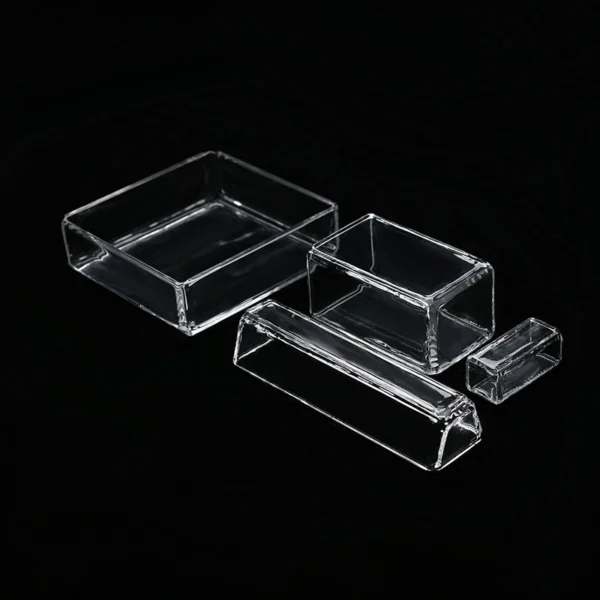
Quartz glassware refers to laboratory and industrial components manufactured from high-purity fused silica, an amorphous form of silicon dioxide produced by melting crystalline quartz or synthetic silica at extremely high temperatures. Unlike soda-lime or borosilicate glass, which contain various additive oxides to modify properties, high-quality quartz glassware consists almost entirely of SiO₂, resulting in a unique combination of physical, chemical, and optical properties.
The manufacturing process significantly impacts final quality. Fused quartz produced from natural crystal quartz offers excellent purity and cost-effectiveness for most industrial applications, while synthetic fused silica delivers even higher purity and superior UV transmission for the most demanding optical and semiconductor applications.
Core Material Properties
Thermal Properties
- Exceptionally low coefficient of thermal expansion — the material expands minimally with temperature changes
- High softening point allowing operation at temperatures far exceeding conventional glass types
- Excellent thermal shock resistance, enabling rapid temperature changes without catastrophic failure
- Good thermal stability maintaining dimensional accuracy across wide temperature ranges
Chemical Properties
- High chemical inertness resisting attack from most acids, solvents, and neutral solutions
- Low ionic leaching, minimizing contamination of process materials
- Resistance to alkali and salt solutions at moderate temperatures
- Note: Susceptible to hydrofluoric acid and hot strong alkaline solutions
Optical Properties
- Broad transmission range spanning deep ultraviolet through visible and into the infrared spectrum
- High UV transmittance, far exceeding borosilicate glass which blocks most UV radiation
- Low refractive index with minimal dispersion
- Excellent optical homogeneity for precision applications
Mechanical Properties
- High hardness and compressive strength
- Good electrical insulation properties
- Brittleness similar to other glass types, requiring careful handling
- High tensile strength under proper loading conditions
Quartz Glassware Product Categories
Laboratory Glassware
- Beakers, flasks, and crucibles for high-temperature chemistry
- Test tubes and culture tubes for thermal processing
- Cuvettes and cells for spectroscopy
- Petri dishes and evaporation dishes
- Mortars and pestles for sample preparation
Industrial Components
- Quartz tubes and reactors for furnace applications
- Crucibles for crystal growth and metal melting
- Wafer boats and carriers for semiconductor processing
- Diffusion tubes and furnace liners
- Flanges and custom fabricated assemblies
Optical Components
- Windows and viewports
- Lenses and prisms
- Optical flats and substrates
- UV lamp envelopes and sleeves
Quartz Glassware vs. Borosilicate Glass: When to Upgrade
One of the most common engineering decisions is choosing between quartz glassware and borosilicate glass for a given application. Understanding the performance boundaries of each material is essential for optimizing both performance and cost.
| Performance Parameter | Quartz Glassware | Borosilicate Glass |
|---|---|---|
| Maximum Service Temperature | Significantly higher | Moderate |
| Thermal Shock Resistance | Excellent | Good |
| UV Transmission (deep UV) | Excellent | Poor (blocks most UV) |
| Chemical Purity | Very high (near-pure SiO₂) | Good (contains additives) |
| Coefficient of Thermal Expansion | Very low | Low |
| Chemical Resistance (acids) | Excellent | Good |
| Optical Transmission Range | Very broad (UV to IR) | Moderate (visible only) |
| Upfront Cost | Higher | Lower |
| Service Life (demanding apps) | Much longer | Shorter |
| Typical Applications | Semiconductor, high-temp furnaces, UV spectroscopy | General lab work, routine chemistry, storage |
Decision Framework: When to Choose Quartz Glassware
Choose quartz glassware when:
- Operating temperatures exceed borosilicate limits — For processes involving sustained high temperatures or rapid thermal cycling, quartz is the only viable option. Borosilicate softens and deforms at temperatures where quartz performs reliably.
- Deep UV transmission is required — Quartz transmits far into the ultraviolet spectrum, while borosilicate absorbs most UV radiation. This makes quartz essential for UV spectroscopy, photochemistry, and UV sterilization applications.
- Contamination must be minimized — In semiconductor manufacturing, trace analytical chemistry, and high-purity materials processing, the ionic purity of quartz prevents contamination that could ruin products or skew analytical results.
- Thermal shock is a concern — The extremely low thermal expansion coefficient of quartz allows it to survive rapid temperature changes that would shatter borosilicate glass.
- Long-term cost of ownership matters — While quartz costs more upfront, its superior durability and resistance to degradation often result in lower total cost of ownership in demanding applications due to fewer replacements and less downtime.
Stick with borosilicate glass when:
- Temperatures remain moderate and stable
- Optical requirements are limited to visible wavelengths
- Chemical exposure is mild and routine
- Budget constraints are tight and performance requirements are modest
- The application involves general laboratory procedures or chemical storage
Application Analysis: Where Quartz Glassware Excels
Semiconductor Manufacturing
The semiconductor industry is the largest consumer of high-purity quartz glassware due to its exceptional purity and thermal stability.
Key Applications:
- Wafer boats and carriers for transporting silicon wafers through processing steps
- Diffusion tubes and furnace liners for thermal oxidation and doping processes
- Quartz crucibles for silicon crystal growth (Czochralski method)
- Process tubes and chambers for chemical vapor deposition (CVD)
- Cleaning tanks and baths for wafer processing
Why Quartz Is Essential:
- Ultra-high purity prevents metallic ion contamination of silicon wafers
- Thermal stability maintains dimensional accuracy at processing temperatures
- Chemical resistance withstands aggressive cleaning chemistries
- Low particle generation minimizes yield-reducing contamination
Laboratory & Analytical Chemistry
Research and analytical laboratories rely on quartz glassware for specialized applications where borosilicate glass is insufficient.
Key Applications:
- High-temperature digestion and ashing crucibles
- UV-transparent cuvettes for spectrophotometry
- Thermal analysis sample holders
- Photochemical reaction vessels
- Trace analysis glassware minimizing blank contamination
Photovoltaics & Solar Energy
Solar cell manufacturing uses significant quantities of quartz glassware in both crystal growth and cell processing. Key applications include crucibles for polysilicon ingot growth, diffusion tubes for emitter formation, wafer carriers and boats, and process chambers. High purity ensures solar cell efficiency is not compromised by impurities, while thermal stability handles the extreme temperatures of silicon processing.
High-Temperature Industrial Processes
Various industrial processes leverage quartz glassware for its ability to withstand extreme heat while providing chemical inertness. Typical uses include tube furnace reactors for materials synthesis, high-temperature observation windows and viewports, molten metal containment, thermal processing of ceramics and powders, and glass melting equipment.
Optical & Lighting Applications
Quartz glassware’s exceptional optical properties make it valuable for UV lamp envelopes and sleeves, optical windows and viewports, laser cavities and optical components, infrared heating elements, and fiber optic preforms. Broad transmission from deep UV to near IR, high damage threshold, and excellent optical homogeneity are the key advantages.
Common Problems & Failure Modes
Devitrification (Crystallization)
What it is: Devitrification is the process where amorphous quartz glass begins to form crystalline structures on the surface or within the material. This appears as cloudy, milky, or frosty areas and weakens the material, making it more susceptible to thermal shock failure.
Causes: Prolonged exposure to high temperatures, surface contamination from alkali metals or handling residues, poor-quality material with higher impurity levels, and inadequate cleaning before high-temperature use.
Prevention: Ensure thorough cleaning before high-temperature use, handle with clean gloves, use high-purity material grades for extended high-temperature service, avoid prolonged operation in the critical devitrification temperature range when possible, and inspect regularly for early signs.
Thermal Shock Fracture
While quartz has excellent thermal shock resistance, it can still fracture when subjected to extreme or uneven temperature changes, especially if the material has surface defects or is improperly supported. Prevention includes gradual heating and cooling rates, uniform heating, proper mounting with compliant gaskets, regular inspection for surface damage, and use of polished surfaces which resist crack initiation better than rough surfaces.
Chemical Attack & Corrosion
Quartz is highly chemically resistant but can be attacked by hydrofluoric acid (even dilute), hot strong alkaline solutions, hot phosphoric acid at elevated temperatures, and certain molten salts. Avoid these chemistries where possible, reduce exposure time and temperature when full avoidance is not possible, and rinse thoroughly after use.
Mechanical Failure
Physical breakage from impact, over-tightening of clamps, vibration fatigue, or combined thermal and mechanical stress remains a risk. Proper handling procedures, protective sleeves where appropriate, adequate support, and regular inspection for chips or cracks help minimize this failure mode.
Selection Guide: How to Choose the Right Quartz Glassware
Step 1: Define Application Requirements
Clearly define operating conditions:
- Thermal — Maximum operating temperature, cycling frequency and rate, duration at peak temperatures
- Chemical — Process chemicals and concentrations, exposure duration, purity requirements
- Optical — Wavelength range, transmission requirements, surface quality
- Mechanical — Pressure or vacuum conditions, loading, dimensional tolerances
Step 2: Select the Appropriate Quartz Grade
- Standard Fused Quartz — Good purity for most industrial applications, cost-effective, suitable for furnace tubes and general labware
- High-Purity Fused Quartz — Lower metallic impurities, suitable for semiconductor and photovoltaic applications, reduced devitrification tendency
- Synthetic Fused Silica — Highest purity and optical quality, superior deep-UV transmission, ideal for optical components and the most demanding semiconductor applications
- Opaque (Milky) Quartz — Contains tiny bubbles for thermal insulation, used for crucibles and heat shielding, not suitable for optical applications
Step 3: Evaluate Fabrication Quality
- Surface Finish — Polished surfaces resist devitrification and chemical attack better; fire-polished is standard for most applications
- Dimensional Tolerances — Precision tolerances required for custom assemblies; tighter tolerances increase cost but ensure proper fit
- Weld and Joint Quality — Critical for fabricated assemblies; look for full-penetration welds with proper annealing
Step 4: Evaluate Suppliers
Key criteria include manufacturing capability, quality control processes, engineering support, custom fabrication capability, certifications, lead times, and technical support responsiveness.
Step 5: Consider Total Cost of Ownership
Include initial purchase price, expected service life, replacement frequency and associated downtime, labor costs, scrap or rework costs from component failure, and quality impact on final product or process results. In many industrial and semiconductor applications, premium quartz glassware delivers lower total cost of ownership despite higher upfront cost.
Conclusion
Quartz glassware represents an essential material for engineers and technical professionals working with high-temperature processes, UV applications, or contamination-sensitive manufacturing. Its unique combination of thermal stability, chemical inertness, optical transmission, and purity makes it irreplaceable in semiconductor manufacturing, analytical laboratories, photovoltaics, and various industrial processes.
The key to successful specification is understanding your specific application requirements and selecting the appropriate material grade, fabrication quality, and supplier. While the upfront cost is higher than conventional borosilicate glass, the performance benefits and extended service life often deliver superior total cost of ownership in demanding applications.
Not all quartz glassware is created equal. Material purity, fabrication quality, surface finish, and supplier capability all significantly impact real-world performance and service life. Investing time in proper selection and sourcing pays dividends in reduced downtime, longer component life, and more reliable process results.
Looking for high-quality quartz glassware for your industrial or laboratory application?
FGQuartz offers a comprehensive range of standard and custom fused silica components, including high-purity quartz tubes, crucibles, labware, semiconductor-grade products, and custom fabricated assemblies. Our engineering team provides material selection guidance and design optimization support.
Contact us today for a customized quotation. We respond within 24 hours on business days.