Quick Answer
A semiconductor diffusion furnace typically runs on four fused silica components: the process tube (sometimes with a nested liner), the boat that carries wafers, the paddle that pushes the boat in and out, and a set of supporting pieces — spacers, end caps, dummy wafers, gas distribution nozzles. All are high-purity fused silica, but they solve different problems. The tube owns the process envelope. The boat owns wafer spacing and thermal mass. The paddle owns insertion geometry and coating compatibility. The supporting cast owns gas flow, dummy loading and end-zone stress. Specifying them as a system — not as separate RFQs — avoids the mismatch that shortens tube life and cracks boats.
Key Takeaways
- One diffusion furnace = tube + boat + paddle + supporting pieces, but grade, wall distribution and thermal path need to be co-specified.
- Process tube sees the longest high-temperature dwell and the highest particle sensitivity; liner tubes are the sacrificial layer when doping or coating processes run aggressive chemistries.
- Boat is where wafer slot geometry, foot design and cantilever vs dual-support meet thermal stress — slot chamfer, foot relief and wall distribution are design-for-manufacturability items, not decoration.
- Paddle looks simple until you add coating, length, paddle-head geometry and the moment arm of a loaded boat.
- Devitrification, particle shed and boat-foot cracking are the three failure modes that trace back to specification, not to machining.
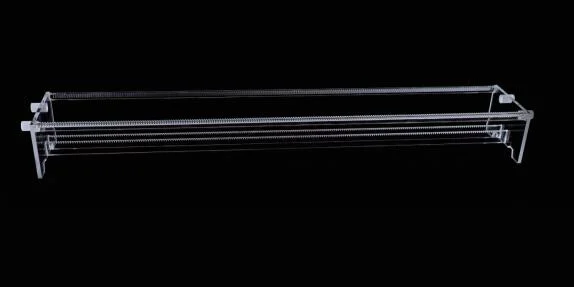
What Lives Inside a Diffusion Furnace — The Full List
Most buyers think “tube + boat + paddle” and stop. The complete fused silica package for a diffusion, oxidation, anneal or LPCVD furnace usually spans:
- Process tube — the primary tube mounted in the furnace hot zone
- Liner tube — nested inside the process tube for doped or coated runs
- Quartz boat — wafer carrier, slot count matched to wafer size
- Quartz paddle — boat pusher, head geometry matched to boat foot
- Boat spacers / pedestals — thermal isolation between boat and tube end
- End cap / door plug — seals the tube mouth between runs
- Dummy wafers / guard rings — front and back of boat to even out doping
- Gas distribution nozzles / diffusers — sometimes fused silica, sometimes fused silica-to-metal transition
This page focuses on the big three — tube, boat, paddle — because they carry the specification risk. The supporting cast is called out where it interacts with them.
Diffusion Furnace Quartz Tube
What the Tube Does
The process tube is the envelope that separates the furnace atmosphere from the outside world. It sees the full thermal cycle, the process gas, the dopant stream and — in many facilities — the cleaning cycle afterward. If the tube devitrifies, particles shed. If the tube bows, boat insertion rubs. If the tube ID does not match boat-plus-paddle-plus-gas-nozzle clearance, you find out at load-in.
Process Tube vs Liner Tube
A process tube is the primary mounted tube, often flanged at the load end, plain or necked at the source end. A liner tube nests inside it. The logic: when the process is doped or coated, the inner surface takes the hit. Replace the liner, keep the process tube. For clean oxidation or anneal, a single process tube is common; for doped runs, liner-on-process is the norm.
Flanged End, Necked End, Side Ports
- Flanged load end — mates to the furnace door or gas manifold; flange face flatness and seal condition decide leak-up rate.
- Necked source end — reduced ID to mate smaller gas lines or transition to fused silica-to-metal seal.
- Side ports — for bypass gas, purge or pressure tap; flame-welded, not machined, because the tube is already formed.
Tube design note: wall distribution at the flange transition and at the necked zone is where thermal gradient concentrates. A uniform-wall drawing that looks fine on paper can still stress-crack at the flange root after repeated cycles if the transition radius is not reviewed.
Quartz Boat for Wafer Processing
Slot Geometry & Wafer Size Matching
Boats are specified by wafer size, not by a universal dimension. Slot pitch sets wafer-to-wafer spacing for gas access and thermal uniformity. Slot chamfer decides whether a wafer slides in clean or chips the slot shoulder. Slot depth and side relief control wafer lean.
Vertical boats usually sit on a foot — either a cantilever foot (single support, simpler, but moment-arm sensitive) or a dual-foot or saddle support (better load spread, more complex flame-weld). Foot relief and wall thickness at the foot-to-body transition are where most boat cracks initiate, because that is where the thermal gradient and the dead weight of wafers meet.
Boat Types by Construction
- Slotted vertical boat — most common, wafer standing in slots
- Cassette-style or dual-slot — tighter pitch, higher count, more thermal mass
- Horizontal boat — wafer lying flat, less common in modern diffusion
- Custom reactor boat — multi-port, flanged base, integrated gas path
Quartz Paddle
What the Paddle Does
The paddle pushes the boat into the hot zone and pulls it out. Length is set by furnace depth plus load-end hardware. Head geometry is set by boat foot — a paddle head that does not seat the boat foot cleanly will misalign the boat on every cycle, and the tube ID will tell you about it via rub marks.
Coated vs Uncoated Paddle
Paddles can run bare fused silica or with a protective coating (silicon carbide or silicon oxycarbide class, depending on process). Coating reduces particle shed from the paddle itself and improves survivability under repeated insertions. The trade-off: coated paddles have a re-coat life, and the coating thickness uniformity at the head and along the blade affects balance. Uncoated paddles are simpler and lower cost, but in doped or high-particle processes they shed sooner.
Paddle Design Items
- Length tolerance — paddle-plus-boat stack versus tube ID clearance
- Head pocket — must match boat foot profile, not just “flat push”
- Blade width — clearance to tube wall, especially on liner-inside-process configurations
- Coating continuity — edges, head pocket, transition to shank
The Supporting Cast
- Spacers or pedestals — sit between boat foot and tube end or between boat and dummy load; thermal break and height set
- End cap or door plug — seals tube mouth, sometimes with gas pass-through
- Dummy wafers — fused silica or silicon, front and back of boat to even doping profile
- Gas nozzles or diffusers — fused silica tube-with-inner-nozzle configurations, sometimes flame-welded to the process tube
These rarely get their own RFQ, but they show up in the bill of materials and they interact with tube ID, boat foot height and paddle length. Specifying tube, boat and paddle without checking spacer height is a common mismatch.
Comparison Table — Tube / Boat / Paddle at a Glance
Component | Owns | Failure mode to watch | Design leverage |
|---|---|---|---|
Process tube | Atmosphere envelope, hot zone ID | Devitrification, bow, flange-root crack | Wall distribution at transitions, flange flatness |
Liner tube | Sacrificial inner surface | Particle shed, sticking to process tube | OD fit to process tube ID, length relative to hot zone |
Wafer spacing, thermal mass in load | Foot crack, slot-shoulder chip, warp | Foot relief, slot chamfer, wall distribution | |
Quartz paddle | Boat insertion and extraction | Coating peel, head-pocket mismatch, blade rub | Head-boot match to boat foot, coated versus uncoated choice |
Spacer or end cap | Thermal break, seal | Crack at load-end thermal gradient | Height set relative to boat foot and tube end |
Application Analysis — Diffusion / Oxidation / Anneal / LPCVD
Diffusion (doped). Process tube plus liner is common. Boat slot count high, paddle usually coated because of dopant stickiness on insertion. Dummy wafers front and back.
Oxidation (clean). Single process tube often sufficient. Boat wall can be lighter, paddle uncoated is viable. Particle control still drives tube selection.
Anneal (batch). Batch anneal shares diffusion furnace form factor; tube sees slightly lower dopant but longer dwell. Boat thermal mass matters more than slot count.
LPCVD (nitride or oxide). Tube plus liner, sometimes multi-tube cluster. Boat sees longer high-temperature exposure, foot design becomes the limiter. Paddle coated preferred because of deposition bounce-back.
Across all four, the pattern is the same: tube owns the envelope, boat owns the load, paddle owns the insertion, and material grade plus wall distribution decide how many cycles you get.
Material Grade Selection Without the Percentage Game
Diffusion furnace fused silica is specified by grade and transmission class, not by a published purity number:
- Deep-UV grade — for high-purity diffusion where transmission and hydroxyl content matter
- UV-visible grade — standard diffusion and oxidation
- Infrared-biased grade — some industrial diffusion where transmission spec is relaxed
Process cleanliness, storage, pre-bake and tube handling carry as much of the particle story as the grade itself. A deep-UV-grade tube handled in open air without pre-bake will shed faster than a well-handled lower grade under a clean protocol — which is why grade alone is never the full answer.
Common Problems
Tube devitrification. Crystallization on the inner surface, milky patches. Traces back to process chemistry, tube grade, cleaning protocol and maximum service temperature. Not a machining problem.
Boat foot cracking. Most common failure. Traces back to foot relief radius, wall distribution at foot-to-body, and whether the boat sits on a spacer or hangs cantilever under full wafer load.
Paddle coating peel. Traces back to coating preparation, paddle surface condition before coat, and whether the paddle sees thermal shock on insertion — cold paddle into hot zone equals coating shear.
Particle shed from liner. Traces back to liner OD fit (loose liner rocks and creates rub particles) or liner inner surface devitrification.
Slot-shoulder chipping on boat. Traces back to slot chamfer radius and whether the wafer load or unload robot has radial play.
None of these are “bad quartz.” They are specification or design mismatches between tube, boat, paddle and process.
Selection Guide — How to Spec a Diffusion Furnace Quartz Set
Step 1 — Furnace form factor. Tube ID, tube length, hot zone length, load-end flange or plain, source-end necked or open. This locks process tube and liner dimensions.
Step 2 — Wafer size and boat slot count. Wafer diameter decides slot pitch and slot depth. Slot count is set by furnace hot-zone length and wafer spacing needed for gas and thermal uniformity. Foot style (cantilever, dual, saddle) decided by furnace load-end hardware.
Step 3 — Process chemistry. Clean oxidation means single tube, uncoated paddle is viable. Doped diffusion means liner plus coated paddle. LPCVD nitride means liner plus coated paddle plus dummy strategy.
Step 4 — Boat foot, paddle head, spacer height. These three have to be co-specified or the boat rocks on insertion. Most “paddle rubs tube” complaints trace to this triangle, not to paddle width.
Step 5 — Grade. By transmission and hydroxyl need, not by a number.
Step 6 — Replacement rhythm. Tube and liner are consumables; boat and paddle last longer but have a coating or foot life. Specifying them together lets the supplier phase delivery instead of rush-replacing one piece while the others still have cycles.
Send the furnace model, wafer size, process chemistry and current bill of materials — or the drawing set — and the design review returns a matched tube, boat, paddle and spacer proposal, not three separate quotes.
FAQ
Q: What quartz parts are used in a semiconductor diffusion furnace?
A: Typically a process tube (sometimes with a nested liner), a fused silica boat that carries wafers, a fused silica paddle that pushes the boat, and supporting pieces — spacers, end caps, dummy wafers, gas nozzles. The tube owns the envelope, the boat owns the load, the paddle owns insertion.
Q: Quartz boat vs quartz paddle — what is the difference?
A: The boat carries wafers inside the hot zone; slots, foot design and wall distribution are its design items. The paddle pushes the boat in and out of the tube; head geometry must match the boat foot, and length must clear the load-end hardware. They fail differently and are specified separately.
Q: What wafer sizes do quartz boat slot counts match?
A: Boats are built to wafer diameter — slot pitch, slot depth and slot chamfer all scale with wafer size. Slot count is set by furnace hot-zone length and wafer spacing needed for gas and thermal uniformity. Send wafer size and hot-zone length for a matched proposal.
Q: Process tube vs liner tube — which do I need?
A: Clean oxidation or anneal often runs a single process tube. Doped diffusion or LPCVD with aggressive chemistry typically runs a liner nested inside the process tube so the liner takes the particle and doping hit. Replace the liner, keep the process tube.
Q: Do quartz paddles need coating in diffusion?
A: In clean oxidation, uncoated is common. In doped diffusion or LPCVD, coated paddles reduce particle shed and survive insertion cycles better. Coating type and re-coat life are part of the specification, not an afterthought.
Q: Why do diffusion tubes devitrify?
A: Devitrification is crystallization of the fused silica surface, triggered by process chemistry, peak temperature, grade and cleaning protocol. It is not a machining defect. Tube grade, process chemistry and tube handling — pre-bake, cleaning — are the levers.
Q: What grade for diffusion furnace quartz?
A: By application: deep-UV grade for high-purity diffusion, UV-visible grade for standard diffusion and oxidation, infrared-biased grade where transmission spec is relaxed. Process cleanliness and pre-bake carry as much weight as grade.
Q: Can you supply tube, boat and paddle as a matched set?
A: Yes. Specifying them together avoids mismatches on paddle-head-to-boat-foot, boat-foot-to-spacer, and tube-ID-to-boat-stack clearance. Design review covers the triangle before cutting begins.
Q: Do you support replacement quartz for existing furnace models?
A: Yes. Send the furnace model, current tube dimensions, boat slot count and wafer size — or send the drawing set — and the proposal returns as a direct replacement or an improved version if the original had a known stress point.
Q: What file formats for quote?
A: DXF, STEP, IGES, PDF. For replacement parts, furnace model plus wafer size plus process chemistry is often enough to start; for new designs, the drawing set triggers design review.
Conclusion
A diffusion furnace fused silica package is not three separate parts. It is a thermal system: tube envelope, boat load, paddle insertion and the spacers that tie them together. Specifying grade without wall distribution, or boat foot without paddle head, or tube ID without liner OD, is where most premature failures start. FGQuartz machines, flame-welds and fire-polishes in-house, so tube, boat and paddle are reviewed as one design pass, not three vendor handoffs.