Quick Answer
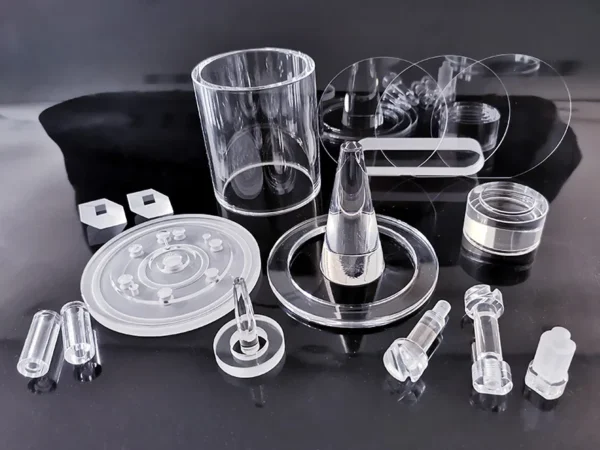
FGQuartz manufactures custom quartz glass and fused silica parts to customer drawing when standard tubes, rods and plates will not fit the process. In-house capabilities span cold working (CNC turning, milling, drilling, optical grinding) and hot working (flame forming, welding, bending, fire polishing), which lets a single part move from raw material to finished assembly without leaving the facility. Complex geometries—multi-port reactors, flanged tubes, angled bores, integrated viewports—are evaluated at the drawing stage so the machining route, wall distribution and thermal stress paths are set before cutting begins.
Key Takeaways
-
Quartz parts manufacturing is a process choice problem, not just a machining problem—geometry decides whether CNC, flame or both are required.
-
CNC owns tight tolerances and flat or cylindrical features; flame working owns welded joints, bent tubes and sealed ends; fire polishing removes micro-chipping and restores surface continuity after CNC.
-
Fused silica machines differently from metals—diamond tooling, coolant strategy and feed control matter more than spindle speed.
-
Geometry limits exist: very deep blind holes, aggressive undercuts, extreme wall-thickness ratios and tight interior corners are reviewed case by case.
-
Design-for-manufacturability review is done before quotation—send DXF, STEP, IGES or PDF.
Why “Custom” in Quartz Parts Manufacturing Is a Different Question Than in Metal
Engineers often arrive with a metal-part mindset: “Can you mill this in quartz the same way?” The answer is usually partially. Fused silica is hard, brittle, heat-resistant and transparent to a wide optical band—which makes it indispensable in semiconductor, solar, optical and high-temperature processing, but also means the rules are different:
-
Tooling: diamond-based, not high-speed steel or carbide.
-
Chip formation: microfracture-controlled, not shear.
-
Heat: machining heat must be managed or surface microcracking follows.
-
Post-machining: fire polishing is often the step that turns a “machined quartz part” into a usable component.
Understanding these differences upfront prevents the two most expensive mistakes in quartz parts manufacturing: designing a geometry that cannot be cleared by diamond tooling, and assuming a machined edge is ready for high-purity or high-temperature service without surface healing.
The Three Levers — CNC, Flame Working, Fire Polishing
CNC Cold Working
CNC turning, milling, drilling, flat and cylindrical grinding, and ultrasonic-assisted features. This is the capability that delivers dimensional accuracy and repeatability across volume.
Best for:
-
Plane-parallel plates with controlled flatness
-
Rectangular or slotted wafer-boat bodies
-
Drilled side ports, baffle plates and flanges
-
Dimensional features that must repeat from piece to piece
The boundary: CNC cannot weld, cannot seal an end, cannot bend a tube. Interior corners below the tool radius stay unreachable. Very deep small-diameter bores risk tool chatter and wall heat buildup.
Flame Hot Working
Hydrogen-oxygen flame allows the material to be worked locally at temperature without destroying the surrounding structure. This is where quartz parts manufacturing diverges completely from metal machining.
Capabilities include:
-
Tube drawing and re-forming
-
Welding flanged joints (tube-to-plate, tube-to-tube, multi-section)
-
T-sections, multi-port reactors and angled stubs
-
End sealing, necking and bending
-
Assemblies where a single monolithic CNC blank would be geometrically impossible
The trade-off: flame introduces local heat history, so stress relief and controlled cooling are built into the sequence—especially for optics-grade or high-thermal-cycle parts.
Fire Polishing
After CNC, edges and bore mouths carry micro-chipping from diamond tool exit. Fire polishing passes a controlled flame over those zones so the surface locally softens and heals.
What it delivers:
-
Edge chips removed
-
Bore mouths rounded for flow and cleaning
-
Visual and microscopic continuity restored
-
Lower nucleation sites for thermal or chemical attack
What it is not: fire polishing is a healing step, not a flatness step. It does not replace optical polishing.
Comparison Table
|
Process
|
What it adds
|
Typical use in quartz parts
|
Geometry limits
|
|---|---|---|---|
|
CNC machining
|
Dimensional accuracy, flatness, repeatability
|
Plates, boats, slotted parts, drilled ports
|
No welding; interior corner at least tool radius; deep small bores reviewed case by case
|
|
Flame working
|
Joints, bends, seals, monolithic assemblies
|
Flanged tubes, multi-port reactors, viewports, sealed ends
|
Heat history introduced—stress control required; not for tight flatness alone
|
|
Fire polishing
|
Surface heal, edge rounding, chip removal
|
After CNC edges, bore mouths, cut ends
|
Not optical polish; shape change is micron-scale
|
Where Complex Geometries Hit the Wall
No supplier publishes this openly. Here is the honest boundary FGQuartz works to:
Extreme wall-thickness ratios. Thin sections adjacent to thick bosses create cooling gradients that can stress the part later in-service. Material is redistributed during design-for-manufacturability review rather than machined naively.
Deep blind holes with small inside diameter. Diamond tool reach and coolant evacuation both degrade as depth-to-diameter ratio grows. Often respecified as through-hole plus plug or flame-sealed end.
Undercuts and internal threads. Quartz does not thread-mill cleanly at small pitch. External threads are achievable; internal threads are usually redesigned to flange and O-ring.
Multi-material bonds. Quartz-to-metal is a flame-seal discipline using matched coefficient-of-thermal-expansion metals, not a machining question. Specify this at the drawing stage.
Optical and structural in one blank. Possible, but the flatness or homogeneity specification and the machining clamping plan must be co-designed or the optic degrades during fabrication.
Application Analysis — How the Process Mix Shows Up by Sector
Semiconductor and Solar
Wafer boats with custom slot count, diffusion tubes with side-port flanges, crucible-adjacent baffles. Mostly CNC bodies plus flame-welded joints plus fire-polished edges. Material grade is selected by application; grade and process cleanliness carry the purity signal.
Optical and Laser
Plates and windows where CNC cuts the outer profile, then optical polishing takes over. Fire polish is not the final step here—it is an intermediate heal before lapping. Grade selection (JGS1, JGS2, JGS3 and their international equivalents) determines transmission range.
Laboratory and Analytical
Cuvettes, reaction tubes, plasma torch components—often small, one-off, low minimum order quantity. Flame working dominates (seals, bends, drawn noses), with CNC used only for flange adapters or mounting interfaces.
Fiber-Optic
Substrate tubes and starting rods for preform manufacturing. Dimensional uniformity is the specification, not a tolerance number. Flame drawing plus CNC end preparation plus fire polish.
High-Temperature Industrial
Infrared heater envelopes, sight windows, thermocouple protection tubes. Wall distribution and thermal-shock path drive the design-for-manufacturability review more than the machining difficulty itself.
Selection Guide — How to Decide Your Route
Step 1. Is it a profile, flat or hole problem? → CNC first.
Step 2. Does it need a joint, bend or sealed end? → Flame working enters.
Step 3. Are there edges or bore mouths exposed to flow, cleaning or high-temperature cycling? → Fire polish after CNC.
Step 4. Is the part optically active? → CNC rough, fire heal, optical polish on a separate track.
Step 5. Is the part seeing repeated thermal cycles? → Wall distribution and stress review before cutting begins.
Send the drawing and we will tell you which route—often a hybrid—and why.
Common Problems Buyers Run Into
Drawing dimensioned in metal-shop logic. Radii too small, walls too thin, corners too sharp. Design-for-manufacturability review catches this before quotation.
Assuming fire polish equals optical polish. It does not. Two different specifications, two different process tracks.
Asking CNC tolerance on a flame-welded assembly. The weld zone is not CNC-class. Design the critical dimensions onto CNC-only faces.
FAQ
Q: Can quartz parts be CNC machined?
A: Yes. Fused silica and quartz glass are CNC-machinable using diamond tooling for turning, milling, drilling and grinding. Tight tolerances are achievable on outer profiles, flats, bores and slots—but interior corners, deep small bores and undercuts are reviewed case by case.
Q: What is fire polishing in quartz parts manufacturing?
A: Fire polishing passes a controlled hydrogen-oxygen flame over machined edges or bore mouths so the surface locally softens and micro-chips heal. It restores edge continuity after CNC but does not replace optical polishing.
Q: CNC or flame working—which does my part need?
A: If the part is a profile, plate, slotted body or drilled port, CNC owns it. If the part needs a welded joint, bent tube, sealed end or multi-port assembly, flame working enters. Many custom parts are a hybrid—CNC body, flame joints, fire polish.
Q: What quartz geometries are problematic?
A: Very deep blind holes with small inside diameter, aggressive undercuts, extreme wall-thickness ratios and tight interior corners. These are not automatic rejects—they trigger a design-for-manufacturability review and often a minor redesign such as through-hole instead of blind, relieved corner or redistributed wall.
Q: Can you fire-polish after CNC?
A: Yes, and often recommended. CNC leaves micro-chipping at edge exits and bore mouths. Fire polishing heals those zones before the part sees process flow, cleaning or high-temperature cycling.
Q: What file formats do you accept for quote?
A: DXF, STEP, IGES and PDF. A free design-for-manufacturability review is completed before quotation so the machining route and any geometry adjustments are agreed upfront.
Q: Do you support prototype to production?
A: Yes. Single-piece prototype through volume production, with low minimum order quantity. The same design-for-manufacturability logic applies at both scales—the difference is batch setup, not process choice.
Q: How do you handle material grade selection?
A: By application wavelength and purity need. JGS1 for deep-UV, JGS2 for UV-visible, JGS3 for infrared, with equivalents to international grades explained on our specifications page. Purity is carried by grade and process, not by a published percentage.
Q: Can quartz be welded to metal?
A: Yes, but it is a flame-seal discipline using matched coefficient-of-thermal-expansion metals such as Kovar or molybdenum, not a machining question. Specify this at the drawing stage so the transition zone is designed in.
Q: How do you control thermal stress in a complex quartz assembly?
A: Wall distribution, joint placement and cooling path are reviewed during design-for-manufacturability before cutting begins. Flame-worked zones receive stress relief and controlled cooling as part of the sequence. Critical applications are discussed with the customer before production.
Conclusion
Quartz parts manufacturing is less about “can you machine this” and more about “which process mix—and which design trade-offs—produce a part that survives the process it is going into.” FGQuartz runs CNC, flame working and fire polishing in-house so the decision is technical, not a hand-off between vendors. Send a drawing. Get a route, not just a price.