Quick answer: JGS1, JGS2, and JGS3 are the three standard grades of optical fused silica defined under China’s GB/T 18371 standard. The difference comes down to how each is made and how much hydroxyl (OH) and metallic impurity it carries — which in turn decides what wavelengths it transmits. Choose JGS1 for deep-UV work (down to ~185 nm), JGS2 for general UV–visible optics at a lower price, and JGS3 for infrared and high-power laser applications where low OH absorption matters. Match the grade to your working wavelength, not to the lowest quote.
If you’ve ever opened a drawing and seen “JGS2” stamped next to a window spec — or had a supplier ask “JGS1 or JGS3?” during a quote — and weren’t 100% sure what changes, this guide is written for you. We’ll keep it practical: what each grade actually is, where the real performance line sits, and how to pick without overpaying for purity you don’t need.
What does “JGS” actually mean?
JGS is the romanization of the Chinese term jīng guāng shí, which translates roughly to “optical-grade quartz glass.” The number that follows is a transmission grade, not a quality ranking — JGS3 is not “worse” than JGS1, it is simply optimized for a different part of the spectrum.
All three are fused silica: the amorphous, glassy form of SiO₂. That word “amorphous” matters. Unlike crystalline quartz, fused silica is optically isotropic and free of birefringence, which is exactly why it is the workhorse material for lenses, windows, and laser optics rather than natural crystal.
One distinction that trips up a lot of buyers: fused quartz vs. fused silica.
- Fused quartz is melted from natural crystalline quartz. It carries trace metal impurities from the raw material. JGS2 and JGS3 fall here.
- Fused silica (synthetic) is grown from a silicon compound such as silicon tetrachloride (SiCl₄). It is purer and more controllable. JGS1 sits here.
So when someone says “synthetic vs. natural quartz,” they are really pointing at the JGS1-versus-the-rest divide.
The 30-second comparison table
| Property | JGS1 | JGS2 | JGS3 |
|---|---|---|---|
| Common name | UV-grade fused silica (synthetic) | UV-grade fused quartz (natural) | IR-grade fused silica |
| Raw material / method | SiCl₄, oxyhydrogen flame hydrolysis | Natural crystal, flame fusion | Natural crystal/sand, vacuum electric fusion |
| OH content | High (~1000–2000 ppm) | Medium (~100–200 ppm) | Very low (<5–20 ppm) |
| Metal impurities | Lowest | Tens of ppm | Tens of ppm |
| Useful transmission band | ~185–2500 nm | ~220–2500 nm | ~260–3500 nm |
| Deep-UV (below 220 nm) | Excellent | Limited | Poor |
| Infrared (beyond 2.5 µm) | Limited (OH band ~2730 nm) | Limited (OH band ~2730 nm) | Excellent (no OH band) |
| Internal quality | Bubble-free, homogeneous | Possible striae in large pieces | May contain small bubbles/striae |
| Relative cost | Highest | Lowest | Mid |
| Best for | DUV optics, UV lithography, UV spectroscopy | General UV–VIS windows, lab optics | IR windows, high-power IR lasers, broadband |
The single most important row in that table is OH content — so let’s unpack why.
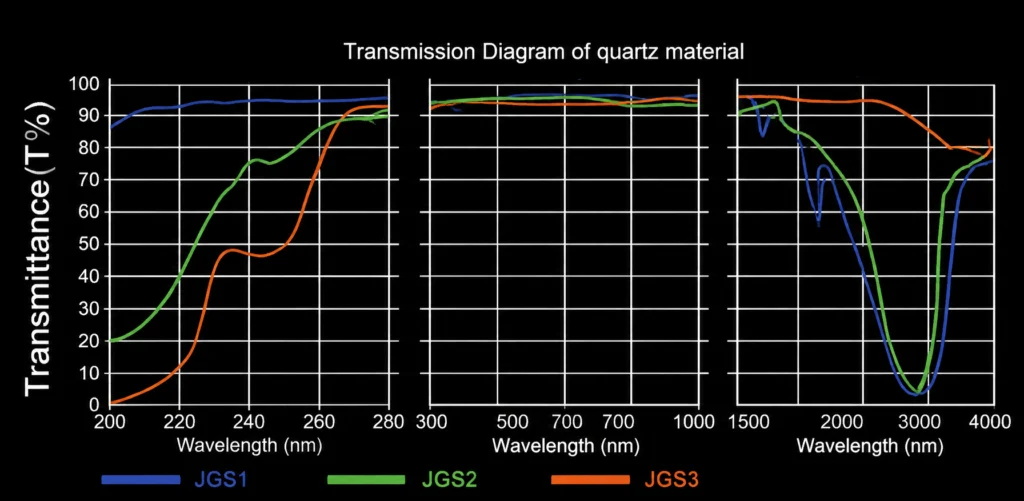
Why hydroxyl (OH) content is the whole story
Almost every meaningful difference between these grades comes back to one thing: how much water, in the form of OH groups, is locked into the glass.
When fused silica is made in a hydrogen-oxygen flame (JGS1’s process), the flame chemistry drives OH groups into the glass matrix. That OH does two opposite things:
- In the UV: OH helps. It passivates structural defects that would otherwise absorb short-wavelength light, which is why high-OH JGS1 can transmit all the way down to about 185 nm and reach roughly 90% transmittance there.
- In the IR: OH hurts. Those same hydroxyl groups create a strong absorption band centered near 2730 nm, cutting off useful infrared transmission.
JGS3 is the mirror image. It is made by vacuum electric fusion, which keeps OH down near or below a few ppm. That kills the 2730 nm absorption band and opens up clean infrared transmission out toward 3.5 µm — but with little OH to passivate UV defects, JGS3 loses deep-UV performance.
JGS2 sits in the middle on OH (~100–200 ppm), which is part of why it is the practical, lower-cost choice when you are working in the near-UV to visible range and do not need the extremes.
The takeaway: there is no single “best” grade. High OH buys you UV and costs you IR. Low OH buys you IR and costs you UV. You are choosing which end of the spectrum to win.
Grade-by-grade breakdown
JGS1 — the deep-UV specialist
JGS1 is synthetic fused silica made from SiCl₄ melted in a high-purity oxyhydrogen flame. The result is the purest of the three, essentially free of bubbles and inclusions, with excellent optical homogeneity.
- Transmission: ~185–2500 nm, with standout deep-UV performance
- Where it shines: UV lithography components, DUV lenses and windows, UV spectroscopy, fluorescence-sensitive instruments, deep-UV laser optics
- Watch out for: the OH band near 2.7 µm makes it a poor IR choice; it is also the most expensive grade
If your specification is driven by anything below ~220 nm, JGS1 is usually the only right answer — paying for it is cheaper than the failure of a UV system that cannot see its own wavelength.
JGS2 — the cost-effective generalist
JGS2 is natural fused quartz made by flame-fusing crystalline quartz. It carries a few tens of ppm of metal impurities and moderate OH, which slightly limits deep-UV transmission compared to JGS1 — but for the huge range of work that lives in the 220–2500 nm band, that difference simply does not matter.
- Transmission: ~220–2500 nm
- Where it shines: general-purpose UV and visible windows, sight glasses, optical flats, condenser optics, lab cuvettes and labware, lamp envelopes
- Watch out for: larger pieces may contain striae or small bubbles; for tight-tolerance imaging optics, verify the striae/homogeneity sub-grade
JGS2 is the grade most buyers actually need and the one most often over-specified past. If you are reaching for JGS1 “to be safe” on a visible-light part, you are usually just paying more for purity the application cannot use.
JGS3 — the infrared and high-power laser grade
JGS3 is produced by vacuum electric fusion, driving OH down to very low levels. That removes the 2730 nm absorption band and delivers clean transmission across the visible and into the infrared (~260–3500 nm).
- Transmission: ~260–3500 nm
- Where it shines: IR windows and optics, high-power IR laser components, broadband UV–VIS–IR systems, multispectral instruments
- Watch out for: weak deep-UV performance; may contain small bubbles or striae, so confirm the internal-quality sub-grade for imaging-critical parts
How to choose: a simple decision path
Work through these in order and you will land on the right grade almost every time:
- Does your system operate below ~250 nm (deep UV)?
→ Yes: JGS1. Stop here. - Does your system need clean infrared transmission beyond ~2.5 µm, or use a high-power IR laser?
→ Yes: JGS3. Stop here. - Are you working mainly in the 220 nm–2500 nm UV-to-visible range (windows, labware, general optics) and want the best value?
→ Yes: JGS2. - Do you need a broadband part that spans UV through IR in one piece?
→ Lean JGS3 for its wider IR reach, and confirm the UV edge meets your shortest wavelength.
When two grades both technically work, the tie-breakers are cost (JGS2 < JGS3 < JGS1) and internal optical quality (JGS1 is the most bubble- and striae-free). For a precision imaging window you might pay up for JGS1’s homogeneity even when JGS2’s transmission would pass.
The cost of choosing the wrong grade
Buyers usually err in one of two directions, and both are expensive:
- Over-specifying: Defaulting to JGS1 for a visible-light window or sight glass. You pay a premium for deep-UV purity and bubble-free homogeneity the application never uses. On a volume order, that is real money left on the table.
- Under-specifying: Saving on JGS2 or JGS3 for a sub-250 nm UV system. The part physically cannot transmit the working wavelength efficiently — you get low throughput, accelerated solarization, or outright system failure. The “savings” turn into a re-order plus downtime.
The fix is the same in both cases: specify to the working wavelength and environment first, then optimize cost. If you are unsure where your design sits on that line, that is exactly the conversation to have with your supplier’s engineering team before the quote is finalized.
How this maps to real FGQuartz products
The grade conversation isn’t abstract — it shows up the moment you specify a part:
- Quartz glass plates and UV windows are where grade selection matters most. We supply JGS1, JGS2, and JGS3 polished plates and windows matched to your wavelength.
- Quartz glass tubes for UV sterilization, diffusion furnaces, and lamp envelopes are grade-dependent — UVC sleeves lean JGS1/JGS2 for transmission, furnace process tubes prioritize thermal performance.
- Optical quartz glass applications spanning lenses, prisms, and cuvettes from deep-UV to near-IR.
- Custom quartz glass components when your part needs a specific grade machined to drawing.
Not sure which grade your design calls for? Send us your wavelength range and dimensions and our team will recommend the grade — and flag if you are about to over-spec.
FGQuartz has manufactured high-purity quartz glass and fused silica components since 2005, supplying JGS1, JGS2, and JGS3 grade tubes, plates, windows, and custom parts worldwide. Request a quote with your wavelength and dimensions for a grade recommendation within 24 hours.